In 2026, climate data migrated from the back pages of the sustainability report to the center of the P&L. With global shipping lanes and fossil energy prices facing extreme geopolitical volatility, dependence on fossil fuels is a financial risk to measure.
Current data shows that 74% of S&P 500 companies revised their emissions disclosures last year. Companies are moving from rough estimates to data analytics that can identify operational hotspots for costs and emissions.
By treating climate data as an operational asset, leaders are better able to build resilient supply chains less dependent on fossil fuels and volatile prices, while avoiding regulatory fines and market-access barriers.
In an increasingly unpredictable global market, energy efficient supply chains are no longer a sustainability effort; they are a reliable financial hedge.
Your climate data is a growth enabler.
Energy efficiency means a smarter supply chain. March 2026 has seen massive disruption in the global oil and gas markets. With increasing freight costs as a result, it's become clear that fossil fuel usage is not only a climate risk, but a measurable financial risk that can no longer be ignored.
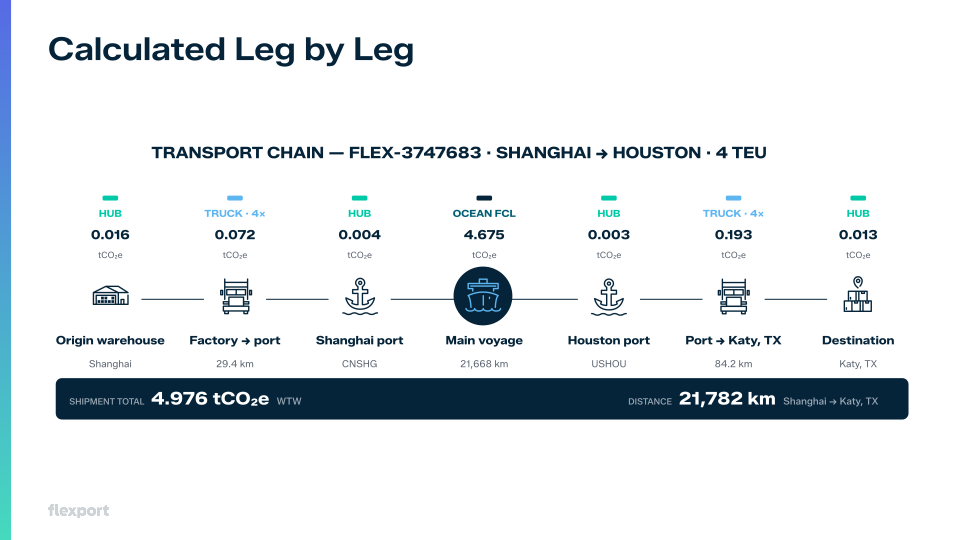
Granular climate data provides a roadmap to effective operations. The same granular visibility required for regulatory climate compliance can also be used to identify the "operational hotspots" where efficiency gains and cost reductions can be made. Whether it is identifying inefficient routing, under-utilized containers, or high-emission "emergency" air freight, the data allows you to shift from resource intensive logistics to proactive, economical planning.
Reframing the narrative on climate reporting moves the conversation from "How can we meet the bare minimum required?" to "How do we use this data to run a more cost-efficient low emitting business?".
1. High-quality Emissions Data Creates a Competitive Advantage
Getting your emissions data right, in one place, and flexible enough to use for varying frameworks, saves time, reduces risk, and keeps your goods moving. Climate compliance is no longer a hurdle; it is a "data moat" that ensures your ability to access cross border markets, meet customer reporting standards and improve performance in vendor selection proposals.
While 2025 was defined by regulatory delays and shifting implementation timelines, 2026 is seeing a consolidation of reporting requirements that makes one thing certain: non compliance is not an option.
- European Union: The Corporate Sustainability Reporting Directive (CSRD) is now a reality for large companies. Companies meeting the threshold need to start preparing for their first reporting year (FY2027). In the meantime, the EU’s market-access regulation CBAM went into effect, while simplification of the EUDR is underway.
- United States: California’s SB253 has become the national benchmark. Because of the state's economic scale, any global company operating in the U.S. must now adopt a "data-first" approach to emissions disclosure; non compliance faces hefty fines. New York will be the next state following with mandatory climate disclosure.
- Asia-Pacific: The shift is global. Over 30 jurisdictions, including manufacturing hubs like Singapore and Japan, have adopted ISSB standards for mandatory climate disclosures to align with international investors’ expectations.
2. Scaling Low Emission Fuels for a More Stable Future
Fossil fuels are volatile; e-fuel pricing is becoming predictable. In the current market, the "green premium" for alternative fuels is becoming smaller, while its expanded usage is evolving into a "stability insurance" premium.
Traditional fuel surcharges are the primary "wild card" in any logistics budget. Cleaner alternatives offer a way to lock in long-term cost structures. The more these fuels scale, the lower the reliance on traditional fuel sources.
- Predictable Pricing: Unlike the geopolitical fluctuations of fossil energy, electric drayage and e-methanol offer more stable, contractable pricing. Early adopters are trading the "low-cost" promise of fossil fuels for the "stable-cost" reality of renewables.
- The ZEMBA Proof Point: The Zero Emission Maritime Buyers Alliance (ZEMBA) has successfully demonstrated that low-emission shipping is commercially viable at scale. Their latest tenders have avoided over 82,000 tonnes of CO₂e, proving that the infrastructure is ready for those willing to commit. Flexport’s involvement in initiatives like ZEMBA - the Zero Emission Maritime Buyers Alliance - supports the commercial deployment of truly sustainable, scalable solutions.
Diversification of fuel types, specifically toward greater use of sustainable, scalable e-fuels, will enable stability and long-term energy resilience for this essential sector. Creating a competitive market for these new, clean fuels through our collaborative work in the Zero Emission Maritime Buyers Alliance (ZEMBA) represents a tangible pathway to future-proof supply chains and protects them from escalating costs, logistics disruptions, and increasing geopolitical risk. Ingrid Irigoyen, ZEMBA President and CEO
- Localized Incentives: From "Clean Truck" port fee exemptions in the U.S. to reduced road taxes in the EU, the financial incentives for low-emission transport are minimizing the cost differential for these alternatives.
3.Efficiency and Decarbonization are Two Sides of the Same Coin
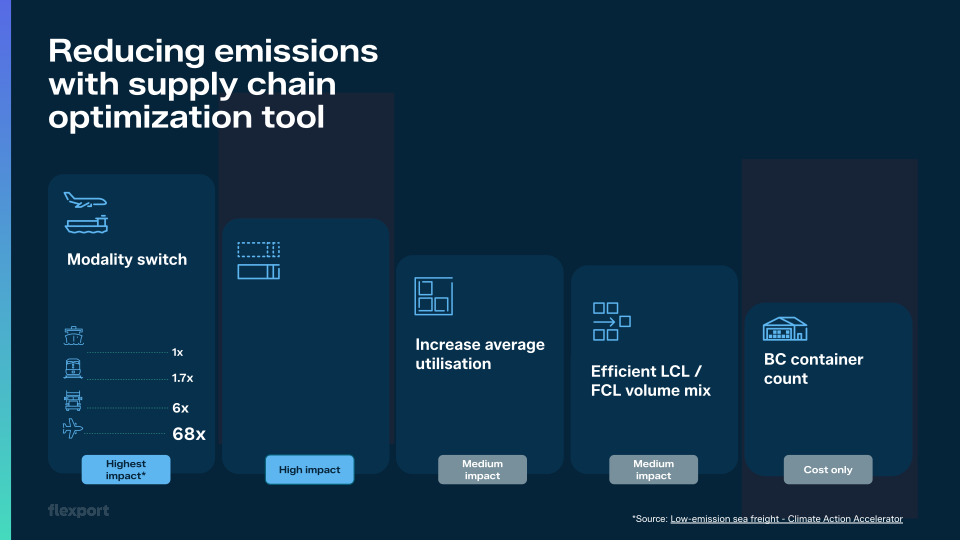
The most practical way to lower your emissions footprint is to avoid high intensity transport options, like air. Modality switching and supply chain optimization opportunities provide the ultimate "win-win", reducing emissions and costs simultaneously.
Incorporating proven technologies and data insights to drive efficiency and adoption of low carbon transport creates a flywheel effect - ensuring that there are stable, reliable solutions for the future of logistics.
The best part is that many of the foundational inputs to production of marine e-fuels—like renewable energy, sustainable carbon sources, electrolyzers, and other game-changing technologies—are essential for decarbonizing many other aspects of the global economy as well. In other words, there are real multiplier effects and economies of scale that can be tapped by boosting production and use of these e-fuels now. Ingrid Irigoyen, President and CEO, ZEMBA
Operational Levers for 2026:
- Aggressive Consolidation: Every empty mile is a wasted dollar and a carbon penalty. By optimizing order management to fill containers, and reduce overall TEU on the water, companies can reduce both their emission intensity and their total invoice volume.
- Strategic Mode Shift: Air freight is often used as a "safety valve" for poor planning, but it is 68xx more emission-intensive than ocean freight. Leading firms are using better visibility to increase lead times, allowing them to shift to ocean or rail, which buffers them against jet fuel price spikes.
- AI-Driven Procurement: The use of AI in nearly tripled in 2025. By 2027, 60% of procurement leaders will use AI-powered platforms to assess suppliers end-to-end, including sustainability performance, selecting partners not just on price, but on their ability and action on minimizing environmental impact.
You cannot optimize what you cannot see. Strategic resilience requires a single source of truth for both your logistics spend and your emissions .
How we turn insight into Action
Flexport helps businesses bridge the gap between "climate intent" and "operational impact" through two primary pillars:
- Emissions Reporting (powered by EcoTransIT World) We provide automated, shipment-level GHG calculations using ISO 14083 and GLEC aligned methodology through our integration with EcoTransit World. This gives you the data required for global compliance (e.g. CSRD, ISSB, California Act), removing the manual burden of compliance.
- Supply Chain Optimization Analysis Our platform identifies the specific lanes where you can save the most. We highlight opportunities for mode shifts (Air to Ocean), consolidation, and route changes that lower your emissions and your spend in tandem.
Get started today with Flexport
- Report with confidence: explore your integrated emissions reporting today
- Target "Low hanging fruit": understand where consolidations can save you money
- Evaluate low carbon fuel options: reach out to climate@flexport.com to learn more