
Trends to Watch
Talking Tariffs
- CAPE Phase 2 Launches June 29 for Reconciliation-Flagged Entries: CBP announced the next phase of its Consolidated Administration and Processing of Entries (CAPE) IEEPA tariff refund system, effective June 29, expanding eligibility to a new category of entries.
- CAPE Phase 2 will accept entries flagged for reconciliation (entry types 01, 02, and 06) for which the reconciliation entry (type 09) has not yet been filed. Consistent with Phase 1, only unliquidated entries and entries within 80 days of liquidation are eligible.
- Entries flagged for reconciliation that already have a type 09 reconciliation entry on file are excluded from Phase 2 and will be addressed in a future CAPE development phase.
- Once a flagged entry is accepted on a CAPE declaration, the importer may then file the reconciliation entry. CAPE removes IEEPA duties from flagged entries prior to reconciliation filing, separating refund calculations from the entry.
- CBP will treat acceptance of a CAPE declaration as confirmation that all associated CAPE declarations were filed and accepted once the reconciliation entry is submitted.
- Importers whose reconciliation filing deadlines expire within 30 days should prioritize filing the reconciliation before submitting to CAPE. All Phase 1 filing and processing requirements remain in effect.
- Use the Flexport Tariff Refund Calculator to estimate your refund amount across IEEPA duty categories, and consult Flexport's IEEPA refunds blog for guidance on the CAPE filing process.
- U.S. and Mexico Advance USMCA Renegotiation Talks: Following three days of bilateral discussions in Washington, the two countries issued a joint statement on June 18 indicating substantive progress ahead of the July 1 formal review trigger.
- Negotiators advanced discussions on rules of origin (ROO) for certain industrial goods and economic security provisions, and held preliminary talks on agriculture, labor, environment, and trade in steel, aluminum, and automobiles.
- The parties agreed to establish a committee to review the implementation of Chapter 12 (Sectoral Annexes) of the U.S.-Mexico-Canada Agreement (USMCA) to enhance regulatory compatibility.
- Minister Ebrard stated that July 1 marks the formal start of revisions to the agreement, not its termination, and that a trilateral virtual meeting among Canada, Mexico, and the U.S. is planned for that date. Canada and Mexico have expressed support for a 16-year extension of the pact; the U.S. has not.
- If the U.S. declines to agree to the 16-year extension, a 10-year revision window opens during which modifications could be negotiated. The next negotiating round is expected in late July in Mexico City, where the U.S. and Mexico plan to exchange draft texts with greater specificity.
- CBP Overhauls International Mail Entry Process, Codifies De Minimis Suspension: U.S. Customs and Border Protection (CBP) published two interim final rules on June 23 that fundamentally reshape how low-value international mail shipments enter the United States, with the new requirements taking effect July 24.
- Beginning July 24, only licensed customs brokers or parties with the legal right to make entry may file informal international mail entries for shipments valued under $2,500. Entries subject to Chapter 99 duties, including Section 232, Section 122, or Section 301 tariffs, are ineligible for this new informal process.
- A separate interim final rule formally amends CBP regulations to suspend de minimis treatment for shipments valued under $800, codifying the executive order that has been in effect since August 2025.
- The new informal postal entry process requires filers to transmit an Excel spreadsheet to CBPDM@cbp.dhs.gov no later than the 7th of the month following a shipment's arrival, covering HTS classification, country of origin, duty rate, value, tracking number, and other data elements. Payment is due via Pay.gov by the same deadline. A basic importation and entry bond is required.
- CBP is simultaneously launching a voluntary pilot, Entry Type 13, beginning September 22 for international mail shipments ineligible for informal entry due to partner government agency (PGA) requirements or Chapter 98/99 classifications. Shipments subject to antidumping/countervailing duties (AD/CVD) or quota are not eligible for the pilot and require formal entry.
- CBP is providing a narrow 90-day compliance window through October 22 for merchandise subject to Chapter 98/99 duties, PGA requirements, or FTA duty-free claims to continue using the new informal process while businesses adjust.
- Comments on both interim final rules are due July 24.
- Importers and customs brokers receiving international mail shipments should assess whether their current processes comply with the new entry, bonding, and spreadsheet-filing requirements before July 24. The Flexport Trade Advisory team can assist with navigating compliance obligations under the new rules.
Ocean
TRANS-PACIFIC EASTBOUND (TPEB)
- Capacity and Demand:
- Carriers canceled approximately 7% of scheduled Trans-Pacific Eastbound (TPEB) capacity in Week 26, down from approximately 9% in Week 25. Space remains constrained across all gateways. U.S. East Coast and Gulf services are more restricted than West Coast lanes, with ongoing cargo rollings on multiple strings.
- Panama Canal draft limits for neopanamax vessels are set to tighten on July 3, which will reduce available load capacity on canal-routing services to U.S. East Coast and Gulf destinations. Several carriers have implemented weight restrictions on Panama strings in anticipation.
- Global container demand reached record levels in April 2026, with volumes above any prior April on record. On the Transpacific, shippers advanced bookings earlier than in prior seasons, moving cargo ahead of the June 15 rate increases. Space on U.S. East Coast and Gulf services is largely committed through the end of June.
- Freight Rates:
- The Shanghai Containerized Freight Index (SCFI) rose approximately 10% week-on-week on U.S. West Coast lanes in Week 26, extending a run of consecutive weekly increases now spanning six weeks. U.S. East Coast lanes also rose approximately 10% in Week 26. Other market indices confirm the same directional trend. Carriers have implemented a rate increase on floating and increased Peak Season Surcharge (PSS) on fixed rates effective June 15, both of which are broadly holding across all gateways.
- Recommendation:
- Book 4-5 weeks ahead. Shippers with time-sensitive cargo or U.S. East Coast and Gulf destinations should consider premium service levels to reduce the risk of rolling.
FAR EAST WESTBOUND (FEWB)
- Capacity and Demand:
- Carriers canceled approximately 8% of scheduled Far East Westbound (FEWB) capacity in Week 26, up from approximately 4% in Weeks 24 and 25.
- Cape of Good Hope routing extends each voyage by 10 or more days compared to Suez Canal routing and reduces the effective number of vessel rotations available per year. Transshipment hubs along the Cape route are experiencing multi-day berthing delays, compounding the supply constraint and contributing to equipment shortages at Chinese and Southeast Asian origin ports.
- Global container volumes reached record levels in April 2026. Demand on Asia-Europe lanes remains strong, with vessel utilization near full capacity for June sailings. The recently announced U.S.-Iran framework agreement could give some relief to the situation as carriers could potentially start returning to Suez in the medium term but as of now too early to tell.
- Freight Rates:
- The Shanghai Containerized Freight Index (SCFI) for North Europe rose approximately 20% in Week 25 and held broadly flat in Week 26, following seven consecutive weeks of increases. Mediterranean lanes saw similar movement in Week 25, with broadly stable rates in Week 26. Other market indices confirm rates are holding at elevated levels. Carriers have announced an increase to Peak Season Surcharges (PSS) effective July 1.
- Recommendation:
- Book 5-6 weeks ahead. For time-sensitive or high-value cargo, secured premium services are advisable through at least the end of July.
TRANS-ATLANTIC WESTBOUND (TAWB)
- Capacity and Demand:
- Carriers canceled approximately 9% of scheduled Trans-Atlantic Westbound (TAWB) capacity in Week 26, up from approximately 4% in Week 25. Cancellations are concentrated on services to the U.S. West Coast and Gulf destinations; U.S. East Coast lanes have more available space. Equipment shortages persist across Northern European origins, particularly Germany, Benelux, and Central Europe. Major Northern European ports are operating at high utilization, with vessel wait times of two to three days at key hubs. Schedule reliability on westbound Atlantic services currently stands at approximately 44-55%, meaning a material share of sailings are arriving behind schedule.
- June and July are expected to be the last strong demand months before traditional European summer warehouse closures reduce shipping volumes in August. Import volumes on TAWB declined year-over-year in April as the tariff-driven front-loading of Q1 faded. Underlying demand remains steady ahead of the seasonal slowdown.
- Container and chassis shortages persist across all major TAWB export origins, including Germany, Benelux, Austria, Hungary, and Slovakia.
- Freight Rates:
- Rates are broadly stable on North Europe to U.S. East Coast and Gulf lanes, with modest upward pressure on U.S. West Coast lanes. A Peak Season Surcharge (PSS) remains active across Northern European and Mediterranean origins. The Q3 Bunker Adjustment Factor (BAF) already reflects current fuel cost relative to Q2; as a result, carriers have removed the Emergency Fuel Surcharge/Emergency Bunker Surcharge effective July 1.
- Recommendation:
- Book 3-4 weeks ahead. Confirm space early for U.S. West Coast and Gulf destinations. July sailings are expected to fill quickly as shippers target the last major shipping window before the European Summer slowdown.
INDIAN SUBCONTINENT TO NORTH AMERICA
- Capacity and Demand:
- Capacity on the Indian Subcontinent (ISC) to North America services remains constrained. Combined with MSC's removal of the Indus Express service string, multiple carriers have structural blank sailings on the Indian Subcontinent to U.S. East Coast services in Weeks 25 through 29.
- Booking demand on the Indian Subcontinent (ISC) to North America trade lane has increased heading into the summer peak. Shippers are advancing cargo ahead of announced rate increases, and booking lead times at major Indian Subcontinent origin ports are extending as backlogs grow. Origin lead times will increase into July due to the backlog of cargo moving through major Indian ports.
- Freight Rates:
- Carriers have implemented a rate increase and a Peak Season Surcharge (PSS) effective June 15 on Indian Subcontinent (ISC) to North America services. Further rate increases are expected through the peak season.
- Recommendation:
- Book 4-5 weeks ahead. Space is expected to remain constrained through July into August.
Air
- Find the latest updates on global air freight operations on our Middle East escalation blog.
- North China:
- Volumes to Europe held roughly flat week on week, with spot rates ticking up modestly; the China-to-Europe corridor remains historically elevated versus the same period last year.
- Space on premium lanes is competitive, with booking lead times of 5–7 days recommended for time-sensitive cargo.
- Key commodities include electronics, industrial goods, and e-commerce fulfillment ahead of anticipated mid-year inventory restocking.
- South China:
- Spot rates from Hong Kong increased for the third consecutive week on the Asia-to-U.S. corridor, reflecting sustained demand from electronics and consumer goods shippers.
- Capacity out of South China is manageable but tightening for the week of June 22–28; shippers with mid-July cargo should book now to secure competitive rates.
- Consolidation freight continues to face space pressure on ex-HKG widebody services.
- Taiwan:
- Spot rates from Taipei to the U.S. held flat week on week, with demand supported by semiconductor components and tech hardware.
- Space is tight on direct TPE-U.S. services; carriers are holding firm on pricing as Taiwan demand stays above seasonal norms.
- Vietnam:
- Volumes from Vietnam to the U.S. declined week on week, partly reversing a post-holiday rebound from the prior two weeks; rates were flat on both U.S. and Europe corridors.
- Demand remains driven by apparel, footwear, and furniture. Shippers are advised to confirm bookings 7–10 days in advance ahead of expected peak season volume builds.
- Cambodia:
- No material changes this cycle. Capacity is manageable. Key commodities remain garments and soft goods to U.S. and European buyers.
- Korea:
- Korea-to-U.S. volumes have been steady, driven by auto parts, consumer electronics, and pharmaceuticals. Monitor for capacity adjustments tied to carrier schedule changes.
- Malaysia:
- Volumes from Malaysia rebounded strongly this week after two consecutive weeks of declines, tightening space as a result.
- The surge in chargeable weight reflects a combination of electronics manufacturing output and e-commerce fulfillment to U.S. and European destinations.
- Rates moved higher on the demand rebound; book at least one week in advance for reliable capacity.
- Thailand:
- Spot rates from Bangkok to Europe fell this week, continuing a softening trend on that corridor; Thailand-to-U.S. rates were comparatively stable.
- Demand is supported by automotive components, processed food, and hard goods. The rate softening on Europe lanes may reflect a temporary capacity overhang rather than a structural demand shift.
- Indonesia:
- Volumes from Indonesia to Europe slipped slightly week on week, though spot rates edged up modestly, in line with other Southeast Asian origins.
- Electronics and garments are the primary commodities. Capacity is manageable on most carrier services.
- India:
- Volumes from India declined to both Europe and the U.S. this week, with the drop more pronounced on Europe-bound lanes.
- Pharma, textiles, and engineering goods continue to drive demand. Rate levels remain elevated year on year.
- The post-Eid al-Adha demand recovery in the broader region has not yet translated into a volume rebound from India specifically; watch for pickup over the next 2–3 weeks.
- Broader ISC (Bangladesh, Sri Lanka, Pakistan):
- Bangladesh posted a strong volume recovery this week, reversing steep declines over the prior two weeks; the rebound was driven by ready-made garments with June and July delivery windows.
- Sri Lanka volumes fell on both U.S. and Europe corridors, continuing a correction after prior-period strength.
- Pakistan data is limited this cycle; no material change reported.
(Source: Flexport)
Please reach out to your account representative for details on any impacts on your shipments.
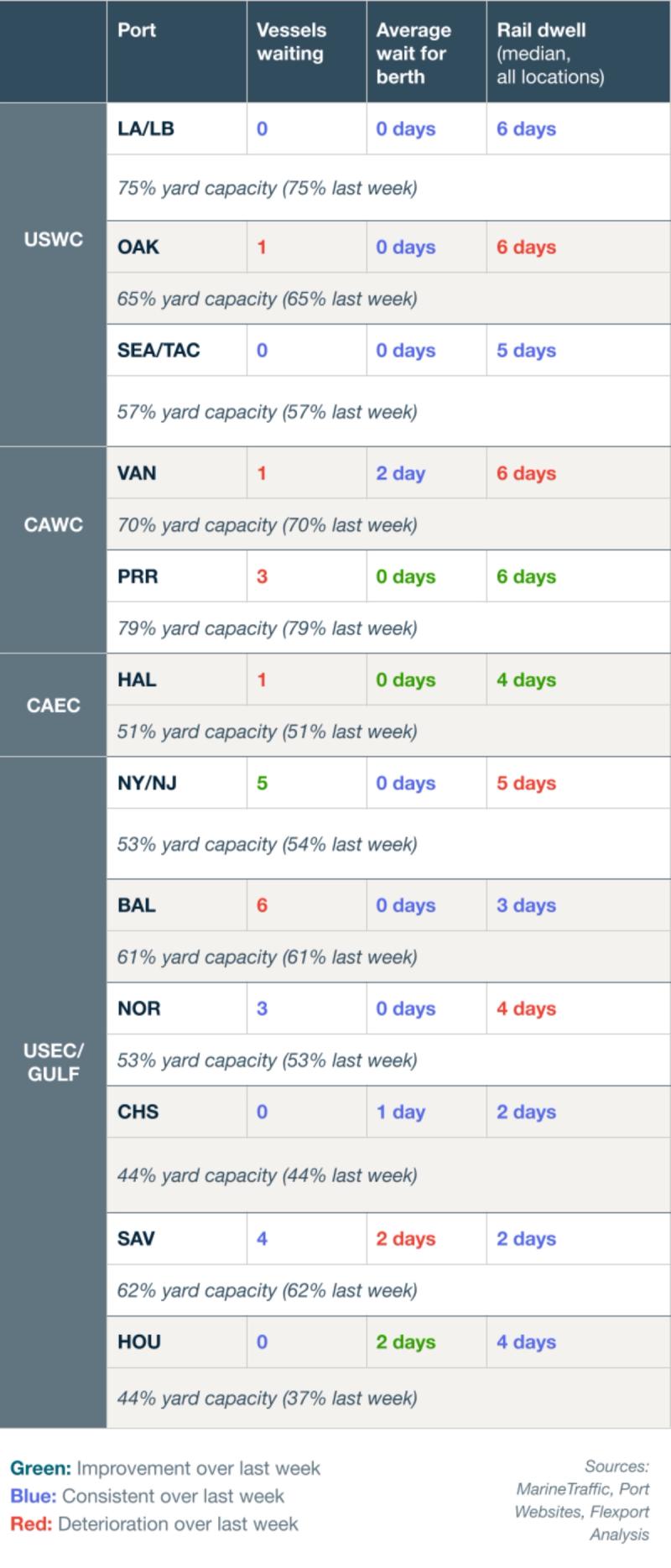
North America Vessel Dwell Times
Webinars
Trucking Market Outlook: Rates, Trends, & Regulatory Impact
Wednesday, July 1 @ 9:00 am PT / 12:00 pm ET
North America Freight Market Update Live
Thursday, July 16 @ 9:00 am PT / 12:00 pm ET
Tariff Trends 2026: Expert Insights on the Evolving U.S. Customs Landscape
Available On-Demand
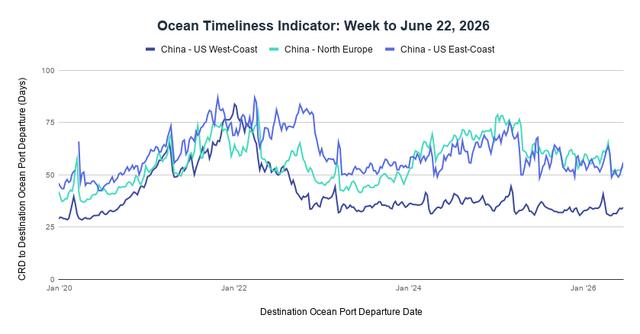
Ocean Timeliness Indicator
Week to June 22, 2026
Transit time remained flat at 34 days from China to the U.S. West Coast; increased from 53 days to 56 days from China to the U.S. East Coast; and increased from 53 days to 54 days from China to North Europe.
See the full report and read about our methodology in the Flexport Ocean Timeliness Indicator.