
Trends to Watch
Talking Tariffs
- Section 338 Tariffs on Canada: Aug. 19 Deadline Looms, Legal Challenges Expected: The 50% Section 338 tariff on Canada, covering close to one-twentieth of what Canada ships to the U.S. each year, is drawing surprisingly little pushback from Republican lawmakers, and the action could still be called off if Canada satisfies the U.S. Trade Representative (USTR) before the Aug. 19 deadline.
- Canada hasn't decided whether it would match the tariff dollar for dollar or scale back its response if Washington follows through.
- Trade attorneys and academics who track these disputes expect a legal fight regardless. Once the duty actually hits importers, they anticipate lawsuits challenging it in court.
- With so little runway left before Aug. 19, companies with Canadian supply chains should model both outcomes now: the tariff itself and a scaled-back Canadian response, using the Flexport Tariff Simulator.
- Section 122 Tariffs: Renewal Undecided as Government Appeals CIT Ruling: The USTR left open whether the 10% Section 122 tariffs will survive their July 24 expiration, with Greer telling reporters after a July 22 Senate Finance Committee hearing that he wouldn't commit either way, even as the administration keeps pressing its case for the tariffs in court.
- Greer separately said new forced-labor enforcement rates could come out "as soon as tomorrow," without elaborating on scope.
- In its opening appellate brief, the government argues the Court of International Trade (CIT) got Section 122 wrong, contending the court leaned too heavily on legislative history and read the statute too narrowly when it struck down the tariffs in its May 7 ruling.
- Importers holding entries under Section 122 shouldn't assume the tariffs lapse July 24. Both the renewal decision and the appeal are still live, and the Flexport Tariff Refund Calculator can help quantify exposure under either outcome.
- Congress Splits Over Russia Sanctions Bill and Broader Tariff Authority: The Senate's draft bill pairing Russia sanctions with secondary tariffs on China and India is running into friction on multiple fronts.
- The National Foreign Trade Council (NFTC) warned lawmakers that the bill's tariff mechanics need tightening before it advances.
- Trade experts expect Democrats to push back on parts of the bill and note that bipartisan agreement on tariff legislation is generally hard to come by.
- At least one senator is publicly urging quick passage instead, so the bill's path forward still looks unsettled.
- Sen. Ron Wyden introduced separate legislation that would go further: repealing Section 338 and Section 122 outright and requiring congressional approval before the White House can invoke Section 301, Section 201, or Section 232 going forward.
- CBP and Agency Updates: Mail Processing, Brazil Guidance, and More: U.S. Customs and Border Protection (CBP) and other agencies published a batch of administrative updates this week.
- CBP issued new guidance on tariffs affecting imports from Brazil.
- The agency's July 22 Customs Bulletin didn't include any ruling notices, and CBP posted new antidumping and countervailing duty (AD/CVD) case messages as of July 21, along with several miscellaneous releases.
- CBP also updated its implementation guides for the Entry Type 13 test covering mail processing.
- The Food and Drug Administration (FDA) released new and revised import alerts on July 21.
- Trade Actions Still Taking Shape: USMCA, Jordan, and Generic Drugs: Several developments this week point to tariff decisions that haven't landed yet.
- Greer told the Senate Finance Committee that renegotiating USMCA's rules of origin won't wrap up in 2026, while saying he hopes Canada and Mexico will "improve their commitments" to the U.S. by year's end so enforcement can be tightened.
- The White House's new reciprocal trade agreement with Jordan is expected to help its textile and apparel sector, but it doesn't resolve what tariff Jordanian goods will face under a pending Section 301 forced-labor action, originally proposed at 12.5%.
- President Trump signaled tariffs on generic drugs are coming, though the administration hasn't taken any formal legal or regulatory action yet.
- AD/CVD Activity Spans Plywood, Steel Pipe, Chemicals, Fatty Acids, and Cranes: The Department of Commerce and the International Trade Commission (ITC) advanced or opened several trade remedy cases this week, covering a wide range of products.
- Commerce issued final AD and CVD determinations on hardwood and decorative plywood.
- A new petition seeks AD/CVD relief on welded stainless pipe from India, Turkey, and the United Arab Emirates.
- Monsanto withdrew its petition for AD/CVD duties on Chinese glyphosate.
- Commerce issued preliminary AD review results for France steel cut-to-length (CTL) plate, published additional AD/CVD notices, and the ITC opened new investigations, all dated July 21.
- New CVD cash deposit rates took effect for fatty acid imports from Indonesia and Malaysia, and Commerce released details of an AD order covering cranes from Japan.
- Importers across wood products, steel pipe, agricultural chemicals, fatty acids, and industrial equipment should check scope language against their own product lines. Flexport's Trade Advisory group can help assess exposure and flag comment deadlines.
Ocean
- Ocean market news:
- The Strait of Hormuz crisis has escalated since last week. Weekend reporting describes the corridor as having reverted fully to war conditions, with a new round of large-scale strikes between the U.S. and Iran.
- Vessel transits have collapsed further: 53 transits were recorded in the week through July 20, down 66% from 157 the week before. Tanker and gas carrier crossings, which move most Gulf energy cargo, fell to 30 from 90 over the same period. Only about 13 vessels a day transited the strait between July 17 and 19, against a normal rate near 88 a day.
- The Red Sea disruption remains a separate event from the Hormuz closure, and it has also escalated. On July 20, Houthi forces declared a maritime blockade targeting Saudi-linked shipping specifically, in retaliation for a blockade of Yemen and a strike on Sanaa's airport. This is narrower than a full Bab el-Mandeb closure, but industry reporting this week has flagged a real risk that the strait could be closed entirely if the wider conflict draws the Houthis in further. A full closure would mark a significant deepening of the Red Sea disruption on top of the Cape of Good Hope diversions already in place since late 2023.
- Blank sailing activity has settled into a structurally higher baseline than before the pandemic. Carriers are now routinely withdrawing 10-14% of scheduled capacity on the busiest lanes, versus a 6-8% range in 2019, with Trans-Pacific Eastbound and Asia-Europe still the most affected.
- Freight rates appear to be topping out. After climbing for 5 straight weeks to their highest level since September 2024 in early July, the broad market rate index eased for the first time this week, falling 2% as of July 16. However, on TPEB, carriers have announced Aug. 1 GRIs that may slow the rate erosion, especially to the West Coast. Schedule reliability moved the other way: after reaching its best level of the year in May, industry on-time performance fell 3.7 percentage points in June, the first notable monthly decline of 2026.
- A drop in the U.S. inventory-to-sales ratio, one of the largest seven-month declines in over three decades outside of 2009 and 2020, appears to be driving a chunk of current import demand. Because this reflects a sales surge rather than falling inventories, the market could flip quickly from tight to oversupplied if sales growth slows.
- Port congestion remains elevated, and the Panama Canal is tightening further. Draft limits at the Neopanamax locks step down from 49.5 feet to 49.0 feet on July 24, then to 48.5 feet on August 15, as the canal authority manages watershed levels ahead of an expected El Nino pattern later this year.
TRANS-PACIFIC EASTBOUND (TPEB)
- Capacity and Demand:
- Blank sailing activity rose to 1.3% of scheduled capacity this week, up from 0.4% last week, though still low in absolute terms. The lane carries the highest structural withdrawal baseline of any major trade, with carriers routinely pulling back roughly 14% of scheduled East Coast capacity and 11% of West Coast capacity as a matter of course.
- Retailers front-loaded imports ahead of tariff deadlines through June, and that push has started to ease. A new round of Section 301 duties on select origins takes effect July 22, alongside the scheduled July 24 expiration of existing Section 122 duties, which may prompt another short-term push of import activity before easing into fall.
- The Panama Canal water level will be further decreased, resulting in more restrictions, and several carriers are starting to implement a Panama Canal Surcharge; this will further increase rate levels and hold space tight for East Coast and Gulf services routed via the Panama Canal.
- Freight Rates: Rates that climbed to their highest level in nearly two years in early July have started to soften, falling for the first time in several weeks as of the most recent reading, especially on the West Coast. However, early indications point to August rate increases that may slow the softening and signal that space remains well utilized.
- Recommendation: Even though the market has opened up slightly, we still recommend booking 4 to 6 weeks ahead of time and utilizing available space, as demand remains stable and space is well utilized.
FAR EAST WESTBOUND (FEWB)
- Capacity and Demand:
- Blank sailing activity stayed modest, but the lane remains one of the most actively managed: carriers have withdrawn 5% of scheduled sailings across the major East-West trades over the next 5 weeks (Weeks 30 to 34), with Asia-Europe/Med accounting for roughly a third of all cancellations.
- The lane continues to run a structurally elevated withdrawal rate versus historical norms, tied to the extra tonnage carriers have added to cover longer Cape of Good Hope routings. This week's escalation on both the Hormuz and Red Sea fronts adds fresh uncertainty to any near-term return to Suez Canal transit. Only a portion of services still route through Suez today; most large-vessel capacity remains on the Cape routing.
- Underlying demand is steady. This year's peak arrived early and was partly pulled forward by front-loading ahead of the July 1 end of the EU's low-value import exemption, plus a mid-month rate increase.
- With that deadline now passed, the near-term outlook points to softer momentum through late Q3: underlying volumes hold up, but the marginal growth rate looks to have peaked, and demand is skewing toward the Mediterranean and Southern Europe while Northern Europe cools under the new ecommerce import rules.
- Freight Rates: Rates on this lane have also started to ease in mid-July, in line with the broader market pullback from its early-July peak.
- Recommendation:
- Continue planning for Cape of Good Hope transit times through the third quarter.
- Watch developments around the Bab el-Mandeb closely. A full closure would be a material new disruption layered on top of the existing Red Sea diversion, not a continuation of it.
TRANS-ATLANTIC WESTBOUND (TAWB)
- Capacity and Demand:
- Blank sailing activity rose to 6.9% this week after sitting at 0% the prior week, a reversal worth watching. This lane has consistently carried the lowest structural withdrawal rate of the four trades in this update over the past year.
- No material shift in demand was identified this week.
- Freight Rates: No lane-specific rate action was identified this week beyond the broader market pullback. Almost all carriers announced PSS effective in the middle of August.
- Equipment: Container/chassis shortages persist across TAWB origins (Germany, Benelux, Austria, Hungary, Slovakia) into week 32.
- Port Situation: NEUR congestion continues — Rotterdam barge waits of 90–96 hours, Bremerhaven/Hamburg yard utilization ~89–93%, Antwerp/Zeebrugge delays over 3 days. Global reliability ~62%.
- Recommendation:
- Monitor whether this week's uptick in blank sailing activity holds into next week.
- Given persistent equipment shortages and ~62% reliability, book 3–4 weeks ahead; absent further signals, continue standard booking practices otherwise.
INDIAN SUBCONTINENT TO NORTH AMERICA (ISC)
- Capacity and Demand:
- Capacity on this lane remains the most constrained it has been since summer 2024, related to front-loading for potential ILA labor action across USEC and GC ports.
- Weekly direct sailing frequency between Northwest India and the U.S. East Coast is stepping down between June and August as two services are removed from the market.
- Separately, one service has resumed standard Red Sea and Suez Canal routing — the first on this corridor to do so since the regional conflict escalated in the spring — even as capacity elsewhere on the lane has tightened.
- At origin, a container backlog at a major Indian gateway port, tied to a trucking shortage, is contributing to a growing backlog of cargo as demand outpaces capacity.
- Demand to North America has been strong, rising roughly 40% from April to May and continuing to build through June and July. This lane appears to be in the middle of an extended peak season expected to run through August.
- Freight Rates: Rates on this corridor have climbed to their highest level in about a year and a half, driven by tight capacity, port congestion, and the lingering effects of regional disruption.
- Recommendation:
- Secure space early given tight capacity and an extended peak season, and build extra time into routings for origin port delays.
Air
- Jet fuel costs ease from the April peak, but carrier surcharges hold as hostilities renew in the Middle East and mid-year demand softens across most lanes.
- Overview:
- The IATA Air Cargo Week 28 data (week ending July 12) showed worldwide air cargo rates softening week over week for the third consecutive week — the first back-to-back decline since the Middle East conflict began in February.
- Demand signals remain mixed: Trans-Pacific volumes are subdued, with U.S.-bound flows from North China at lower levels established over recent weeks and no recovery signals on the horizon.
- The EU parcel handling charge, effective July 1, structurally reduced ecommerce volumes on Asia-to-Europe lanes. The market has found a near-term floor, but recovery is not expected while EU summer holidays continue.
- Cambodia remains the tightest market in Asia, with space congested and booking lead times extending to 7 working days.
- Jet fuel prices peaked on April 7, when the Strait of Hormuz disruption was most acute, then fell after a preliminary U.S.-Iran agreement in June provided partial Hormuz access relief. Prices remain approximately 38% above year-ago levels, far above Brent crude's 7% year-over-year gain, reflecting the ongoing premium on Persian Gulf supply risk.
- Renewed U.S.-Iran fighting in the first weeks of July reintroduced upward pressure. Fuel surcharges across key APAC and Middle East routes are likely to rise accordingly, with several carriers filing increases effective in July.
- Multiple airlines have put Middle East route resumptions on hold following the latest U.S.-Iran escalation, tightening connections through Gulf gateways. SWISS WorldCargo raised its U.S.-origin surcharge effective August 3, citing sustained fuel and operational cost pressure linked to the conflict.
- Xeneta expects air freight spot rates to rise by up to 15% in the coming months, citing constrained trans-Pacific capacity and limited new freighter deliveries following Boeing 777-8F program delays.
- MSC Air Cargo placed an order for 777-8 freighters this week; Cargolux, unable to wait for those deliveries, announced it is acquiring China Airlines' B747-400Fs to meet near-term capacity needs.
- North China (PVG/PEK):
- Trans-Pacific Eastbound (TPEB) demand is at subdued levels established over recent weeks, with no recovery signals or new downside triggers at market level.
- U.S. West Coast rates are holding flat week over week; Chicago is softening modestly as e-cigarette-related project cargo declines, removing one of the few demand pockets that had been supporting outperformance on that gateway.
- Asia-to-Europe rates are flat from last week at a low base; the EU parcel handling charge that took effect July 1 has depressed ecommerce flows, and general cargo is not compensating.
- South China (HKG/SZX/CAN):
- TPEB demand rose slightly last weekend, driven by general cargo; U.S. West Coast space is expected to be tight next week.
- Market rates are rising on U.S. lanes, driven by general cargo demand picking up from the weekend; Far East Westbound (FEWB) demand continues to soften with rates decreasing.
- Taiwan (TPE):
- Demand and supply are stable week over week; U.S. lane rates remain high while the EU market is relatively slack.
- Booking lead time of 5 to 7 days is recommended to secure optimal space arrangements.
- Vietnam (SGN/HAN):
- Market is softening; rates are falling, and some airlines now have open capacity.
- Shippers willing to book 5 to 7 days in advance can take advantage of improved availability.
- Cambodia (PNH):
- Demand remains strong, space is congested, and rates are high.
- Booking 7 working days in advance is required to secure space.
- Korea (ICN):
- Demand has softened, but freight rates have not declined correspondingly, due to a current backlog from previous weeks still being worked through.
- Europe and intra-Asia lanes are manageable; shippers on U.S. lanes should place bookings at least 3 to 5 days before estimated time of departure.
- Malaysia (KUL):
- Due to ongoing Middle East hostilities, several airlines have reduced or suspended services into the region: Cargolux and Singapore Airlines have canceled services to the Middle East, and Turkish Airlines has officially suspended routes to Bahrain (BAH) and Kuwait (KWI).
- Despite these carrier actions, overall space availability on TPEB and FEWB lanes from Malaysia remains stable; however, a slight rate increase is projected for the final 2 weeks of July as capacity tightens.
- Thailand (BKK):
- Demand is relatively stable; airlines continue to offer more open capacity and rates have softened further.
- Booking 5 to 7 days in advance is recommended.
- India (BOM/DEL/MAA/BLR):
- Severe ocean container congestion and processing backlogs across major U.S. ports continue driving shippers to pivot to air, tightening capacity on India-to-U.S. lanes.
- Booking 1 week in advance is recommended.
- Broader Indian subcontinent:
- Sri Lanka: Most carriers are back on schedule; base rates are stable and fuel surcharges continue to ease, though Middle East-based carriers are experiencing space constraints from rising perishable volumes.
- Bangladesh: EU lanes are reliable with space available; U.S. lanes are running tight.
- Pakistan: The tightest market in the subcontinent. Capacity is fully committed across all lanes, and airlines are quoting only 1 to 2 days of rate validity.
- Transatlantic (Europe to U.S.):
- Air Canada Cargo implemented a fuel surcharge increase effective June 15, adding to cost pressure on transatlantic lanes; average all-in rates continue to reflect elevated surcharge levels across major European carriers.
- Summer belly capacity on transatlantic routes is absorbing some freight demand, keeping spot pricing from climbing further, but space is not readily available for last-minute bookings.
- No disruptions reported at CDG, FRA, or LHR; operations at key European cargo hubs are normal.
(Source: Flexport)
Please reach out to your account representative for details on any impacts on your shipments.
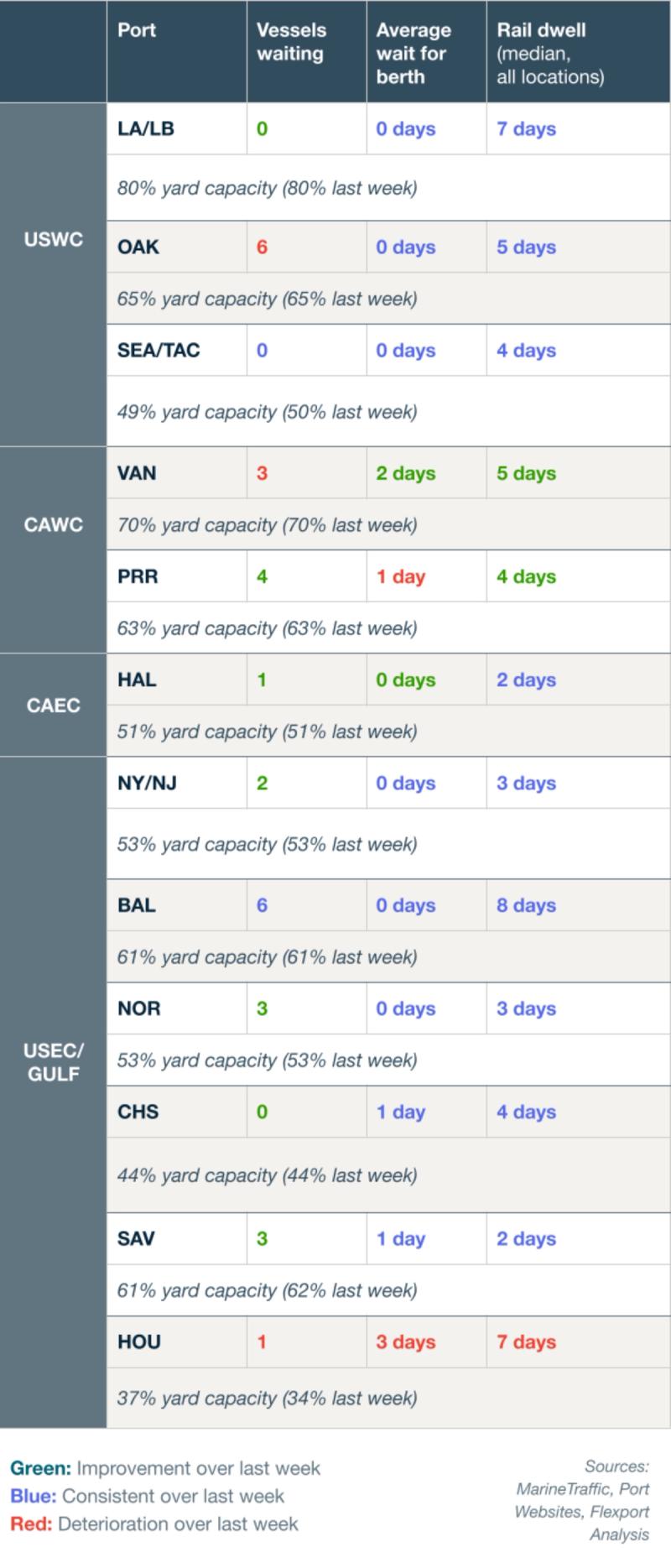
North America Vessel Dwell Times
Webinars
Tariff Trends 2026: Expert Insights on the Evolving U.S. Tariff Landscape
Friday, July 24 @ 9:00 am PT / 12:00 pm ET
Navigating Peak Season: Essential Omnichannel & Fulfillment Strategies for Success
Thursday, August 6 @ 12:30pm PT / 3:30pm ET
Available On-Demand
North America Freight Market Update Live
Available On-Demand
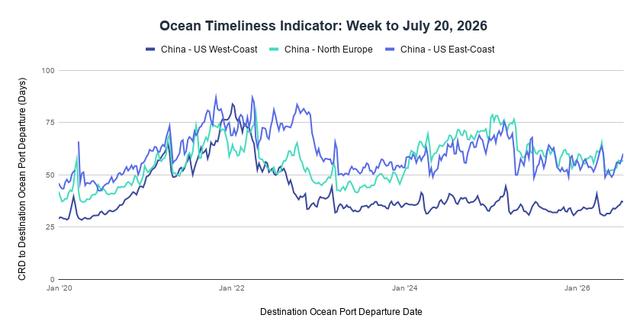
Ocean Timeliness Indicator
Week to July 20, 2026
Transit time from China to the US West-Coast decreased by 1.0 days, falling from 37.1 to 36.1 days. The China to North Europe route saw a 1.0-day decrease, moving from 56.9 to 55.9 days. Lastly, the transit time to North Europe decreased by 0.8 days, falling from 74.5 to 73.7 days.
See the full report and read about our methodology in the Flexport Ocean Timeliness Indicator.