Trends to Watch
Talking Tariffs
- CBP's Section 338 Guidance Bulletin Contains Errors, Filers Should Double-Check: Flexport's trade compliance team flagged that CBP's initial implementation bulletin for the Section 338 Canada tariffs went out with mistakes, including an incorrect Chapter 99 code range cited for the drawback provision.
- The bulletin also listed a stacking order that references Section 122 duties, even though Section 122 tariffs are no longer in effect. CBP corrected this error in subsequent guidance.
- Canada's Retaliation: Dollar-for-Dollar Response Effective Sept. 8: Canada is matching the new 50% Section 338 tariffs on $20 billion worth of its exports with retaliation across 874 tariff lines, doubling duties on American steel and aluminum to 50% and adding tariffs of 15%, 25%, or 50% on a range of other goods.
- The retaliation takes effect Sept. 8 and targets steel, dairy, appliances, agricultural equipment, pulp and paper products, and electronics. With duties escalating on both sides of the border, importers moving goods in either direction should reassess landed costs now rather than after the Sept. 8 effective date. The Flexport Tariff Simulator already reflects the update.
- IEEPA Refund Pipeline Tops $130 Billion While CAPE's Next Phase Stays Stalled: CBP has accepted roughly $132.5 billion in what a recent court declaration calls "potential and certified refunds" for processing through the Consolidated Administration and Processing of Entries (CAPE) system, as of Aug. 21. The system's third phase, meant to expand who's eligible, remains on hold with no new launch date.
- That's a lot of money moving through a system whose eligibility rules are still being worked out, including the open question of whether finally liquidated entries can qualify without a separate lawsuit.
- CBP Finalizes Rule on Electronic Export Manifests for Trains Leaving the U.S.: CBP finalized a rule requiring rail carriers to transmit export manifest data electronically through the Automated Commercial Environment (ACE) for any train departing the U.S., adding a new required data element to the filing.
Ocean
TRANS-PACIFIC EASTBOUND (TPEB)
- Capacity and Demand:
- Carriers continue to deploy capacity in full. Blank sailing bookings sit under 1% for the current week and stay in the low single digits through most of September, edging up toward 6% only in the week of September 28 as carriers begin trimming capacity ahead of the Golden Week holiday — still short of a material pull-back.
- The real constraint on effective supply right now is congestion, not blank sailings: the East Asia port disruptions noted above are tying up vessel capacity and adding delay, particularly around Shanghai, Ningbo, and Zhoushan.
- Import demand remains resilient. The Port of Long Beach logged its second-busiest July on record even with a modest year-over-year dip, and combined volume at the ports of Los Angeles and Long Beach held near record levels into August.
- Separately, the Panama Canal Authority will reduce daily transit slots starting September 3, with a further cut on September 15, as noted above; shippers routing East Coast or Gulf cargo through the canal should expect longer waiting times without a confirmed reservation, and watch for additional schedule and cost impact into the fall. Some carriers are exploring Cape of Good Hope routing on select vessels — it adds transit time but relieves canal congestion.
- Freight Rates:
- Asia-to-U.S. East Coast spot rates continued climbing this week, outperforming the West Coast. North American trade lane rates broadly hit a four-year high on August 19 as Panama Canal draft restrictions kept tightening, and the gap between the two coasts has widened this month as a result.
- A broad container rate benchmark, the Platts Container Index, reached its highest level this year on August 21.
- Carriers have started announcing September 1 rate increases.
- Recommendation: Shippers should build extra buffer into cargo-ready dates around Shanghai, Ningbo, and Zhoushan while the typhoon-driven backlog clears, and book early given the compounding effects of congestion and tightening capacity.
FAR EAST WESTBOUND (FEWB)
- Capacity and Demand:
- Carriers are keeping capacity fully deployed, with blank sailings staying in the low single digits through most of the forecast window. Separately, carriers have announced blank sailings on select Asia-Europe and Asia-Mediterranean services around China's Golden Week holiday in early October, anticipating a seasonal demand lull — this is not a signal of a broader pull-back.
- European demand remains soft, as an early peak season continues to unwind.
- The East Asia typhoon disruption and port congestion noted above are adding origin-side schedule risk on top of that seasonal softening.
- Labor talks between German port workers and terminal employers continued in Hamburg this week without a confirmed resolution, following last week's 24-hour warning strike at 6 ports; shippers should expect some residual delay at Hamburg, Bremerhaven, and Wilhelmshaven and build in a buffer in case of renewed action.
- The Suez routing shift also touches this lane directly: MSC has now joined Maersk's Gemini Cooperation and the CMA CGM/Cosco-led Ocean Alliance in resuming selected Suez transits, while the Premier Alliance has yet to begin a broader shift.
- Freight Rates: Spot rates have eased roughly 20% from their July peak, though they remain about 60% above spring levels.
- Recommendation: Shippers should treat shorter transit times as an emerging option on part of the network rather than a guarantee, and expect the transition to keep moving gradually, carrier by carrier.
TRANS-ATLANTIC WESTBOUND (TAWB)
- Capacity and Demand:
- Capacity discipline remains the story here, not demand. Blank sailing bookings are running near 11% for the current week and next week, before falling to the low single digits by early September.
- Demand has stayed flat to slightly softer year over year.
- The German port strike, noted above, adds near-term schedule risk on the origin side, with talks in Hamburg still unresolved as of this week; shippers should expect some residual delay out of Hamburg, Bremerhaven, and Wilhelmshaven and watch for renewed disruption.
- Freight Rates: Carriers continue pushing new peak season surcharges for September on Northern Europe and Mediterranean-to-U.S. routings. That combination points to carriers managing utilization to protect rate levels rather than a genuine space squeeze.
- Recommendation: Shippers with flexibility may want to avoid locking in longer-term commitments while this capacity/demand imbalance persists, though near-term rate resilience is likely as long as carriers hold their current capacity discipline.
INDIAN SUBCONTINENT TO NORTH AMERICA (ISC)
- Capacity and Demand:
- Supply remains the binding constraint on this corridor on top of peak season demand.
- Major services from Northwest India to USEC are overwhelmed and the backlog of cargo ready to move at origin continues without any decline in demand levels.
- Space from Southeast India and Bangladesh to USEC will become further constrained due to a "stop booking" issuance in the corridor from a major carrier through September.
- Congestion at Middle East transshipment hubs is adding further strain: container lines have extended congestion surcharges beyond Jeddah to Khor Fakkan, Fujairah, and Sohar, where vessel waiting times now stretch beyond 1 week at some terminals.
- The ongoing monsoon season and shifting carrier network patterns tied to the Middle East conflict continue to tighten conditions again.
- Looking further out, export volumes tied to the Diwali holiday in early November are expected to add further pressure on available space this fall.
- Freight Rates: Freight rates on Indian subcontinent lanes have continued climbing this month, driven by tight space and peak season demand, with premium rate levels enabling cargo to get loaded sooner than FAK and NAC bookings.
- Recommendation: Shippers should keep booking several weeks ahead given the tight fleet backdrop, and have shippers confirm CRD as soon as possible.
Air
- North China (PVG/PEK):
- U.S. West Coast demand fell again this week as ecommerce shippers canceled bookings, adding to an already soft seasonal pattern.
- Pricing is expected to hold near current levels, with no near-term catalyst in sight.
- U.S. East Coast volumes eased slightly versus last week, with rates following demand down at a slower pace than on the West Coast.
- Europe-bound demand held flat at the same soft, range-bound levels seen in recent weeks.
- South China (HKG/SZX/CAN):
- U.S. demand rose slightly over the weekend on general cargo, though ecommerce target rates stayed low.
- A backlog from multiple Aircraft on Ground (AOG) events over the past two weeks pushed rates up slightly.
- Europe-bound demand continued to soften, keeping rates at low levels.
- Taiwan (TPE):
- U.S. demand held steady versus last week.
- Book 5 to 7 days in advance to secure space.
- Vietnam (SGN/HAN):
- The market saw swings starting mid-week, with congestion at origin affecting U.S.-bound capacity, particularly out of Hanoi.
- Rates have not moved yet, but an increase is expected in the coming weeks.
- Europe-bound demand and capacity held steady, though a small rate increase is expected next week.
- Cambodia (PNH):
- Demand stayed elevated, keeping space tight and rates up.
- Book at least 7 working days in advance to secure space.
- Korea (ICN):
- Demand held stable versus last week.
- Book 5 to 7 days in advance.
- Malaysia (KUL):
- Demand stayed stable, with rates holding steady on both U.S. and Europe lanes.
- Book 5 to 7 days ahead of departure to protect space against market shifts.
- Thailand (BKK):
- The market held stable versus last week, with demand expected to improve toward month-end.
- Carriers flagged tight capacity into the U.S. East Coast, particularly ORD and JFK.
- Book 5 to 7 days ahead; rates held unchanged versus last week.
- Indonesia (CGK):
- The market entered peak season, with capacity uneven across lanes.
- Export demand is squeezing available space and pushing U.S.-bound rates up modestly, and airlines are rerouting cargo through less congested airports, adding to transit times.
- Europe-bound capacity held steady, though early tightening is emerging.
- Book 7 to 10 days ahead of the cargo-ready date.
- India (BOM/DEL/MAA/BLR):
- Demand held steady versus last week as shippers continue to pivot to air to bypass ocean bottlenecks, keeping India-to-U.S. capacity busy.
- Book 5 days in advance.
- Broader Indian subcontinent (Bangladesh, Sri Lanka, Pakistan):
- Sri Lanka: Base rates held steady while fuel surcharges eased, and Middle East carriers faced space constraints tied to a rise in perishable cargo volumes.
- Bangladesh: The Europe-bound schedule stayed reliable with space available, while the U.S. lane ran tighter and less reliable.
- Pakistan: Schedules stayed reliable, but rates ran elevated, with airlines quoting rate validity of only 1 to 2 days.
(Source: Flexport)
Please reach out to your account representative for details on any impacts on your shipments.
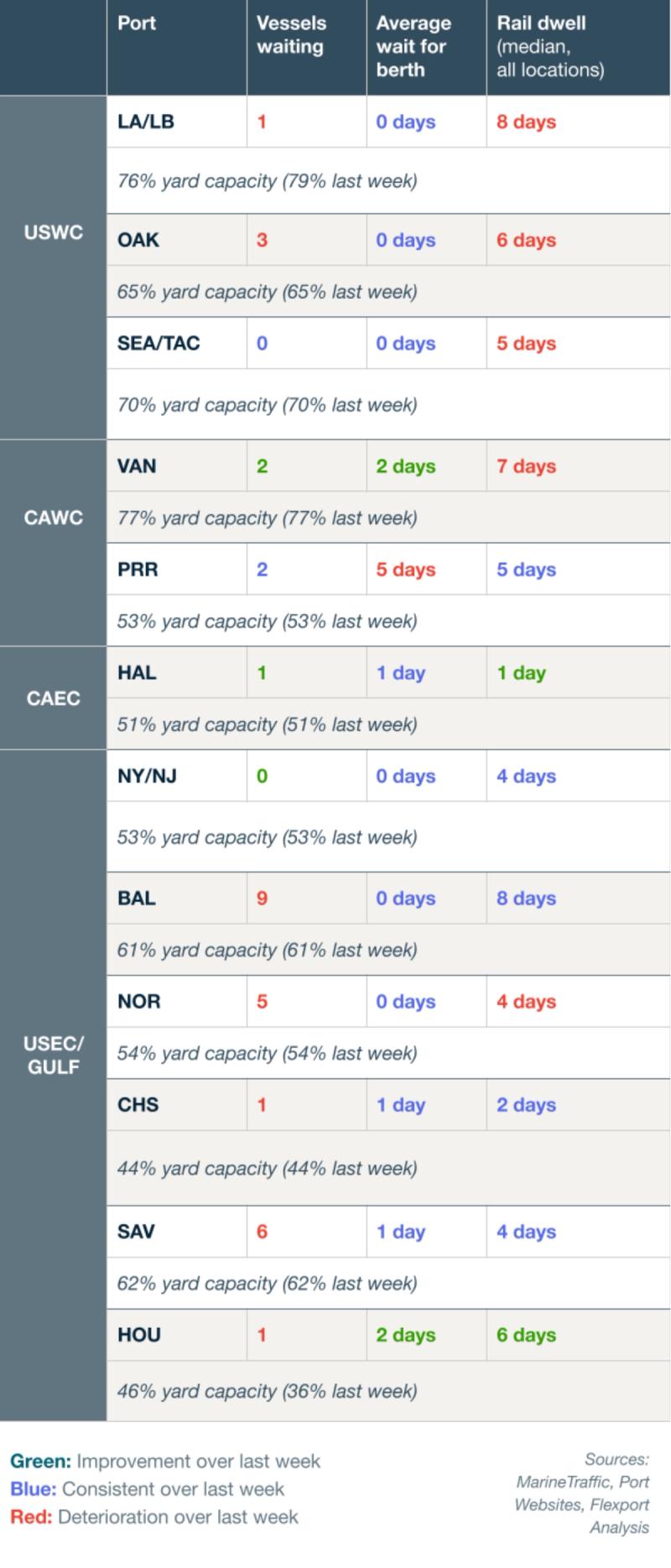
North America Vessel Dwell Times
Webinars
North America Freight Market Update Live
Thursday, September 10 @ 9:00 am PT / 12:00 pm ET
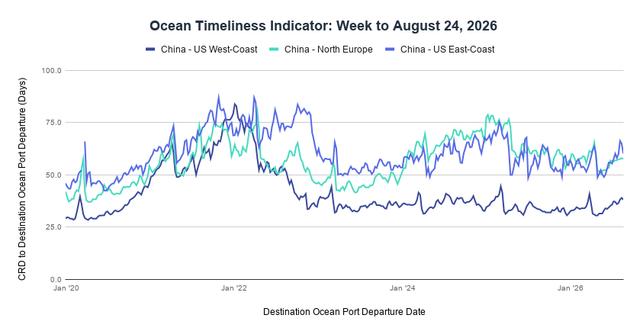
Ocean Timeliness Indicator
Transit time decreased from China to the U.S. West Coast, decreased from China to the U.S. East Coast, and decreased from China to North Europe.
Week to August 24 2026
Transit time decreased from 39 days to 38.1 days from China to the U.S. West Coast; decreased from 64.9 days to 60.3 days from China to the U.S. East Coast; and decreased from 58 days to 57.6 days from China to North Europe.
See the full report and read about our methodology in the Flexport Ocean Timeliness Indicator.