Trends to Watch
Talking Tariffs
- Congress: Schumer's Repeal Bill Lands as Odds Improve for a House Vote on Russia Sanctions: Sen. Chuck Schumer introduced a bill that would repeal both Section 338 and Section 122 outright, while also ending the Section 301 forced-labor tariffs and refunding what's already been collected under them.
- Separately, one lawmaker now puts the odds of a House vote on the Senate's Russia sanctions and secondary tariffs bill at "better than 50%," an improvement from the uncertainty seen in recent weeks.
- Neither bill has a confirmed timeline yet. Importers with exposure to any of these tariff authorities should keep tracking both rather than assume the status quo holds.
- AGOA Renewal: In a recently passed continuing resolution on the budget, AGOA was reauthorized through December 2028.
- Testimony in front of the House Ways and Means Committee led to a recommendation that Congress pass a 10-year renewal of AGOA.
- CBP Tells Filers How to Apply the New Section 232 Drone Duties: CBP released guidance on how importers should implement the Section 232 tariffs on unmanned aircraft systems (UAS) and their components, which took effect Sept. 3.
- The guidance should help clarify some of the classification and stacking questions that came up when the tariffs were first announced last month.
- International Mail Shipments Will Need CPSC eFiling Under Entry Type 13 Starting Oct. 22: The Consumer Product Safety Commission (CPSC) will require electronic filing for international mail shipments processed under Entry Type 13 starting Oct. 22, continuing the broader shift toward electronic mail processing that CBP has been building out over recent months.
Ocean
TRANS-PACIFIC EASTBOUND (TPEB)
- Capacity and Demand:
- Carriers continue to deploy capacity in full. Blank sailing bookings stay in the low single digits through most of September, climbing toward 8% only in the week of October 5 as carriers trim ahead of China's early-October Golden Week holiday — still a forecast rather than a confirmed pull-back, and worth watching as forward bookings firm up. Blank sailings are expected to surge further after Golden Week.
- The real constraint on effective supply remains congestion: the port disruption noted above is tying up vessel capacity and adding delay, particularly around Shanghai and Ningbo.
- Separately, the Panama Canal Authority's daily transit-slot cuts took effect September 3 as planned, with a further reduction to follow September 15; a planned tightening of vessel draft limits, however, has been pushed back to October 1, offering modest near-term relief on vessel size.
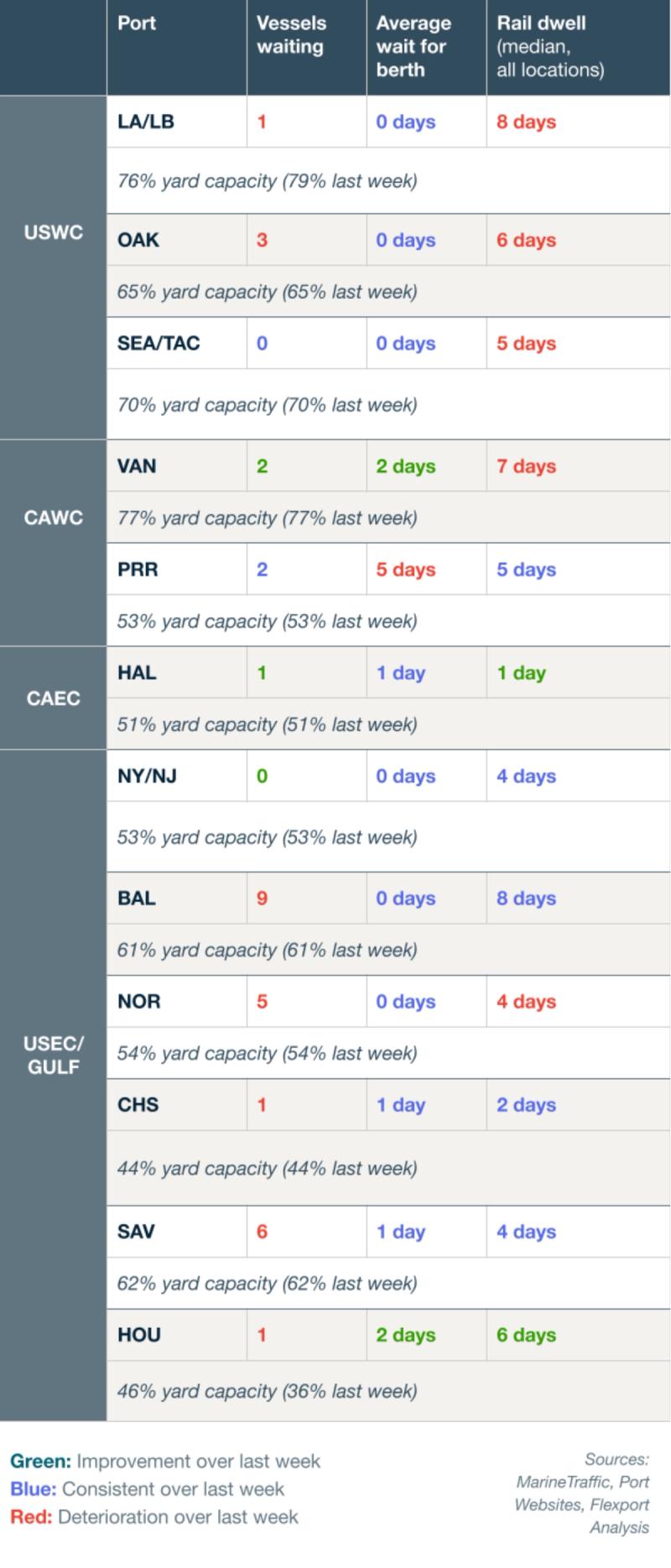
- Interior Point Intermodal volume is surging and shifting from all-water routings to Mini Land Bridge for East Coast and inland cargo. That's adding pressure on rail connections at Los Angeles and Long Beach, where dwell times and congestion are starting to lengthen.
- Freight Rates: September rates continue to rise on both the East Coast and West Coast. Stable demand, full vessel capacity utilization, typhoon-driven interruptions at origin, and Panama Canal challenges affecting the East Coast are pushing rates up together.
- Recommendation: Shippers should build extra buffer into cargo-ready dates around Shanghai and Ningbo-Zhoushan while the backlog clears, book early given the compounding effect of congestion and tightening capacity into Golden Week, and secure a confirmed Panama Canal reservation for any East Coast or Gulf cargo routed through the canal.
FAR EAST WESTBOUND (FEWB)
- Capacity and Demand:
- Carriers are keeping capacity fully deployed, with blank sailings staying near zero through most of the forecast window and edging up only modestly by early October around the Golden Week holiday lull.
- The China port disruption noted above is adding origin-side schedule risk on top of that modest Golden Week-related increase.
- The Suez routing shift also touches this lane directly, as noted above: shippers should treat shorter transit times as a genuine but still partial option, available on more services than a few weeks ago, and expect the shift to keep moving carrier by carrier.
- Separately, a nationwide labor strike is set to hit Dutch seaports on September 4, with Rotterdam, Amsterdam, and Zeeland all affected.
- Freight Rates: European spot rates have eased over the past several weeks as capacity returns to the corridor.
- Recommendation: Shippers with cargo moving through the Dutch gateways should expect delay risk around September 4 and build in a buffer.
TRANS-ATLANTIC WESTBOUND (TAWB)
- Capacity and Demand:
- Ocean carriers continue to rely on strict capacity discipline to stabilize the trade lane. Blank sailing cancellations are running near 9% for the current week, with voided capacity projected to ease into low single digits by mid-September before a prospective jump back toward the high teens around the week of October 5 (a developing forecast as forward bookings firm up).
- On the demand side, headhaul cargo volumes have continued to soften and contract across North Europe and Mediterranean export corridors, with US import throughput down ~2.6% year-over-year.
- Dutch port labor action scheduled for Friday, September 4 (a 7.5-hour work stoppage from 11:15 to 19:00 local time) will impact loading terminals at Rotterdam and Amsterdam. Shippers should anticipate brief gate delays, slowed container yard (CY) operations, and localized weekend dispatch backlogs.
- Freight Rates: Despite weak underlying demand and reduced port throughput, main carriers are pushing for rate increases. This reflects proactive supply management aimed at supporting rate floors rather than responding to genuine space constraints.
- Recommendation: Shippers with flexibility may want to avoid locking in longer commitments while this capacity/demand imbalance persists, though spot rates are expected to maintain near-term floor support as carriers hold capacity discipline.
INDIAN SUBCONTINENT TO NORTH AMERICA (ISC)
- Capacity and Demand:
- Space remains the binding constraint on this corridor. Demand is running at a similar level to last summer's peak, while capacity has been reduced by the trickle-down effects of the regional conflict and the Strait of Hormuz escalation noted above, which continues to push Middle East transshipment volumes onto strings serving the Indian subcontinent and add congestion at those hubs. Among the top 30 global ports, throughput volumes at Nhava Sheva and Colombo had the largest percentage increase for 1H 2026, per Alphaliner, more than 11% growth for each port.
- Loading timelines remain long: premium service is getting cargo loaded within 2 to 3 weeks, standard service within 3 to 5 weeks, and named-account contracts within 4 to 6 weeks.
- Separately, a change in rules related to empty-container depot operators at Mundra, one of India's largest container gateways, is restricting equipment repositioning and putting full-container trucks at risk of missing port cutoffs; the dispute follows new empty-container handling rules imposed by the port operator and could widen if unresolved.
- Looking further out, export volumes tied to the Diwali holiday in early November are expected to add further pressure on available space into the fall, with U.S. East Coast space likely to stay tight into mid-to-late November.
- Freight Rates: Carriers implemented a further peak season rate increase effective September 1 on lanes to the U.S. East Coast and Gulf; West Coast lanes saw no comparable increase this cycle.
- Recommendation: Book early as the situation enables; have CRD confirmed by origin as soon as possible in order to get loaded as quickly as possible.
Air
- North China (PVG/PEK):
- Rates held flat week over week on both U.S. and Europe lanes, continuing a quiet, seasonal lull.
- Early booking inquiries for mid-September are picking up, but forwarders say it's too soon to call it a demand trend.
- London gained a small rate uptick on PVG-LHR routings — the first split between UK and continental Europe gateways since the market flattened in July.
- South China (HKG/SZX/CAN):
- Demand ticked up after some freighter cancellations, tightening U.S. East Coast space.
- Airlines are rolling out planned Q4 capacity, easing ORD and JFK rates slightly even as West Coast demand holds steady on Mexico transshipment volume.
- Forwarders are holding space into next week to protect allocations tied to Apple's new product cycle, lifting both U.S. and Europe bookings.
- Taiwan (TPE):
- U.S. demand is stable week over week.
- Booking 5 to 7 days ahead is advised to secure space.
- Vietnam (SGN/HAN):
- A national holiday in Week 36 is set to soften demand, and rates are easing slightly even as airlines raise fuel surcharges in September.
- Lufthansa Cargo and Cargolux have canceled select SGN and HAN flights in early September, tightening available capacity.
- Cambodia (PNH):
- Demand remains strong and space is congested. Rates are elevated.
- Forwarders are advised to book 7 working days ahead to secure space.
- Korea (ICN):
- Europe-bound demand rose slightly, while the broader Korea market holds steady.
- Booking 4 to 6 days ahead is advised; direct Asiana service to Southeast Asia remains more cost-effective than transshipment routings.
- Malaysia (KUL):
- Demand is steady, but capacity stays tight as ecommerce volumes and continued ocean-to-air diversions absorb available space.
- Forwarders are advised to confirm bookings 5 to 7 days ahead of departure.
- Thailand (BKK):
- The market is stable heading into month end, with airlines able to support ad hoc capacity on request.
- Several carriers plan to raise fuel surcharges starting September 1.
- Indonesia (CGK):
- Peak season demand continues to squeeze available space, and U.S.-bound rates are edging higher as a result.
- Airlines are routing cargo through alternate airports to manage the strain, adding transit time; Europe-bound space remains comparatively stable with early signs of tightening.
- Booking 7 to 10 days ahead of cargo-ready date is advised.
- India (BOM/DEL/MAA/BLR):
- Demand keeps rising as shippers move cargo from congested ocean routes onto India-to-U.S. air capacity.
- Booking 5 days ahead is advised to secure space.
- Broader Indian subcontinent (Bangladesh, Sri Lanka, Pakistan):
- Sri Lanka: Schedules are reliable outside a couple of carrier gaps; fuel surcharges are easing even as Middle East carrier space tightens on rising perishable volumes.
- Bangladesh: Europe-bound schedules and space are reliable, while the U.S. lane remains tight and less predictable.
- Pakistan: Schedules are reliable, but rates are elevated, with airlines quoting rate validity of only 1 to 2 days.
North America Vessel Dwell Times
Webinars
European Freight Market Update Live
Tuesday, September 8 @ 15:00 BST / 17:00 CEST
North America Freight Market Update Live
Thursday, September 10 @ 9:00 am PT / 12:00 pm ET