Trends to Watch
Talking Tariffs
- New Section 232 Tariffs on Drones and Components Take Effect Sept. 3: A new Section 232 action sets tariffs on unmanned aircraft systems (UAS) and their components, ranging from 10% to 100% depending on country of origin, drone size, and features.
- Small UAS (25 kilograms takeoff weight or under) without thermal imaging face a 25% duty. Larger UAS, and any small UAS with thermal imaging, face 100%.
- Docking stations and chargers face a 100% duty regardless of size. Select drone parts also face 100%, though many carry exclusions if they aren't intended for UAS use, with further carve-outs for agricultural or retail-delivery drones and equipment bound for the Department of War.
- Capped rates of 10% for the United Kingdom and 15% for the EU, Japan, Taiwan, Switzerland, Liechtenstein, and South Korea apply only if importers can certify that substantially all critical components come from a qualifying country, a standard the Commerce Department will apply case by case.
- A second wave targeting drone propellers and body parts adds a 25% duty starting Feb. 9, 2027.
- These rates are already live in the Flexport Tariff Simulator for anyone modeling exposure ahead of the September effective date.
- White House Report Signals Sharper Transshipment Enforcement: The White House released a report laying out its rationale for transshipment enforcement under Executive Order 14411, and a separate clarification specified that the administration's often-cited $60 billion transshipment estimate is just one of five figures it has floated, ranging from $34 billion to $303 billion.
- The report calls on Congress to codify a clearer standard for country-of-origin determinations, arguing current case law produces inconsistent results.
- It also flags more than 40 countries and specific HS code pairings likely to draw closer scrutiny, and signals new due-diligence and penalty expectations for customs brokers, including a push toward requiring CTPAT-validated brokers for certain filings.
- The underlying regulations are expected around late November. Importers with complex origin or transshipment exposure should start building supporting documentation now rather than waiting for the rule to land.
- Canada Section 338 Tariffs: Deadline Pushed to Aug. 22, Alcohol, Dairy, and Auto Duties Temporarily Suspended: President Trump pushed back the deadline for the 50% Section 338 tariffs on Canada again, this time to Aug. 22, giving negotiators a few more days to reach a deal.
- The administration issued a proclamation temporarily suspending additional duties on Canadian alcoholic beverages, dairy, and motor vehicles, framed as an offset tied to ongoing trade discrimination concerns.
- If no deal is reached, shipments already carrying Section 301 forced-labor tariffs would also pick up the 50% Section 338 duty once the new deadline passes. Given how many times this deadline has already moved, importers with Canadian exposure should keep contingency plans ready rather than bet on another extension.
- IEEPA Refund Litigation: CAPE Tool Delayed, Judge Rejects Government's Timeliness Argument: CBP postponed the third phase of its Consolidated Administration and Processing of Entries (CAPE) refund tool, originally due Aug. 20, until further notice, citing added complexity.
- Separately, a Court of International Trade judge rejected the government's argument that a plaintiff's class certification motion in an IEEPA refund case came too late, saying the request shouldn't have caught the government off guard.
- Together, these developments suggest the mechanics of who actually gets an IEEPA refund, and how, are still being worked out in real time. Importers shouldn't assume a firm timeline for automatic relief just yet.
- Automakers Get New Deadlines to Claim USMCA Tariff Relief: The Commerce Department set new deadlines for manufacturers seeking tariff relief on automobiles and auto parts under the U.S.-Mexico-Canada Agreement (USMCA).
- Manufacturers relying on USMCA-based relief should confirm they can meet the new deadlines to avoid losing eligibility.
- CBP and AD/CVD Roundup: Quartz Quota Codes, Strawberries, Steel Flanges, and Pipe: CBP and Commerce posted several updates this week.
- CBP's latest Harmonized System update adds subheadings needed to administer the quartz surface products quota.
- Commerce set new antidumping cash deposit rates that apply to Mexican winter strawberry imports.
Ocean
TRANS-PACIFIC EASTBOUND (TPEB)
- Capacity and Demand:
- Carriers are deploying capacity in full. Blank sailings remain though due to structural blanks and capacity out of position. Weather conditions and compounding congestion in Asia have resulted in more port omissions in August.
- Import demand expectations were revised higher this month, with strength now expected to last through September rather than tapering after an early peak.
- Separately, Typhoon Dolphin's landfall in China added port congestion at Shanghai and Ningbo, with an estimated 2.4 million twenty-foot equivalent units (TEU) tied up in the backlog. Clearing out the backlog and repositioning equipment is expected to last through the end of August.
- The Panama Canal Authority is also tightening draft restrictions, and carriers have announced further transit surcharges from mid-September; shippers routing East Coast and Gulf cargo through the canal should watch for schedule impact alongside the added fees.
- Freight Rates:
- Asia-to-U.S. West Coast spot rates rose 9% week over week, and Asia-to-U.S. East Coast spot rates rose 3% to a new high.
- The move is more supply-side than demand-driven: booking trends have remained elevated but fairly consistent month over month, while supply has had to contend with conditions in Panama, the typhoons, and elevated demand on other trades.
- Recommendation: Shippers should keep booking early and build extra transit buffer around Shanghai and Ningbo cargo-ready dates while that backlog clears.
FAR EAST WESTBOUND (FEWB)
- Capacity and Demand:
- Blank sailing bookings are running near zero into mid-September, so this isn't a capacity story — an early peak season is unwinding ahead of schedule instead. Given Europe's sluggish retail recovery and early cargo movements, the traditional late-Q3 peak is likely to be smoothed out into a prolonged, steady restock period. Furthermore, impacted by seasonal typhoons, Asian hub ports (including major ports in China and Singapore) face schedule delays and yard density pressure. Even if the blank sailing ratio is low, carriers continue to fine-tune supply through port omissions to absorb schedule disruption.
- A German port strike adds near-term schedule risk into Northern Europe on top of the normal seasonal easing; shippers should expect some residual delay at Hamburg, Bremerhaven, and Wilhelmshaven until the backlog from the walkout clears.
- A Suez routing shift also touches this lane directly: as capacity gradually normalizes toward standard Suez transit, shippers should treat shorter transit times as an emerging option on part of the network rather than a guarantee, and expect continued volatility while carriers move carrier by carrier.
- Freight Rates: Asia-to-Northern Europe spot rates have eased about 20% from their July peak, though they remain 60% above May levels, and Asia-to-Mediterranean rates are down roughly 30% from their peak.
- Recommendation: Build in a buffer around the August 24 to 25 negotiation date in case of renewed strike action.
TRANS-ATLANTIC WESTBOUND (TAWB)
- Capacity and Demand:
- Capacity here looks tighter than the demand picture supports. Blank sailing bookings ran near or above 10% over the past 2 weeks and dipped below that mark for 1 week; forward data show them climbing back above 10% in early September before easing by mid-month.
- Demand has stayed flat to slightly softer year over year, and overall deployed capacity on the trade is down close to 5% year over year in the first half of the year.
- The German port strike adds near-term schedule risk on the origin side; shippers should expect some residual delay out of Hamburg, Bremerhaven, and Wilhelmshaven, and watch the August 24 to 25 talks for renewed disruption.
- Freight Rates:
- Northern Europe-to-U.S. East Coast spot rates are up 86% since late February, and long-term rates are up 53% over the same period. That combination points to carriers managing utilization to protect rate levels rather than a genuine space squeeze.
- Rates are expected to soften and continue easing into year-end as demand and capacity fundamentals reassert themselves, though near-term rate resilience is likely while carriers hold capacity discipline.
- CMA is reporting that some clients already started to book space for October. As their vessels are completely full, they have already announced a new PSS from NEUR to the USA effective September 20.
- Recommendation: Shippers with flexibility may want to hold off on locking in longer-term commitments.
- Critical container/chassis shortages persist across TAWB origins (Germany, Benelux, Austria, Hungary, Slovakia) into week 37.
INDIAN SUBCONTINENT TO NORTH AMERICA (ISC)
- Capacity and Demand:
- Even with peak season demand levels, limited capacity on this corridor remains the binding constraint. Structural capacity has come out of the Northwest India-to-U.S. East Coast trade this year, and industry-wide idle container ship capacity is running below 1%, leaving carriers little room to add ships even if they wanted to. Rates are also running strong on other corridors, like TPEB, so vessels have been prioritized for those trades.
- Two carriers have been able to replace September structural blank sailings with vessels, but that alone will not clear out the growing backlog at origins.
- A separate dynamic has also pulled capacity away from this corridor: with trans-Pacific rates running as strong as they are, carriers are prioritizing ship deployment there, leaving less available for other trade lanes.
- On routing, both Maersk and CMA's services connecting India and the Middle East to the U.S. East Coast returned to standard Suez Canal transit this month. Other carriers continue routing around the Cape of Good Hope.
- Given the Red Sea disruption and unresolved congestion at Jeddah itself, treat the faster transit time as a developing option on part of the network rather than a network-wide guarantee, and expect further adjustments as carriers reassess.
- Port congestion at Nhava Sheva, India's largest container port near Mumbai, and Mundra has eased for now from its peak, but the ongoing monsoon season, peak season, and shifting carrier network patterns tied to the Middle East conflict could tighten conditions again.
- Recommendation: Shippers should work to confirm Cargo Ready Date as soon as possible and seek premium bookings for urgent cargo.
Air
- TPEB space tightens into month-end and peak season as Northeast Asia congestion spreads.
- North China (PVG/PEK):
- Trans-Pacific Eastbound (TPEB) demand stayed soft this week, lagging the peak season ramp building elsewhere in Asia, with AI server, semiconductor, and e-cigarette project cargo providing a demand floor.
- Rates held flat week over week and space is open, with carriers welcoming volumetric cargo. Typhoon Dolphin's flight cancellations are still working through the network but have not moved rates.
- Far East Westbound (FEWB) demand out of North China stayed soft, with rates steady at recent lows.
- South China (HKG/SZX/CAN):
- TPEB demand ticked up over the weekend, led by general cargo, while ecommerce rates stayed soft; some co-loaders stopped booking select ecommerce shipments and reallocated space toward higher-value cargo ahead of Q4.
- FEWB demand kept softening, with rates holding at low levels.
- On the FEWB side, China and Hong Kong rates firmed slightly this week, up 3 to 6 percent week over week per WorldACD even as ecommerce volume keeps falling under the EU's de minimis rule change.
- That points to carriers reallocating freighter lift away from ecommerce toward higher-yield cargo rather than a genuine demand rebound.
- Taiwan (TPE):
- U.S.-bound demand held steady but is expected to tighten from next week as month-end approaches; book 5 to 7 days ahead for the best space.
- A carrier fuel surcharge increase took effect August 16, adding cost pressure on TPEB lanes.
- EU demand remained slack.
- Vietnam (SGN/HAN):
- TPEB and FEWB demand held stable but are expected to pick up as the month closes and peak season approaches.
- Book 5 to 7 days ahead.
- Cambodia (PNH):
- Demand stayed elevated and space remained congested, with rates running above most other Southeast Asia origins.
- Book at least 7 working days ahead on TPEB and FEWB.
- Korea (ICN):
- TPEB demand rose from the prior week and space is heavily congested, with the earliest available capacity pushed to late next weekend or the following week.
- Direct flights have more open space than transshipment routings.
- Malaysia (KUL):
- Outbound demand rose on a pickup in solar panel and server rack shipments, tightening capacity across TPEB lanes and pushing carriers toward express handling for earlier departures.
- Ongoing ocean port congestion is pushing more cargo onto already-tight TPEB air lanes; book at least 10 days ahead.
- A regional typhoon and a volcanic eruption in Russia's Far East are disrupting carrier schedules and forcing longer routings on some flights.
- Thailand (BKK):
- Demand held relatively steady compared with last week, and carriers can support additional ad hoc space at unchanged rates; book 5 to 7 days ahead.
- Indonesia (CGK):
- The market moved into peak season with capacity uneven across lanes; TPEB space tightened and rates ticked up, with some carriers rerouting through less congested airports at the cost of longer transit times.
- FEWB space held comparatively steady, though flights to Frankfurt and Amsterdam are starting to fill.
- Book 7 to 10 days ahead of cargo-ready date.
- India (BOM/DEL/MAA/BLR):
- Demand stayed elevated as shippers continued shifting cargo from ocean to air to bypass maritime bottlenecks, keeping India-to-U.S. capacity busy.
- Book at least 5 days ahead.
- Broader Indian subcontinent (Bangladesh, Sri Lanka, Pakistan):
- Sri Lanka: Flight schedules ran on time apart from two carriers, and fuel surcharges are easing, though Middle East-based carriers are seeing tighter space on rising perishable cargo volumes.
- Bangladesh: EU-lane schedules stayed reliable, while U.S.-lane space remained tight.
- Pakistan: Schedules stayed reliable, but rates remain elevated and carrier quotes are valid for only 1 to 2 days.
(Source: Flexport)
Please reach out to your account representative for details on any impacts on your shipments.
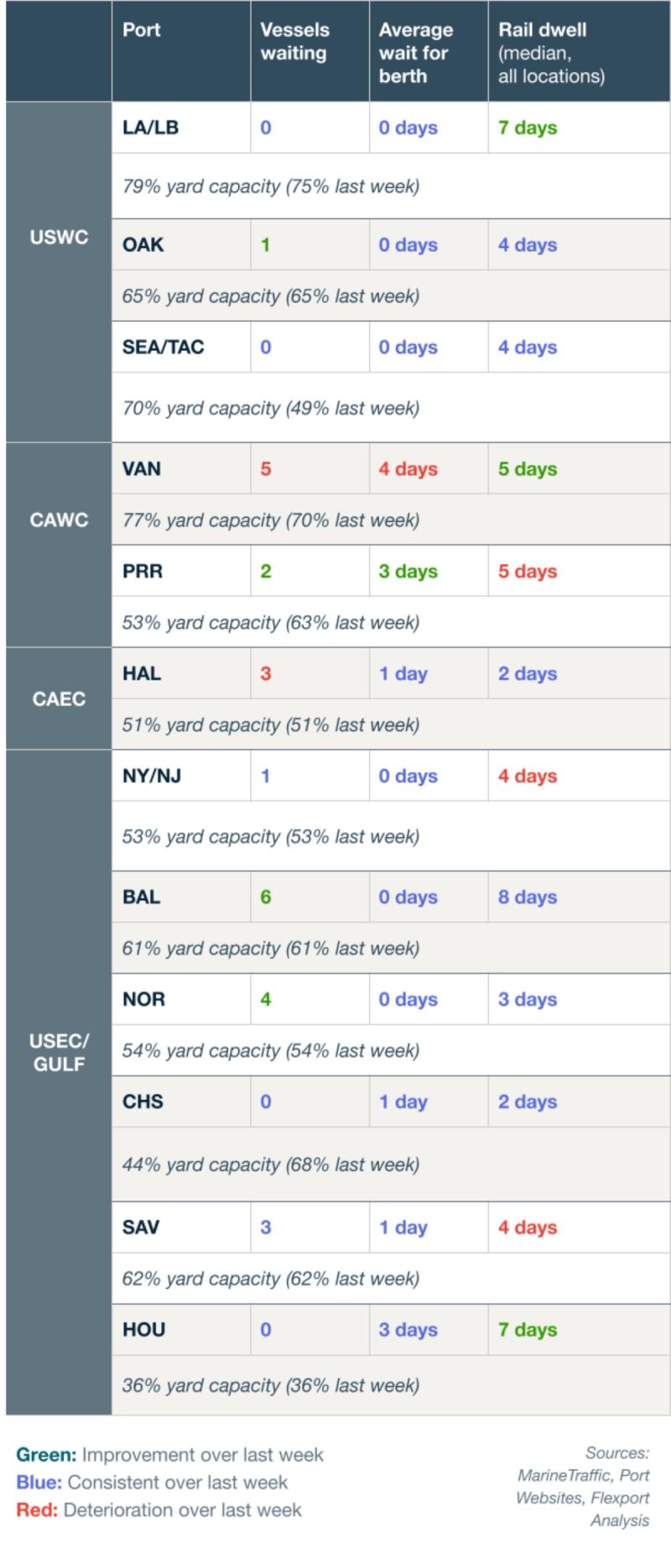
North America Vessel Dwell Times
Webinars
North America Freight Market Update Live
Thursday, September 10 @ 9:00 am PT /12:00 pm ET
Tariff Trends 2026: Expert Insights on the Evolving U.S. Tariff Landscape
Available On-Demand
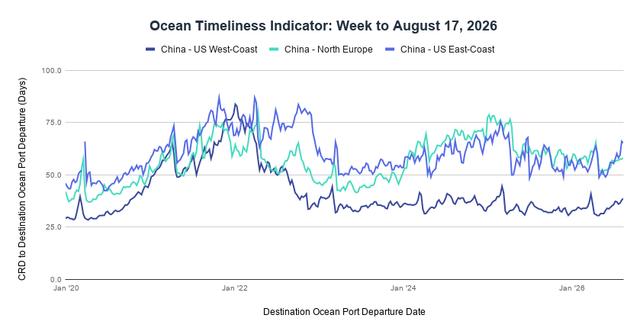
Ocean Timeliness Indicator
Transit time increased from China to the U.S. West Coast, decreased from China to the U.S. East Coast, and increased from China to North Europe.
Week to August 17, 2026
Transit time increased from 37.9 days to 38.7 days from China to the U.S. West Coast; decreased from 66.1 days to 65.3 days from China to the U.S. East Coast; and increased from 57.6 days to 58 days from China to North Europe.
See the full report and read about our methodology in the Flexport Ocean Timeliness Indicator.