
Trends to Watch
Talking Tariffs
- CAPE Refund Timeline Clarified, But Finally Liquidated Entries Face Extended Wait: A June 9 Court of International Trade (CIT) hearing provided the clearest picture yet of how the Consolidated Administration and Processing of Entries (CAPE) refund process will unfold, while underscoring that importers with finally liquidated entries face a path measured in months at best.
- CAPE Phase 2, scoped specifically to reconciliation entries (a narrower category than many importers anticipated), is on track to launch June 29. Phase 3, which would address finally liquidated entries (those more than 90 days past liquidation), is in development with programming expected to be complete by late July.
- On May 29, the Department of Justice filed a notice of appeal at the U.S. Court of Appeals for the Federal Circuit challenging CIT's universal injunction, which had directed CBP to issue International Emergency Economic Powers Act (IEEPA) refunds broadly. The government's position is that CBP lacks authority to refund finally liquidated entries without an importer-specific court order.
- CBP confirmed it will continue processing CAPE refunds for unliquidated and non-final entries while the appeal is pending. The Federal Circuit's timeline to resolve the appeal is uncertain, with legal analysts estimating weeks to months.
- The government also argued at the June 9 hearing that Phase 3 relief for finally liquidated entries may require individual importers to file suit at CIT before refunds can be processed, effectively restricting access to those who pursue litigation.
- If the Federal Circuit grants a stay or the government prevails on appeal, even the Phase 3 pathway could be delayed further. Judge Richard Eaton separately urged CBP to consider extending liquidation deadlines for entries that have continued to liquidate since the Supreme Court's IEEPA ruling.
- Recommendation: Importers with finally liquidated entries should not assume automatic relief through CAPE Phase 3. Evaluate whether filing suit at CIT is necessary to secure your position. Use the Flexport Tariff Refund Calculator to estimate your exposure, and consult Flexport's Trade Advisory team on protest filings and litigation strategy.
- USMCA Review Drags Toward July 1 Deadline With No Renewal in Sight: Trade experts now expect the USMCA review to extend well beyond its July 1, 2026 trigger date, with a Mexico deal potentially achievable by fall but a Canada resolution possibly slipping to July 1, 2027.
- At the first formal round in Mexico City, U.S. Trade Representative (USTR) negotiators shared draft text for the first time, including proposed rules of origin (ROO) changes covering automotive, electronics, and steel and aluminum. The U.S. is reported to be seeking 82% North American content in vehicles (up from 75%), plus a new 50% U.S.-specific content requirement.
- The next negotiating round with Mexico is expected to address agriculture, environment, and labor provisions.
- No formal negotiating process has been launched with Canada. Expert commentary suggests the administration is in no hurry to change that, preferring to finalize terms with Mexico first before pulling Canada back in, mirroring the sequencing used during the original NAFTA renegotiation.
- Canadian priorities include relief from the 50% steel and 25% aluminum tariffs, as well as the 25% auto tariffs, concessions experts do not expect to be offered until a deal is nearly closed.
- The broader ROO agenda extends beyond autos: the administration is pursuing stricter origin rules across strategic supply chains (semiconductors, electronics, and other sectors) to reduce or eliminate Chinese content qualifying for preferential treatment via third-country transformation.
- USMCA-qualifying goods remain carved out of the new Section 301 forced labor tariffs, which experts note signals the administration's reluctance to impose significantly heavier duties on Canadian and Mexican imports at this stage.
- Section 301 Excess Capacity Tariff Timeline Slips Past July 24: The July 24 deadline for country-specific reciprocal tariffs, including 20% on Vietnamese goods and 30% on South African goods, is unlikely to be met, given that USTR has indicated the Section 301 excess capacity report is still several weeks from completion.
- Standard procedure calls for roughly one month of public comment after the report's release, followed by an additional review period before tariffs are announced, making a July 24 implementation date effectively impossible.
- The existing 10% baseline tariff on some trading partners and 12.5% on most others provides a de facto floor that at least matches the 10% Section 122 tariffs expiring in late July, reducing the urgency of hitting a specific deadline.
- Trade experts broadly expect the excess capacity tariff process to conclude "over the summer," though the precise timing remains uncertain. The administration has signaled flexibility on the exact date.
- The legal foundation of the Section 301 forced labor report, which the excess capacity report will likely build on, is already being questioned by some trade attorneys, with the possibility of court challenges flagged as a meaningful risk. Opinions among experts are sharply divided on whether the report's analytical basis is strong enough to withstand judicial review.
Ocean
TRANS-PACIFIC EASTBOUND (TPEB)
- Capacity and Demand:
- Peak season is driving tight capacity management. Blank sailings are heavily concentrated, representing roughly half of all east-west cancellations over the next five weeks, though the broader east-west cancellation rate holds near 5% of total scheduled sailings.
- Space is largely committed across Pacific Southwest (PSW), Pacific Northwest (PNW), and U.S. East Coast (USEC) gateways, with some cargo rollings as booking windows shorten. Notably, the Panama Canal Authority has revised the Neopanamax Locks draft allowance down to 49.5 feet from 50 feet, effective July 1, a change that will further constrain East Coast loading capacity on Panama Canal strings.
- Shippers moved cargo earlier than usual this season. Anticipation of U.S. tariff adjustments in July, combined with incremental demand from the 2026 FIFA World Cup, pulled bookings forward and compressed lead times across all major gateways. June sailings are largely full on most services.
- Freight Rates:
- Rates are increasing. The Shanghai Containerized Freight Index (SCFI) climbed approximately 30% week over week on West Coast lanes and 20% on East Coast lanes during Week 23 (ending June 7), with other market indices pointing in the same direction. Effective June 1, carriers implemented a general rate increase across all gateways, alongside a Peak Season Surcharge (PSS) and an emergency bunker surcharge (EBS) adjustment. Forward data for Week 24 shows the SCFI adding a further approximately 10% on both coasts, indicating the June 1 actions are broadly holding.
- Recommendation:
- Book 3 to 4 weeks ahead. Shippers with time-sensitive cargo should consider premium service levels to protect space and minimize rolling risk.
FAR EAST WESTBOUND (FEWB)
- Capacity and Demand:
- Carriers continue to route cargo via the Cape of Good Hope rather than through the Suez Canal, driven by the ongoing Red Sea disruption from Houthi attacks. Cape of Good Hope routing extends voyage cycles and reduces the effective weekly capacity available to the market. A very small number of services have resumed Suez transits, but this remains the exception. Blank sailings on Asia-Europe and Mediterranean services account for approximately one-third of all scheduled cancellations across major east-west trades over the next five weeks.
- With peak season demand now in full swing, the supply-demand imbalance has become increasingly acute. Carriers are taking more bookings than they can load, and June vessels are effectively full. Rolling risk is elevated and rising. Equipment shortages are beginning to surface at major China origin ports.
- Demand is running well ahead of where it normally sits at this point in the year. Asia-to-Europe volumes were up approximately 15% year over year in the first quarter of 2026, and that momentum has carried into June. The combination of Red Sea disruption, an early start to the summer restocking cycle, and shippers front-loading ahead of July rate increases has compressed the booking window significantly. The market is firmly in the early peak season.
- Freight Rates:
- Rates are rising. The Shanghai Containerized Freight Index (SCFI) has now recovered for six consecutive weeks, though the pace of increase is moderating: Week 23 saw a single-week jump of +$570 on Northern European lanes, while Week 24 added a further +$130. Mediterranean lanes rose approximately 20% in Week 23, with forward data suggesting rates are essentially flat in Week 24, an early indication that Mediterranean rates may be stabilizing near current levels. Other market indices confirm the same direction. Carriers have filed additional surcharge actions on Asia-Europe services effective mid-June. The rate environment is firmly in carriers' favor. With July Bunker Adjustment Factor (BAF) resets and ongoing capacity discipline, rates are expected to remain elevated.
- Recommendation:
- Book 4 to 5 weeks ahead. Build extra lead time into any time-sensitive shipments and consider upgrading to a premium service level.
TRANS-ATLANTIC WESTBOUND (TAWB)
- Supply / Capacity:
- Space from Northern Europe tightened in recent weeks. Certain services are fully committed on U.S. West Coast gateways through early July, with U.S. East Coast availability opening only in the latter part of June on some strings. Cargo from some Northern European origins is being redirected to alternative services as a result. Mediterranean sub-lanes, including Italy, Spain, and Turkey, show somewhat more flexibility than Northern European ports.
- Demand:
- Demand is steady. Seasonal patterns are holding without notable acceleration beyond typical pre-summer levels. The new U.S. customs enforcement restrictions on Foreign Importers of Record may affect demand structure on this trade if shippers shift from Delivered Duty Paid (DDP) to Free On Board (FOB) terms, altering booking responsibilities and timing over the coming months.
- Rate Developments:
- Rates were broadly stable in June, with carriers rolling over May levels across all corridors: Northern Europe, West Mediterranean, and East Mediterranean to the U.S. East Coast and Gulf. CMA CGM announced a Peak Season Surcharge (PSS) from Northern Europe effective mid-June. MSC also announced a PSS from the East Mediterranean to the U.S. East Coast for the same period, though application is not yet confirmed. Looking ahead, most carriers are expected to attempt PSS implementations across all corridors in July.
- Equipment:
- Critical container and chassis shortages persist across Germany, Benelux, Austria, Hungary, and Slovakia into Week 25, with conditions amplified by ongoing German rail disruption adding 2 to 5 days to inland transit times.
- Recommendation:
- Book 3 to 4 weeks in advance, especially for inland origins and Mediterranean ports, to secure space and equipment and avoid rollings.
INDIAN SUBCONTINENT TO NORTH AMERICA
- Capacity and Demand:
- The Indian subcontinent to North America trade operates against the backdrop of the Strait of Hormuz closure, now in its fourth month. The broader regional disruption has created equipment availability pressures at some origin ports, as vessel cycles in the Middle East remain disrupted. Carriers adjusted surcharge structures effective June 1 to reflect higher regional operating costs.
- Demand is increasing, tracking with the broader peak season pattern across Asia-origin trades. A Peak Season Surcharge (PSS) took effect June 1 on Indian subcontinent to West Coast services, consistent with seasonal norms and aligned with surcharge actions across the Trans-Pacific trade on the same date. A PSS on the U.S. West Coast is expected to carry over into the second half of June with potential of a future PSS on EC lanes.
- Freight Rates:
- Rates are rising. A PSS and an emergency bunker surcharge (EBS) adjustment both took effect June 1, increasing the total cost of shipment from subcontinent origins. Rate direction aligns with the broader upward trend across Asia-origin trades. Rates to the West Coast have risen faster on the heels of the early Trans-Pacific Eastbound (TPEB) peak season, with East Coast rates expected to follow.
- Recommendation:
- Account for June 1 surcharge changes in your cost planning. Book ahead and confirm equipment availability, particularly on lanes touching Middle East Gulf ports where the Strait of Hormuz closure continues to create operational uncertainty.
Air
- Find the latest updates on global air freight operations on our Middle East escalation blog.
- North China:
- Rates on U.S. West Coast lanes rose week over week, driven by a surge in project cargo volumes and cargo from other Asia-Pacific origins routing through PVG as a connecting hub.
- East Coast rates held at elevated levels, with demand steady and no near-term capacity additions in sight.
- Europe-bound rates remained stable, continuing at levels set in recent weeks.
- Shippers are advised to book at least 5 to 7 days in advance for both Trans-Pacific and Europe-bound lanes.
- South China:
- Rates rose week over week on both U.S. West Coast and East Coast lanes, driven by a backlog from major tech shippers, continued ecommerce volumes, and FIFA World Cup pre-tournament cargo flows.
- Despite a fuel surcharge reduction, the floating market rate increased, keeping all-in rates in line with late-May levels.
- Europe-bound rates ticked up as maritime disruptions pushed a portion of ocean freight to air.
- Space is tight. Shippers are advised to book at least 5 to 7 days in advance.
- Taiwan:
- Rates and demand are tracking close to last week's levels, holding at the high end of the current range.
- Last-minute bookings face longer transit times due to constrained space at origin.
- Shippers are advised to book at least 5 to 7 days in advance.
- Vietnam:
- Demand continued to rise on both Trans-Pacific and Europe-bound lanes through early June.
- Some carriers were fully booked out of origin through June 13, with hub connections running tight at intermediate stops.
- U.S.-bound rates increased week over week; Europe-bound rates held steady.
- Shippers are advised to book at least 5 to 7 days in advance.
- Cambodia:
- Rates climbed week over week as demand picked up from late-May levels. Carrier hubs are experiencing tight flight connections.
- Shippers are advised to book at least 5 working days in advance.
- Korea:
- Demand picked up week over week after recent softening. Space tightened as a result.
- Shippers are advised to book at least 4 to 6 working days in advance.
- Malaysia:
- Post-holiday demand surged across U.S. air freight lanes, tightening capacity on Trans-Pacific routes.
- Rates are holding steady for now, with conditions expected to tighten further in the coming days.
- Shippers are advised to book at least 5 to 7 days in advance.
- Thailand:
- Capacity is at full stretch out of Bangkok, with both cargo terminals congested and several carriers suspending new booking acceptance this week to work through existing backlogs.
- Demand is driven by large tech and ecommerce accounts. Rates remain at the high end of the current range.
- Shippers are advised to book at least 7 to 10 days in advance.
- Indonesia:
- Export activity picked up, driven partly by a weakening Indonesian rupiah against the U.S. dollar, which has improved the price competitiveness of Indonesian goods relative to other Southeast Asian origins.
- Space availability is stable for cargo confirmed well in advance.
- India:
- Rates edged slightly lower compared to recent weeks. Capacity at origin improved.
- Transit times remain at 6 to 8 days for both Americas and Europe, Middle East, and Africa lanes.
- Shippers are advised to book at least 5 to 7 days in advance.
- Broader Indian Subcontinent (Bangladesh, Sri Lanka, Pakistan):
- Rates and space remain volatile.
- Route urgent shipments as express to secure space on Americas and Europe, Middle East, and Africa lanes.
- Shippers are advised to book at least 5 to 7 days in advance.
- Transatlantic (Europe to U.S.):
- Air Canada Cargo announced a fuel surcharge update effective June 15, the latest in a series of carrier surcharge adjustments as jet fuel costs continue to move.
- Summer passenger belly capacity from European hubs is putting downward pressure on all-in rates compared to the same period last year.
- No capacity disruptions were reported at CDG, FRA, or LHR heading into the week of June 9.
- U.S. Exports:
- SWISS WorldCargo announced a reduction in its U.S.-origin air freight surcharge effective June 22, continuing a pattern of surcharge normalization on U.S. export lanes as jet fuel costs ease from recent peaks.
(Source: Flexport)
Please reach out to your account representative for details on any impacts on your shipments.
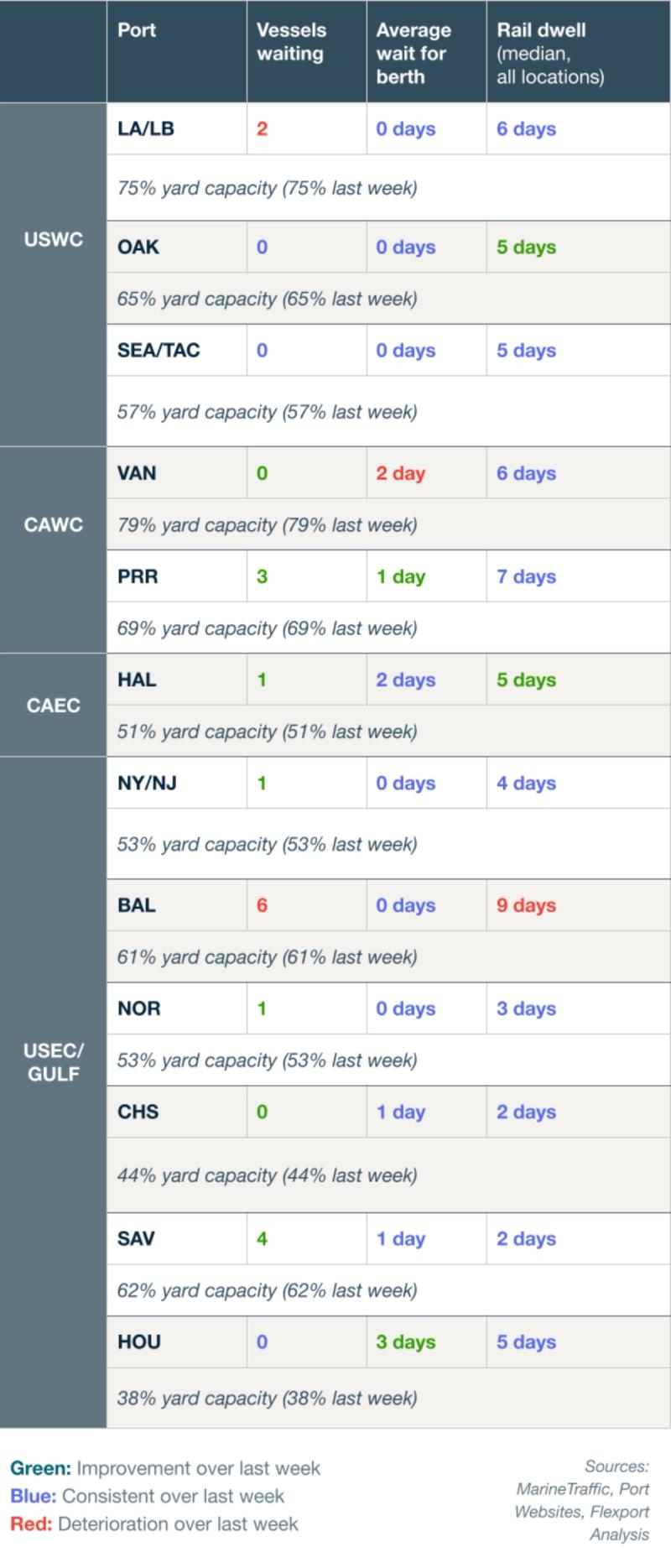
North America Vessel Dwell Times
Webinars
North America Freight Market Update Live
Thursday, June 18 @ 9:00 am PT / 12:00 pm ET
Tariff Trends 2026: Expert Insights on the Evolving U.S. Tariff Landscape
Wednesday, June 17 @ 9:00 am PT / 12:00 pm ET
CAPE Explained: Refunds, Common Issues & Next Steps for Importers
Available On-Demand
Flexport Customs Webinar: CPSC eFiling Is Almost Here. Are You Ready?
Available On-Demand
Breaking Down Trump's Executive Order on Foreign Importers of Record
Available On-Demand
Ocean Timeliness Indicator
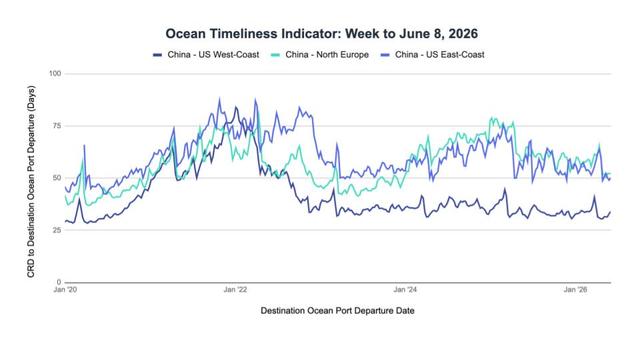
Transit time increased from 33 days to 34 days from China to the U.S. West Coast; increased from 49 days to 50 days from China to the U.S. East Coast; and remained flat at 52 days from China to North Europe.
Week to June 8, 2026
Transit time increased from 33 days to 34 days from China to the U.S. West Coast; increased from 49 days to 50 days from China to the U.S. East Coast; and remained flat at 52 days from China to North Europe.
See the full report and read about our methodology here.