Talking Tariffs
New Section 232 Minimum-Price Tariffs on Polysilicon Take Effect Dec. 4:
The White House issued a presidential action setting Section 232 tariffs on polysilicon and its derivatives, effective Dec. 4. Rather than a flat rate, the mechanism sets minimum import prices (MIPs) and charges duty on the gap whenever a shipment sells below the floor.
- The floors are $21 per kilogram for raw silicon, $100 per kilogram for wafers and ingots, $0.22 per watt for solar cells, and $0.38 per watt for solar modules.
- Importers can avoid the gap duty by certifying they won't resell below the MIP domestically, that the product will ultimately sell above the floor, or that they're locked into an existing sales contract, each backed by an affidavit and reviewed case-by-case.
- On top of any MIP-related duty, Japan, the EU, South Korea, Taiwan, China, and Liechtenstein face a capped 15% rate, the United Kingdom gets an additional 10%, and every other country faces an additional 15%.
- These changes are already live in the Flexport Tariff Simulator, so importers of solar and silicon products can start modeling exposure well ahead of the December effective date.
Senate Passes Bill Allowing 100% Tariffs on Russian Oil Buyers, House Vote Pending:
After an earlier holdup over its tariff provisions, the Senate passed legislation letting the president impose tariffs of up to 100% on countries buying Russian oil and natural gas, stacking on top of existing Section 301 and Section 232 duties. The House still needs to act when it returns from recess Aug. 31.
- This means major buyers of Russian energy (including India, China, Turkey, and the EU) could face these additional tariffs of up to 100% for their energy purchases.
- The last time this kind of authority saw use under the International Emergency Economic Powers Act (IEEPA), it targeted India alone. This version could reach China as well, so businesses with exposure to either country should start thinking through the impact now rather than waiting for the House vote.
Government Objects to Blanket IEEPA Refund Order, Lets Narrower Ones Stand:
The government argued this week that the Court of International Trade (CIT) went too far by ordering refunds of IEEPA duties to every affected importer with "finally liquidated" entries, not just those who sued. It won't challenge the narrower reliquidation orders that apply specifically to the importers who actually brought the case.
- The distinction matters. A blanket refund would have covered every IEEPA duty payer regardless of whether they filed suit, while the narrower orders only benefit the named plaintiffs.
- One open question the industry is watching: whether entries that have already finally liquidated could still become refund-eligible without a separate lawsuit. No formal guidance has addressed this yet.
- Importers who haven't filed their own IEEPA refund claim shouldn't assume this ruling covers them automatically. The Flexport Tariff Refund Calculator can help estimate what's at stake, and Flexport's blog has a deeper walkthrough of filing deadlines at the CIT.
CBP Adjusts User Fees for Inflation, Including a Higher Merchandise Processing Fee Cap:
CBP's annual inflation adjustment to various non-tariff customs fees takes effect Oct. 1.
- The Merchandise Processing Fee (MPF), which importers pay on nearly all entries, sees its minimum rise to $34.58 (from $33.58) and its maximum rise to $670.86 (from $651.50).
CBP System Updates: Two-Factor Authentication and Entry Type 13 Progress:
CBP rolled out two separate system changes this week.
- Automated Commercial Environment (ACE) users will need two-factor authentication (2FA) set up starting in September. The requirement covers brokers, importers, and filers alike, so accounts should be updated ahead of the rollout to avoid losing access.
- CBP also updated its draft Cargo Release Customs and Trade Automated Interface Requirements (CATAIR) and cargo release condition codes to reflect Entry Type 13, continuing the mail processing test it's been building out over recent weeks. Filers handling mail shipments should check the updated codes against their current setup.
CBP Adds Cultural Property Restrictions, Posts Routine Case Updates:
CBP added new import restrictions on select archaeological and ethnological material from Nepal, aimed at curbing illegal trade in cultural property.
Trans-Pacific Eastbound (TPEB)
Capacity and Demand:
- Carriers are deploying full capacity as the peak season continues. Last week's port closures in China due to Typhoon Dolphin are still adding near-term uncertainty, and some schedule adjustments are likely over the next couple of weeks as carriers work through the backlog. Additional extra loaders to the West Coast in late August and early September should help ease some backlog.
- Demand remains strong and stable, with high volume through all of August and early signs of strong volume extending into September.
- Panama Canal water levels are expected to drop again in September, and some carriers are raising Panama Canal surcharges in response. This will further constrain capacity to the East Coast and Gulf.
Freight Rates:
Rates eased through the second half of July, then turned higher again from August 1 and have continued climbing since. Asia-to-U.S. East Coast rates are now at their highest level this year, and West Coast rates have also risen sharply.
Recommendation:
Shippers should build extra buffer into cargo-ready dates out of Shanghai and Ningbo over the next couple of weeks and secure space early, given both the disruption and firm rates.
Far East Westbound (FEWB)
Capacity and Demand:
- Carriers are currently deploying full capacity to support demand, which has remained remarkably steady on this lane. However, last week's major China port closures driven by Typhoon Dolphin have significantly disrupted origin schedules, and further vessel and sailing adjustments are likely in the coming weeks as terminals work to clear the resulting yard congestion and cargo backlogs.
- Meanwhile in Europe, severe drought has pushed the Rhine River to record-low water levels, limiting barge navigation through critical bottlenecks like the Kaub. Inland vessels are operating at a fraction of their normal payloads, triggering low-water surcharges and pushing container volumes onto already strained road and rail networks.
Freight Rates:
Despite these operational bottlenecks and the ongoing Cape diversions keeping effective supply tight, the pricing environment is beginning to stabilize. Spot rates remain historically elevated across the board but are easing gradually, signaling a slow descent from the intense early-summer peak.
Recommendation:
Maintain a 3–4 week booking lead time to navigate origin schedule disruptions and arrange alternative European inland transport (rail/road) to bypass severe Rhine barge delays. While spot rates are gradually easing, secure space proactively as dual-ended operational bottlenecks will keep effective capacity tight in the near term.
Trans-Atlantic Westbound (TAWB)
Capacity and Demand:
Vessel utilization remains highly elevated at 93%+ across NEUR and WMED origins. Carriers are managing capacity closely on this lane through the seasonally slower summer period: blank sailing activity jumped to about 12.7% of scheduled capacity from 0% the week before, and forward data point to continued reductions near 10.5% next week, as carriers scale back sailings to match softer demand from European factory closures rather than let rates slide.
Freight Rates:
Rates have flattened amid soft demand and ample available capacity on this corridor. Even though demand is not strong, the capacity cut by one of the carriers balanced capacity and demand. All carriers took the opportunity to apply PSSs in mid-August.
Recommendation:
Shippers with time-sensitive cargo should still confirm bookings early, since fewer sailings are running even as overall demand stays soft.
Equipment:
Critical container/chassis shortages persist across TAWB origins (Germany, Benelux, Austria, Hungary, Slovakia) into week 33.
Port Situation:
NEUR ports remain congested — Antwerp/Zeebrugge yard utilization 75–90% with berth delays exceeding 3 days, Rotterdam yard utilization 85–92% with barge waits of 90–96 hours, Bremerhaven and Hamburg running 89–93% yard utilization with 1–3 day berth delays; South Europe also under pressure, with Genoa berth delays of 3–4 days and Valencia absorbing diverted volumes. Selective blanks are projected to spike into week 33 (17% cancellation), global reliability sits at ~63%, and bookings should be made 3–4 weeks ahead.
Indian Subcontinent to North America (ISC)
Capacity and Demand:
- Available capacity from ISC to USEC remains tight as healthy peak season demand levels continue with no increases in capacity on the supply side.
- Capacity remains constrained to USWC as TPEB peak season continues, and ISC cargo to WC relies on those same major service strings.
- Demand continues to outpace available supply on the major India-to-U.S. corridors; published trade reporting ties part of the pressure to an ongoing trailer and driver shortage limiting container evacuation at Nhava Sheva, India's largest container port, near Mumbai, on top of already-tight vessel capacity.
Freight Rates:
Rates on the India to U.S. East Coast corridor have continued climbing, with published third-party data putting the increase at its highest level in more than 2 years.
Recommendation:
Shippers on this corridor should secure space early, build in extra transit buffer for delays at Nhava Sheva and other origin ports, and confirm with carriers whether services are being rerouted through transshipment points.
Air
North China (PVG/PEK):
- Typhoon Dolphin grounded and delayed flights out of Shanghai Pudong over the weekend, cutting available lift across all Trans-Pacific Eastbound (TPEB) lanes regardless of gateway carrier.
- Rates are rising this week as space tightens, and carriers expect the backlog to clear over the next several days.
- Far East Westbound (FEWB) demand held steady, but the same capacity squeeze is limiting space on Europe-bound flights too.
South China (HKG/SZX/CAN):
- TPEB demand eased slightly, but spot rates held firm as typhoon-related payload restrictions limited available space; ecommerce shippers booked little space this week.
- FEWB demand keeps softening, with rates trending down and space readily available.
Taiwan (TPE):
- U.S.-bound demand held steady from the prior week.
- Carriers announced a new fuel surcharge increase effective August 16, adding cost pressure.
- Book 5 to 7 days ahead for the best space on U.S. routes; EU demand remains slack.
Vietnam (SGN/HAN):
- TPEB demand stayed weak for a second straight week, with several key shippers cutting volumes roughly in half; rates ticked up slightly on rising fuel surcharge costs even as space remains available.
- FEWB demand keeps softening, with rates low and space open.
Cambodia (PNH):
- Demand remains elevated and space stays congested, with rates higher than most other Southeast Asia origins.
- Book at least 7 days ahead to secure space on TPEB and FEWB routes.
Korea (ICN):
- TPEB demand rose from the prior week and space is heavily congested; earliest available capacity looks to be late next week or the following week.
- Direct flights have more open space than transshipment options.
Malaysia (KUL):
- Outbound demand ticked up, tightening capacity across TPEB lanes.
- Adding to the squeeze: a regional typhoon is disrupting one carrier's schedules, and a volcanic eruption in Russia's Far East is forcing another onto longer routings.
- Rates are holding for now but carry upside risk; book 7 to 10 days ahead of your target departure.
Thailand (BKK):
- Demand is easing slightly this week, and ad hoc capacity is available at negotiable, stable rates.
- A public holiday on August 12 may affect near-term schedules; book 5 to 7 days ahead.
Indonesia (CGK):
- Peak season has arrived with uneven space; TPEB capacity is tight and rates are ticking up, with some carriers routing through alternate, less congested airports and adding transit time.
- FEWB space is holding relatively steady, but flights to Frankfurt and Amsterdam are starting to fill up.
- Book 7 to 10 days ahead of your cargo-ready date.
India (BOM/DEL/MAA/BLR):
- Demand remains elevated as shippers keep shifting cargo from ocean to air to bypass maritime bottlenecks; India-to-U.S. capacity is constrained.
- Book at least 1 week in advance.
Broader Indian subcontinent (Bangladesh, Sri Lanka, Pakistan):
- Sri Lanka: Schedules are running on time and fuel surcharges are easing, though space is tight on rising perishable volumes.
- Bangladesh: EU-lane schedules are reliable, but U.S.-lane space remains tight.
- Pakistan: Schedules are reliable, but rates are elevated and carrier quotes are valid for only 1 to 2 days.
Transatlantic (Europe to U.S.):
- Falling China-to-Europe rates — now down for a sixth straight week as post-July 1 EU import rule changes cool ecommerce volumes — are taking pressure off European gateways.
- Carriers are shifting freighter capacity toward AI-hardware and data center demand on other lanes — a trend worth watching for its knock-on effect on transatlantic lift at hubs like Paris and Amsterdam.
(Source: Flexport)
Please reach out to your account representative for details on any impacts on your shipments.
North America Vessel Dwell Times
Region | Port | Vessels waiting | Avg. wait for berth | Rail dwell (median, all locations) | Yard capacity (last week) |
|---|---|---|---|---|---|
USWC | LA/LB | 0 | 0 days | 8 days | 79% (75% last week) |
USWC | OAK | 3 | 0 days | 4 days | 65% (65% last week) |
USWC | SEA/TAC | 0 | 0 days | 4 days | 49% (49% last week) |
CAWC | VAN | 3 | 3 days | 6 days | 70% (70% last week) |
CAWC | PRR | 4 | 9 days | 4 days | 63% (63% last week) |
CAEC | HAL | 1 | 1 day | 2 days | 51% (51% last week) |
USEC/Gulf | NY/NJ | 1 | 0 days | 3 days | 53% (53% last week) |
USEC/Gulf | BAL | 7 | 0 days | 8 days | 61% (61% last week) |
USEC/Gulf | NOR | 6 | 0 days | 3 days | 54% (53% last week) |
USEC/Gulf | CHS | 0 | 1 day | 2 days | 68% (44% last week) |
USEC/Gulf | SAV | 3 | 1 day | 3 days | 62% (62% last week) |
USEC/Gulf | HOU | 0 | 3 days | 8 days | 36% (45% last week) |
Yard capacity shown as this week (last week). Sources: MarineTraffic, Port Websites, Flexport Analysis.
Ocean Timeliness Indicator
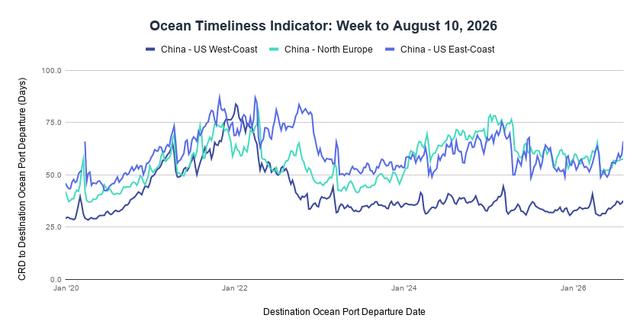
Transit time increased from China to the U.S. West Coast, increased from China to the U.S. East Coast, and remained constant from China to North Europe.
Week to August 10, 2026
Transit time increased from 36.5 days to 37.6 days from China to the U.S. West Coast; increased from 59.5 days to 66.1 days from China to the U.S. East Coast; and remained flat at 57.6 days from China to North Europe.
See the full report and read about our methodology in the Flexport Ocean Timeliness Indicator.