
Welcome to our running blog, your dedicated resource for clear, actionable, and timely updates on European Union and United Kingdom customs, tariffs, and trade policies.
Global supply chains are navigating intense waves of modernization, tighter origin controls, and landmark free trade agreements. Our goal is to strip away the dense legal jargon of customs legislation and deliver the practical insights your business needs to maintain compliance, avoid costly border delays, and optimize tariff exposure.
Whether you are managing complex manufacturing inputs or sourcing consumer retail goods, you will find breakdown guides of critical shifts here. Bookmark this page and subscribe to updates to ensure your logistics and compliance teams never miss a critical customs deadline.
Update: September 21 - EU Customs Code Reform.
On September 16, 2026, the European Parliament gave its final approval to the reform of the Union Customs Code (UCC), and the EU published the reform in its Official Journal on September 19. The reform replaces national customs systems with a single EU Customs Data Hub, establishes a new EU Customs Authority in Lille, France, and introduces a "Trust & Check" status for the most compliant traders, sitting alongside the existing Authorised Economic Operator (AEO) framework.
It applies from September 21, 2027 and phases in over the following years, with the Data Hub becoming mandatory for e-commerce from July 1, 2028 and for all operators by March 1, 2034. Importers, non-EU companies acting as indirect representatives, and e-commerce platforms all take on new or clarified obligations under the reform.
Read more on the EU Customs Reform here
Update: September 1 - The CPTPP Just Went Live Between the UK and Canada.
On 1 September 2026, the UK's accession to the CPTPP (Comprehensive and Progressive Agreement for Trans-Pacific Partnership) entered into force with Canada, the last of the bloc's 11 original members to ratify, closing a gap that had lingered since the UK became a full CPTPP member in December 2024.
The bloc now represents £12.9 trillion in combined GDP, and more than 99% of UK goods exports to member countries qualify for zero tariffs. If you trade with Canada, a second agreement now sits alongside the UK-Canada Trade Continuity Agreement (TCA), with new duty-free access on a handful of products and a choice to make on every shipment about which deal actually saves you more.
Which products are covered?
Most goods moving between the UK and Canada were already duty-free under the TCA. CPTPP adds real new access on top, including a few categories the TCA never touched:
- Sweetcorn gets immediate duty-free, quota-free access, something the TCA never offered.
- Beef and veal pick up a new UK-specific duty-free quota, on top of what the TCA already allows.
- Pork gets an additional duty-free tariff-rate quota volume.
- Dairy, poultry and eggs gain access to Canada's existing CPTPP quotas.
- Most other goods already clear at zero tariff, and CPTPP locks that in. Across the whole bloc, more than 99% of goods trade qualifies for zero tariffs.
Beef, pork, dairy, poultry and eggs still carry tariff-rate quota caps, so it's worth knowing exactly where your volumes land. Ship above the quota and you're back to the standard Most Favoured Nation rate. Within it, this is real money back in your margin.
How to claim the preference
None of these duty breaks apply automatically. Your goods must meet one of the CPTPP's Product-Specific Rules (PSRs):
- Wholly obtained. Produced or extracted entirely in a CPTPP country.
- Change in tariff classification. Materials from outside the bloc need to shift HS (Harmonised System) chapter, heading or subheading through processing before you export the finished product.
- Regional value content. Originating materials and processing meet the required percentage threshold.
- Specific process. Production follows the process defined for that HS code in Annex 3-D.
- Cumulation. Materials from any of the 11 ratified CPTPP members count toward your qualifying content, so a supply chain spanning the bloc doesn't automatically fail.
One more rule: goods must reach the UK without operations outside CPTPP territory, beyond transit handling under customs control.
Once you know which test your product meets, proving it is refreshingly simple. CPTPP runs on self-certification: the importer, exporter or producer can complete the Certification of Origin directly, with no government-issued paperwork required, as long as it covers the minimum data elements in Annex 3-B. Under UK rules, that certification stays valid for two years, and shipments under £1,000 don't need one at all.
Two agreements, your choice
The TCA hasn't gone away. It sits alongside CPTPP, and you're free to use whichever suits a given shipment:
- Stick with the TCA when your existing documentation already qualifies and re-certifying wouldn't change the rate you pay.
- Reach for CPTPP when your product is on the benefits list above, or when your supply chain draws on inputs from other CPTPP members. CPTPP counts originating content from any of its 11 ratified members toward your UK or Canadian total, while the TCA only recognises UK and Canadian inputs.
That difference in cumulation alone can decide which agreement gets you a better rate on a given commodity code.
What importers should do now
It all starts with the HS code. Get it wrong, and a preference claim you've already banked on can unravel, sometimes months after the goods have cleared.
- Confirm the HS code for your goods. It determines your tariff rate, your rules of origin and which agreement applies.
- Revisit your existing codes. A bad classification made months ago can still resurface as a recovery notice.
- Check whether CPTPP or the TCA fits your shipment. Compare the two before you file, since the better rate depends on the product and your supply chain.
- Get your paperwork in order. Certification, cumulation and the direct transport rule all have to hold up before you claim a rate.
If you're shipping from Canada, it's worth doing this review before your next container leaves port. Get in touch with a Flexport customs expert if you need a hand.
Update: July 24 - EU Packaging and Packaging Waste Regulation.
On August 12, 2026, the EU's Packaging and Packaging Waste Regulation (PPWR), Regulation (EU) 2025/40, becomes directly applicable across the bloc. The regulation brings new packaging design, labelling, and documentation obligations into force for anyone placing packaging on the EU market. It entered into force on 11 February 2025, replacing the previous Packaging and Packaging Waste Directive, and its longer-term goals include making virtually all EU packaging recyclable by 2030 and cutting overall packaging waste by 15% by 2040. Several obligations become enforceable well before those dates, starting with the 12 August application date.
What changes for reusable packaging already on the market?
Article 11 of the regulation sets reuse criteria for packaging, and these have technically applied since the regulation's 11 February 2025 entry into force.
- Reusable packaging placed on the EU market before 11 February 2025 doesn't need to be brought into compliance retroactively.
- Reusable packaging placed on the market after that date must comply with Article 11, but competent authorities can only start checking compliance from 12 August 2026 onward.
What's the Declaration of Conformity requirement?
One of the biggest changes taking effect on 12 August is the requirement for a Declaration of Conformity (DoC) to be issued per packaging type, and retained and made available to customs if requested. This will be required for all imports, thereafter the 12th August, 2026.
What's the labelling requirement hiding in plain sight?
Most attention on PPWR labelling has gone to the harmonised pictogram system, which isn't due until 2028. A separate set of identification requirements sits in Article 15, covering manufacturer obligations, with mirror provisions for importers elsewhere in the regulation.
- Manufacturers must ensure packaging carries a type, batch, or serial number for identification, or include that information in accompanying documentation where the packaging itself is too small.
- Manufacturers must also display their name, registered trade name, and postal address on the packaging, either directly or via a QR code, with a single point of contact.
- Importers face a mirror obligation under Article 18: their trade name and postal address must appear on the packaging.
The regulation's definition of "manufacturer" may not match how you've defined that role elsewhere in your supply chain. Confirm who holds this responsibility under PPWR specifically, rather than assuming your existing definition carries over.
Key dates
- 11 February 2025: PPWR entered into force.
- 12 August 2026: Enforcement begins for labelling, Declarations of Conformity, substance limits, and Extended Producer Responsibility (EPR) obligations.
- 2028: Pictogram recycling label requirement takes effect.
- 2030: All packaging placed on the EU market must be designed for recyclability.
- 2040: Target of a 15% reduction in total EU packaging waste.
What should importers do before August 12?
- Test food-contact packaging for per- and polyfluoroalkyl substances (PFAS) and heavy metals now. These substance limits apply from day one, with no grace period, so this should be the top priority for anyone importing food-contact packaging.
- Add batch or serial traceability and manufacturer identification to packaging, per the Article 15 requirements above.
- Issue or collect Declarations of Conformity for each packaging type. Manufacturers, or the brand whose name appears on the pack, need to draft the DoC and build the supporting Annex VII technical file. Importers should be chasing suppliers for theirs now, since a missing DoC can hold up goods at the border.
- Register for Extended Producer Responsibility where required. You may need to register per country if you haven't already. Some countries run their own EPR systems, and the registration process, including whether an authorised representative is needed for businesses not established in the EU, varies by country.
If you import packaged goods into the EU, or manufacture packaging that others import, now's the time to confirm where these obligations apply to you. Get in touch with a Flexport customs expert to talk through what August 12 means for your supply chain.
Update: July 20 - Navigating the EU Digital Product Passport: Guidance for Importers Following the Registry Launch
On July 20, 2026, the European Commission's central Digital Product Passport (DPP) Registry went live following the adoption of its implementing regulation. The launch is an infrastructure milestone, not a blanket compliance deadline: product-specific obligations will phase in gradually, starting with certain battery types, as the EU finalizes delegated acts for each sector.
The DPP is the technical backbone of the Ecodesign for Sustainable Products Regulation (ESPR), which entered into force in July 2024. Under ESPR, products sold in the EU are increasingly designed for longevity, repairability, and recyclability, and the DPP supports that shift with a standardized digital record of a product's sustainability and compliance information.
Here's what importers need to know to prepare.
What is the Digital Product Passport?
The DPP is a digital record linked to a physical product through a data carrier, such as a QR code, radio-frequency identification (RFID) tag, or near-field communication (NFC) tag. It holds verifiable data on a product's sustainability, circularity, and compliance across its lifecycle.
- There's no single, universal DPP data set. Exact requirements are set product by product through delegated acts. ESPR establishes the broad categories importers should expect to track, including a product's safety, origin, materials, repairability, environmental performance, and reuse and recycling potential.
- The Commission has also published core technical standards covering unique identifiers, data carriers, APIs, data exchange protocols, and data storage, so DPP information can be created, shared, and accessed consistently across the EU. Businesses and software providers need to build these standards into their internal DPP processes and data systems.
What is the Central EU DPP Registry?
The EU DPP Registry is a centralized digital infrastructure operated by the European Commission under Article 13 of ESPR.
- It doesn't host your proprietary data. The registry works as a public index, not a data warehouse, so sensitive supply chain details, blueprints, and material compositions stay hosted on your own servers or with a third-party provider.
- Instead, it holds a “proof of registration” linking a product's unique identifier to its responsible economic operator.
- The Commission is also building a web portal with role-based access, giving consumers, economic operators, and authorities different views suited to their needs.
Which products require a DPP, and when?
The 20 July 2026 launch marks when the registry became operational, not the date your product requires a DPP. Your actual deadline depends on when the EU publishes the delegated act for your specific product group. Batteries are first, with construction products, iron and steel, textiles, and other categories following in phases:
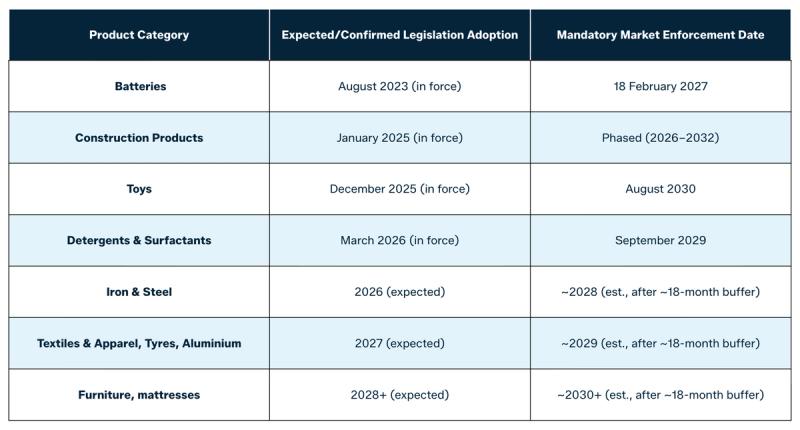
What this means for manufacturers, importers, and other stakeholders
- Manufacturers and supply chain vendors are directly responsible for compiling, validating, and sharing DPP data. That means updating internal data management, tracking materials from raw sourcing through end-of-life recycling, and sharing that information securely with partners.
- Retailers, importers, and wholesalers must confirm goods have a valid DPP before placing them on the EU market. Non-EU manufacturers will need to comply too if they want to sell into the EU.
- Consumers and professional buyers will be able to scan a product's QR code to see data on its expected lifespan, repairability, and materials.
- Regulators and customs authorities will have digital, instantly verifiable proof to check compliance with EU ecodesign and sustainability rules.
What importers should do now
- Track your product timeline. Watch the EU rollout schedule for your sector: delegated acts will apply to categories like steel, textiles, electronics, and furniture in phases.
- Align with your suppliers. Set clear data-sharing expectations for material composition, recycled content, and chemical compliance.
- Start gathering core product data. Build baseline records for material breakdowns, lifespan estimates, and sustainability attributes.
- Centralize your compliance records. Move from manual files to an organized digital workflow for product documentation.
- Evaluate your data carrier options. Work with production partners on physical labeling, such as QR codes or NFC tags, that stays legible for the product's full lifecycle.
Get ready before your sector's deadline lands
Get in touch with a Flexport customs expert to start preparing your supply chain and compliance data for the DPP rollout.
Update: July 15 - UK-India Trade Agreement.
As of Wednesday, June 17, the UK has announced that the new UK-India trade deal will officially start on July 15, 2026. This agreement will phase out or lower import duties on most Indian goods, including clothes, shoes, and seafood. To get these lower tax rates, importers must actively claim them on their customs forms and have signed declarations from their Indian suppliers proving where the goods were made. This is especially important for goods that recently lost their duty-free status under older trade schemes, as the new deal will restore those savings.
The UK-India Comprehensive Economic and Trade Agreement (CETA) enters into force on 15 July 2026, cutting tariffs on a wide range of Indian goods imported into the UK. The UK government has called it the country's largest bilateral trade deal since leaving the EU, projecting it will add £4.8 billion to GDP and increase bilateral trade by £25.5 billion a year in the long run.
What changes for UK importers sourcing from India?
- Clothing, footwear and textiles: significant tariff reductions for qualifying goods.
- Gems and jewellery: tariffs eliminated.
- Seafood: UK tariffs eliminated.
- Select food categories: duty reductions, though sugar, milled rice, pork, chicken and eggs stay excluded.
- Electric and hybrid vehicles (lower-end): duty-free from year six, within an annual quota.
Not all cuts land on day one. Many reductions are staged over up to 10 years, so importers need to check the UK's tariff schedule for their own commodity code rather than assume zero duty from 15 July.
The preference isn't automatic
Lower rates only apply if you claim them. Importers must declare the preference on their customs declaration and hold valid proof of origin at the time of import; without it, the standard UK Global Tariff applies. Goods also have to meet CETA's rules of origin: either wholly obtained in India, or sufficiently transformed there under product-specific rules that can require a change in tariff classification, a minimum share of qualifying value content, or a defined production process. Qualifying value content thresholds are typically 40% on an ex-works basis or 45% on a free-on-board basis, or 35% under an alternative build-up method. Materials that originate in the UK count toward Indian origin under the agreement's bilateral cumulation rules, and vice versa.
Accepted proof of origin is one of three documents: an Origin Declaration self-certified by the Indian exporter, a Certificate of Origin issued by a competent authority in India, or, in some cases, the importer's own supporting documentation. One declaration can cover multiple identical consignments over a 12-month period, and consignments worth £1,000 or less are exempt from the proof of origin requirement entirely.
Action required before 15 July: DCTS graduation
Since 1 January 2026, certain Indian goods, including textiles, made-up textiles, chemicals, and articles of iron, steel and precious metals, lost their preferential rates under the Developing Countries Trading Scheme (DCTS). That leaves a gap of roughly six and a half months where the standard tariff applies. If your goods were cleared under DCTS, you need to transition to CETA's proof of origin mechanism from 15 July to restore preferential access. Confirm with your Indian supplier which regime applied to your goods, and make sure CETA-compliant documentation is in place before your next shipment arrives.
What to do now
- Confirm which of your commodity codes qualify, and check the tariff schedule for the staging timetable that applies to them.
- Get an Origin Declaration or Certificate of Origin from your Indian supplier ahead of 15 July.
- If your goods were previously cleared under DCTS, line up CETA-compliant proof of origin before your next shipment.
- Keep proof of origin and supporting commercial documents on file. The agreement requires records to be retained for at least five years, and HMRC can audit claims after clearance.
HMRC and Indian customs authorities can both carry out post-clearance verification checks, and an incorrect preference claim can lead to a duty demand and penalties, so only claim preference once you hold valid origin documentation.
To claim preferential duty through Flexport, you'll need to provide your Origin Declaration or Certificate of Origin, a commercial invoice, your 10-digit commodity code, and consignment value. Flexport's classification and trade advisory teams can review your codes ahead of 15 July. Contact your Flexport team.
Update: June 30 - EU & UK Steel Import Rules.
New steel trade measures took effect in both the EU and the UK on July 1, 2026, replacing the safeguard measures that had been in place since 2018. Both regimes work the same way: a set volume of tariff-free imports, and a duty on anything above it.
What changed under the EU's new Steel Regulation?
Regulation (EU) 2026/1384, adopted on 17 June 2026, entered into force on 25 June, and took effect 1 July. It replaces the EU's steel safeguard with a permanent framework.
- Annual tariff-free quota: 18.3 million tonnes, covering 26 steel product categories.
- Out-of-quota duty: 50%, once a category's quota is used up.
- New traceability requirement: importers must document the country where the steel was “melted and poured,” not just where it was last processed.
- Scope: all countries of origin except the European Economic Area (EEA). EEA imports skip the quota and duty but still need melt-and-pour documentation.
How is the 18.3 million tonne quota split up?
A separate Implementing Regulation (EU) 2026/1457, adopted 29 June, sets out how the quota is distributed among trading partners.
- Half of the annual quota is reserved exclusively for the EU's free trade agreement (FTA) partners.
- The other half is open to all origins, including FTA partners, on a non-discriminatory basis.
- Countries with a significant share of EU steel imports between 2022 and 2024 get a country-specific quota in that product category.
- Everyone else draws from a residual quota, split into a most-favoured-nation (MFN) portion and a separate FTA portion.
The European Commission says this split leaves FTA partners with a smaller reduction than the 47% average cut the regulation otherwise applies. Because the quota had to be distributed by 1 July, the Commission used an urgency procedure: the implementing regulation is valid for up to six months while it goes through the normal EU member state approval process before the end of 2026.
What's still undecided: the evidence for “melt and pour”.
The Steel Regulation requires melt-and-pour documentation, but the rules on what counts as acceptable evidence aren't final yet. The Commission opened a consultation on 4 June, running to 2 July, asking steel producers, traders, and importers what documentation should be required. The resulting Implementing Act is expected by 31 August 2026 and enters into force 1 October 2026. That leaves a gap where the underlying requirement exists from 1 July, but the exact proof standard is still being defined.
The UK is running a parallel measure
The UK's own steel trade measure also took effect 1 July 2026, replacing the UK's steel safeguard, which expired the day before along with its 25% additional safeguard duty.
- Tariff-free quota volumes are reduced 51% compared with the old safeguard.
- Imports above quota face a 50% tariff, matching the EU's rate.
- The UK government says it engaged closely with the EU while designing the measure, given how interconnected the two markets' steel supply chains are.
- Implementation detail, including a Ukraine exemption, quota administration, and how the measure interacts with the UK's Carbon Border Adjustment Mechanism (CBAM), was updated as recently as 2 July.
What importers should do now:
- Confirm which of the 26 covered product categories your steel imports fall under, and whether your commodity codes changed under the new categorisation.
- Check whether your country of origin has a country-specific quota or draws from the residual MFN or FTA pool.
- If you import into the EU, watch the melt-and-pour consultation outcome before finalising your documentation process.
- If you import into the UK, review the 2 July implementation notice for transitional exemptions and quota administration detail relevant to your goods.
Flexport's Trade Advisory and Customs Brokerage teams can help confirm which quota category and rate applies to your steel imports across both markets. Get in touch with a Flexport customs expert.
Update: June 30 - US-EU Trade Agreement.
As of Tuesday, June 30, the EU has finalized the rules to launch the landmark US-EU Trade Agreement, July 1. This agreement eliminates EU import duties on most US-made industrial goods and opens 20 new duty-free quotas for agricultural and seafood imports.Read more on the US-EU Trade Agreement here