European Freight Market Update Live
Watch the on-demand recording of the European Freight Market Update Live from 10 November: peak season air and ocean capacity, the Suez arrivals wave, EUDR readiness and Flexport's new AI classification tool.
Couldn't load video
European Freight Market Update Live
The below transcript has been generated by an AI system and may contain inaccuracies, errors, or omissions. While efforts have been made to ensure the accuracy of the content, the AI-generated transcript should not be considered fully reliable or definitive record.
Jannik Amstutz
Hello, everyone, and thank you for attending today's European Freight Market Update. My name is Jannik, and I'm a senior manager ocean freight at Flexport. Before we dive in, we'll go over a few quick housekeeping notes to have everyone get oriented. On your screen, you will see a sidebar to the right of the main stage where you can submit questions. At the end of the presentation, we will host a q and a and answer a few audience questions, so be sure you get your questions in early. In the same sidebar, you will also see a tab labeled docs. This is where you can download a copy of today's slide deck.
Now a brief legal note. Please keep in mind that all the information provided in this session is based on the situation at this current time and may not be customized to your specific business requirements. We always recommend reaching out to a Flexport expert to to discuss your particular needs. Now before I, introduce you to our first speaker, here's today's agenda. We are going to share the latest updates on European's air and ocean markets, review key customs developments, and provide recommendations to keep your freight moving also in the eleventh month of this year. So now let's get it going with Franco for the air freight update.
Franco Babini
Thank you, Jannik. Good afternoon, everyone. My name is Franco. I'm regional air freight manager for South Europe. Welcome to today's, air freight market update. As usual, let's start with a general overview of what is going on in the market. So as the title clearly says, we're entering the heart of the peak season. So in October, we experienced quite strong demand, with a 6% increase year over year, and, the capacity remained flat, farther pushing the rates, upwards, namely by approximately 29%. Asia Pacific, as usual, was the origin with the largest gains.
On Transpacific Corridor, we are experiencing extremely intense demand, mainly led by electronics and AI related commodities. On the other hand, on various westbound, despite, this due demand from China and Hong Kong due to the new restrictions on ecommerce, from the European Union, we're also seeing elevated rates. And in the last few weeks, we especially experienced, remarkable demand from Southeast Asia, from Taiwan due to AI equipment, and also from, South Korea due to, strong demand for tech products and especially cosmetics.
If we turn, the page and have a closer look to, first westbound, I said we're seeing rising rates, despite, lower volumes from China and Hong Kong. And we're also still seeing, elevated load factors, namely at 83%, due to, flat capacity. And it is very interesting to notice how the rates remain elevated, underpinned by high jet fuel prices. And, it is, quite interesting to see also that, in in those, lanes such as Far East Westbound and TPEB where we have load factors, high load factors, although although there's not a one to one correlation between, high, jet fuel prices and air freight rates, airlines tend to pass on the increases on the on the fuel to the markets in order to protect and keep their yields elevated.
Now turning to the Transatlantic Corridor, the winter schedule has officially started. And in the last few weeks, we've seen, a reduction in the capacity by approximately 25 to 30%. And, if you have a look at the chart on the right, The US carriers, were the, were the ones with the largest, reductions on the market. And this is because they removed all of the flights that are usually added, during summer, due to the holiday season. Load factors, on this corridor have risen also significantly going from below sixties to roughly 80%. And this is a strong reflection of, the significant demand and the high capacity utilization.
Before, we conclude, as usual, we have, a few recommendations to help you navigate and survive, this peak season. One of the most important, suggestions that we have is to place your bookings early. We know this is not entirely always, under your control, but try booking seven to ten days, before the category date. And this does not only apply to your shipments originating in Asia, but also to the ones originating in Europe, especially, this winter season, since we're experiencing exceptionally high demand. Also, expect, longer transit time, depending on the lane and consider upgrading, to express services in case of urgent cargo. Then really try working on your forecast and try planning ahead around fixed weekly cargo ready dates in order to secure, the capacity ahead of time. And then finally, Black Friday is also approaching. It is going to be on the November 17, and this is an event that usually causes a surge in demand. However, this year following the new, European, Union restrictions on ecommerce, we don't expect such an intense effect on the on the market on first westbound. However, we definitely expect a surge in demand on the Transpacific Corridor, also a surge in the rates. And this is also this effect will be further fueled also by a short pick that we could expect before, Thanksgiving. So keep those, those dates in mind. Thank you so much for your attention. I will now leave the floor to Jannik for the ocean updates.
Jannik Amstutz
Thank you, Franco. And, yeah, let's also dive directly into ocean freight with the first slide, which is the usual, STFI and index development. As you can see, North Europe has dropped for the first time in in four consecutive weeks. The STFI is sitting at 2,325 US dollars per TEU. The Mediterranean SCFI, went slightly upwards for 43 US dollar, so a 13% uptick since the October 9 to take the span of the last month. On The United States, so Transpacific, The US West Coast is at 7,381, US dollar. That's roughly a 100 US dollar increase, And The US East Coast is finally, back to four digits. The SCFI there drops 342 US dollars to to 9,875. As usual, a single weekly movement only shows like a pattern or a trend in the market, but really helps us putting things into context. Clearly, the source returns and also capacity for for both indices are going to decide what has happened next.
And here we are going to the next slide and have a closer look. So for the November market, I have picked four numbers, partially setting the scene for for Europe, in this month. The first number is 9%. That's the share of Asia to North Europe capacity that is going to be blanked in the weeks forty four to forty eight. As usual, this number is at the current, time and might change, but, the whole capacity going out of the market is roughly sitting at 172,000 TEU. For Asia MET, the percentage that is blank is roughly sitting at 6%. 17% would be the next number. This is the share of Asia North Europe sailings in October and November that are double sailings. What do we mean with double sailings? That does mean two or more vessel of the same service string sail in the same week. As a result, clearly, of, one of the next numbers, which is 50.6, that's the global schedule reliability, that we saw back in September, 14.4 points below last year's average. The last number is more than 350,000 TEU, and this is the weekly capacity that is deployed in the market Asia to North Europe in October and November, a record for the trade.
Now one example, on the operational side, because this is where you're going to feel it. Rotterdam's average dwell time was three point three seven days in, week 42. That's an eight week high, and the yard utilization in the port remains incredibly high. So we are usually, above 80 until 90%. The barge and feeder handlings are roughly thirty six to forty eight hours late. And, unfortunately, the low rain waters are not only adding surcharges to barge transportation, but are also also setting limitations as rain for rising levels, at least for the majority of of, Germany is still pending. So in regards to this operational topics and the congestions, let's move to the next slide and have a look what Suez is going to do for us in this regards. We have built a map of Flexport showing the vessels at sea and their current routings. We can filter per week. And here, for example, you can see calendar week 47, which is showing 31 container vessels arriving after transits via Suez and 61 via the Cape Of Good Hope. By cutting the the transit times roughly seven to ten days, the vessels the vessel arrivals have the following potential impact on the north north European ports. Therefore, we need to go to the next slide.
On this slide, we can see, the Suez wave is a big operational topic for the next upcoming weeks. At the peak in week 47, the arrivals are going to reach 131% of the normal capacity. 40% of this is arriving capacity that is going to route via Suez. It is important to mention that these percentages and these numbers are. The compared to normal vessel vessel capacity calling at each port compared with the first half of twenty twenty six average. So this is not final volumes that will be discharged at each individual part of this charge. It's indicative. The topic here is that the percentage is quite high, in regards to what we usually see. Anything above 120% of, the normal capacity, we consider as a congestion zone. And until week three in 2027, so the next consecutive eleven weeks, we will have a minimum of three weeks exceeding this 120%. Again, also here, those numbers are related to the latest schedule availabilities and schedule reliabilities, so it can change. What is very crucial here is to stay in incredibly close contact with the intermodal partner and also the warehouses as the volumes on short notice might increase due to, vessels on the same strings arrive in North Europe in the same time time, zone.
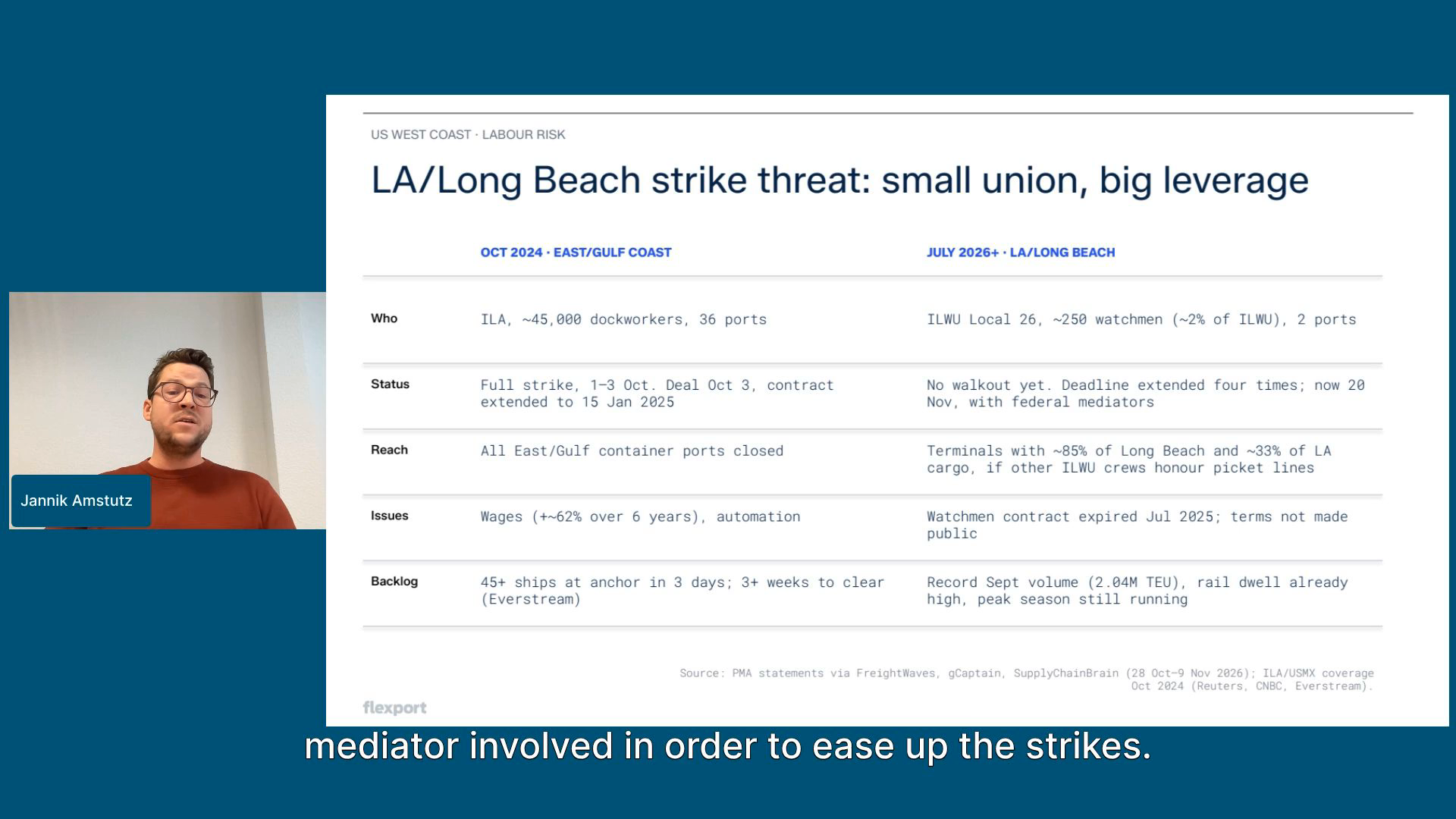
Alright. Let's cross the Atlantic and take a quick look on, strike announcements that have been shared recently. In Los Angeles and Long Beach, the union called ILWU, which has about 250 watchmen representing, 2% of the whole ILW at two ports, has announced the strikes. Those strikes have have been postponed now multiple times, and currently, it's now terminated for the November 20 with a federal mediator involved in order to ease up the strikes. Some of you might remember the ILA strikes, pretty exactly two years ago where, the potential East Coast with, more than 33 ports were set to strike. In the end, the strike only lasted, two days, and the impact was, I would say, limited for the for the moment of time. For LA and Long Beach, it's a quite small union with a potential big leverage. So coming fresh from a 2,000,000 t u month in September in regards to handling and an already tight rail dwell, with ongoing peak seasons, a strike in Los Angeles and Long Beach would be, very crucial in regards to further delays on The US West Coast. If anything changes here, Flexport is definitely, letting everyone know in regards to the developments.
Let's go to the last slide and check on our usual recommendations. The first, recommendation is not going to change. We always talk about securing ocean freight early. We are approaching the the final weeks and months of this year and also approaching a pretty early Chinese Chinese New Year in the first week of February. So if you... You also have to make sure that every plan in regards to that is is set, and it's ideally set before, any Christmas holidays in Europe. Because if you return to work, let's say, in the second week of January, then the time between, returning back to work in Europe and the the festive days in in China is pretty limited to three weeks. So you need to, book in advance. As usual, try to to book in smaller lots in order to get a risk mitigation of of rollovers or sailing late. Stay very close to the Suez arrivals. It is definitely going to put more pressure on the congestion in North Europe and into into the intermodal, capabilities, especially, when we go into the into the last weeks of the year. And last but not least, make sure you are aware if your cargo is going to route via Suez or not. That's it for the ocean freight part, and, I'm going to hand it over to Jamie for customs.
Jamie Houlihan
Thanks, Jannik. Yeah. Onto the customs and trade compliance, section. So, if we go to the next slide. I'm probably a bit of a broken record on this one, but, we're gonna go over EU's, deforestation regulation. The reason for that is it's coming up to its, go into force. So that means that as of the 12/30/2026 for large and medium sized businesses, which are categorized in that left hand side section highlighted in orange, this will go into effect for very specific products. I think by now, most of the the viewers on this call will know exactly what those products are. We've gone through the steps previously. So making sure you collect the information, there's certain data elements you need to collect from your suppliers. You need to make sure you're signed up to Traces, which is a web portal that you'll have to submit this information into. You know, you have to register, get comfortable with it, also get prepared to submit these due diligence statements.
Now there is a, difference between submitting due diligence statements either, shipment by shipment or on a, let's say, more longer term basis, in which you can draw down these statements against each import. It's really important that you're ready, for this go live. The reason that we say it, unlike CBAM, especially on the first, go live, your goods can be stopped if you do not have these due diligence statements in place. So really important that not only do you have them in place, but you have a protocol procedure and SOP of how you're gonna provide your broker these statements. It's great that you have the statements if you're prepared with with all that, but it's important to make sure all your brokers are on the same page to ensure that they're able to put these statements into, the customs declaration from, day one.
If we go to the next slide, one important question I'm I'm getting asked, is does the commodity code determine whether EUDR applies? Yes and no is is is is the answer, and I wanted to cut... Try and, give an example here. So, yes, it can give you the the the indication that EUDR may apply, but but it doesn't give you the full picture. What I mean by that is very specific products based on the certain product rules, contained in the CBAM, in the EUDR legislation, will determine whether the goods are actually under EUDR control or or not. So in most examples, you'll see that for a specific commodity code, there's probably three types of of of, ways in which, you can indicate on the declaration a specific type of import. What you can indicate is either there is a DDS number, so that means it's it's under the EUDR framework. You've got a DDS statement, and you're declaring it against the the product. You don't meet or you don't meet the, threshold, covered in the previous slide. So you're not a medium or or or large, business. And the the final one is the product itself doesn't, isn't covered by the regulation.
So so what I mean by that is... Let's take an example of a tire. Only the natural rubber rubber is is is qualifying for for potential EUDR as a control. If it contains a mixture, then, yes, the, natural rubber that is is contained in the tire would still be controlled. But if it really is is synthetic, then it it it it potentially wouldn't fall under the regulation. Now this applies to many different types of products, and commodity codes maintained in in the in the regulation. So really important you look through and understand whether your products are, let's say, controlled, or or or needing, you know, DDS statements on import because the broker... Usually, your broker will only be able to tell you as much as the commodity codes in question. So they'll be able to obviously identify commodity codes you've imported, but they won't be able to give you the full picture. So important that you're still looking into it. I think the biggest quest... Question I've been getting is, hey. My brokers reached out to me that, you know, they are, my my goods have potential EUDR, controls, on them once we get to, the December 30. Now that's only a preliminary notice that your broker's giving you. You need to do the extra bit of research into the product to make sure that, you know what you're doing on day one. That's it on EUDR.
If we go to the next slide. So, last month, we released our AI classification tool for the... For US classification. What it does is is it brings forward a native, let's say, chat GPT style, classification, AI tooling. What it does differently, and I think many people on on on this call might have, used classification tools, or have have at least dabbled in using AI. What it does is it it it has better guardrails. It looks at the correct information. It looks at the correct reference points, and it actually will guide you to a classification. So, really, what we see is, you know, you can put as much or as little information as you as you want into the, classification search. What it allows you to do is then in a native, let's say, language, be able to guide you down the route of how it would classify those goods. Now a good example might be as I have on on on screen, you know, a a a steel a steel water bottle. It needs to know if it's insulated or not to be able to determine the next step, and then potentially ask you more leading questions to help you determine. So it's gonna really guide you, through through classifying your goods and give you a suggested classification. One thing that I I I really like about the tool is it will actually give you the, the explanation behind it. You know? How did it get to that classification? What references did it use? And, you know, what, let's say, chapter notes may have may have applied. So, it's a really cool tool. It's just been released. Would definitely recommend if you are importing to The US to, give it a go. Try it out. That's it from customs.
Jannik Amstutz
Thanks a lot, Jamie. And, yeah, let's wrap it up with some, q and a. So in case you still have questions, enter them on the right. We can also, jump on to questions on short notice. I said, if we if we don't manage to answer all the questions, we are going to take those offline, so make sure you raise your questions. I think we have at least one.
Franco Babini
Indeed, Jannik. There is one question for you. And, the question is, do you think arrivals through Suez could be faster Beforehand, when vessels transited through the Cape Of Good Hope, the transit was fifteen days less, and now the difference is only nine days?
Jannik Amstutz
Okay. Good question. So first of all, I think it will it will need some time until we understand the the the transit times that that will be back in the market. Right? So carriers for now are partially, turning services back through the Suez Passage, so not everything at once. And as such, we really need to see if the if the transit times can get back to to what we are used to, before the the strait was basically closed. I overall think that there's no reason why we should not achieve the same transit times. Right? So that's that's basically, as an outlook. But, we truly have to have to figure it out after the after the market settles. Alright. We have another one, I think, for customs. Right?
Franco Babini
Yeah. That's, there's one for you, Jamie. Will you be implementing an AI classification tool, to aid for EUDR?
Jamie Houlihan
Sure. Yeah. It's a it's a good question. So, currently, the AI classification tool is purely for customs classification of products in The US. We are looking to expand that to EU classification and other jurisdictions over the coming years. In terms of EUDR, we're not looking at bringing out a tool to determine EUDR at this time. But it's a good question. But in terms of EU classification towards HS classification, we're we're we're looking to expand the tool to cover multiple jurisdictions over the next year. So so, yes, it's expanding, but not in the the EU... EUDR world.
Franco Babini
Alright. Thank you, Jamie.
Jannik Amstutz
Okay.
Franco Babini
And indeed, you can find the link to the tool in the chat and also on our website.
Jannik Amstutz
Perfect. I think that's it. Thanks a lot, Franco. Thanks a lot, Jamie. So we are going to email everyone, as usual, a link to the recording and also to the slide decks. We are going to invite everyone to attend our last FMU for 2026 in regards to, the EMEA format, on probably on the December 8, the usual Tuesday. So for now, everyone, have a great day. Enjoy the rest of the week, and, looking forward to see you again, for the December FMU.
Related webinars
 Customs & ComplianceNovember 19, 2026Register
Tariff Trends 2026: Expert Insights on the Evolving U.S. Tariff Landscape
U.S. tariff policies are changing at an unprecedented pace. Join our expert panel on November 19 for the latest tariff updates, plus CBP's new rule effective January 5, 2027 on CTPAT validation and beneficial owner reporting.
 Market UpdatesNovember 12, 2026Register
North America Freight Market Update Live
Join the North America Freight Market Update Live on November 12: trade lane news, ocean and air capacity, and where rates are heading.
 Customs & ComplianceOctober 21, 2026Watch now
Tariff Trends 2026: Expert Insights on the Evolving U.S. Tariff Landscape
Watch the on-demand recording of the October 21, 2026 Tariff Trends webinar: Section 122, 301 and 338 court updates, CAPE refunds, CBP enforcement, rules of origin and a demo of Flexport's importer audit.
 Market UpdatesOctober 13, 2026Watch now
European Freight Market Update Live
Watch the on-demand recording of the European Freight Market Update Live from 13 October: air and ocean capacity, where rates are heading into peak, the return to Suez and key customs deadlines.