Trends to Watch
Talking Tariffs
- CAPE Phase 1 Launch: U.S. Customs and Border Protection (CBP) announced that it intends to launch CAPE Phase 1, the first version of its automated IEEPA refund system, on April 20, 2026. Earlier this week, CBP confirmed that primary development of CAPE Phase 1 is complete and currently undergoing intensive performance and scenario-based testing. CBP is expected to file another update with the Court of International Trade (CIT) on April 28, 2026.
- CAPE Phase 1 will only handle entries that are either still unliquidated or that liquidated within the preceding 80 days. CBP intends to expand CAPE's coverage in future system phases to cover finally liquidated entries that are reliquidated without IEEPA duties. Other entry types excluded from CAPE Phase 1 include drawback entries, reconciliation entries, entries under protest, and more.
- Importers may not file Post Summary Corrections (PSCs) to initiate IEEPA refunds. All unliquidated entries must go through CAPE.
- Importers of record and authorized brokers must have an active Automated Commercial Environment (ACE) Portal account set up for electronic refunds. All CAPE Declarations will be submitted via the ACE Portal. As of April 9, 2026, a combined total of 56,497 importers and notify parties have signed up to receive electronic refunds. CBP can now deliver electronic refunds for about 82% of all IEEPA duty payments or deposits.
- CBP is still determining how to handle pre-liquidation refunds for suspended entries subject to AD/CVD orders. Unlike standard entries, whose refund process is largely automated and occurs at liquidation, pre-liquidation refunds require manual processing that would likely place enormous strain on agency operations.
- Last week, CIT Judge Richard Eaton reissued his earlier IEEPA refund order after selecting a new lead case for the order. The case transition reset the 60-day window for a potential government appeal of the order's scope, giving the government additional time to decide whether it will challenge the breadth of the refund mandate.
- IEEPA Refund Disbursement: Despite indicating a refund processing timeline of about 45 days, CBP has not issued any formal guidance on when funds will be disbursed.
- While CAPE Phase 1 is expected to address approximately 63% of eligible entries, the remaining ~37% lacks defined timing and process clarity. This means that some refunds may be processed relatively quickly, while others could remain unresolved for an extended period of time.
- ACE is already under significant strain. Upcoming refunds involve an estimated 53 million entries across more than 330,000 importers, resulting in potential system bottlenecks and delays.
- Validation protocols remain unclear—how submitted entries will be reviewed, how discrepancies will be handled, how rejections will be managed, and more. This may place added pressure on importers of record and brokers to reconcile and correct data. Flexport's Audit Your Customs Broker tool can automatically audit your entries for filing errors, identify tariff stacking issues, and estimate duties you may have over- or underpaid.
- President Trump Suggests Potential Iran-Related Tariff on China: On April 12, President Trump indicated that he would impose a 50% tariff on Chinese goods if China supplies Iran with weapons. Earlier that day, CNN reported that China had been preparing to supply Iran with a new air defense system.
- President Trump initially suggested the tariff in an April 8 Truth Social post, where he announced plans to immediately impose a 50% tariff on any country supplying military weapons to Iran. He did not specify which statutory mechanism would be used to impose the duty.
- Other Recent Developments:
- As of April 6, 2026, steel, aluminum, and copper imports are subject to modified Section 232 rate structures: many articles that are mostly composed of steel, aluminum, or copper are now subject to a flat 50% tariff, while derivative products listed in the Annex I of the proclamation are now subject to a 25% tariff. Notably, duties are now assessed on the full value of the imported product instead of the metal content alone. Check out the full list of changes on our blog, and calculate your updated duty impacts and landed costs with the Flexport Tariff Simulator.
- Upcoming Section 232 tariffs on certain pharmaceutical products will take effect on July 31, 2026 for certain large companies, and on September 29, 2026 for smaller companies. The U.S. will apply a capped 100% tariff on patented drugs from companies that have not agreed to most-favored-nation (MFN) drug pricing. Companies that reshore manufacturing to the U.S., companies that agree to MFN drug pricing, and certain trading partners are eligible for reduced duty rates. Find more details on our blog.
Ocean
TRANS-PACIFIC EASTBOUND (TPEB)
- Capacity and Demand:
- Carriers have increased blank sailings through mid-May, with a focus on pulling capacity from the U.S. East Coast and the Pacific Northwest.
- Overall import demand has increased in recent weeks.
- With the uptick in blank sailings, overall vessel utilization has improved.
- Freight Rates:
- Carriers attempted to implement an April 15 General Rate Increase (GRI), but these increases are quickly eroding. In response, carriers have opted to extend current rates through the end of the month.
- Emergency bunker surcharges (EBSs) are in effect. Further adjustments, including inland fuel surcharges (IFSs), take effect on April 17 and May 1.
- Carriers have pushed Peak Season Surcharges (PSSs) to May 1, given the implementation of EBSs and IFSs in April.
FAR EAST WESTBOUND (FEWB)
- Capacity and Demand:
- Given sluggish economic conditions in the Eurozone, import demand remains slow. Energy price shocks and the ongoing Middle East conflict are driving inflation to three-year highs.
- Capacity has seen an effective reduction of approximately 15-16%, given an elevated blank sailing rate of 6.5% between April 6 and May 10.
- The Red Sea remains off limits, and a broad resumption of Suez Canal transits is unlikely before mid-2026 at the earliest. Cape of Good Hope diversions are now the default, absorbing 15-20% of fleet utilization on the trade.
- Operations:
- Qingdao: Wait times range from 72 to 96 hours, given strong winds and vessel bunching.
- Singapore: Yard density is at 80%. Expect transshipment cycles of 7 to 14 days.
- Antwerp, Hamburg, and Rotterdam: Severe weather is slowing terminal throughput and inland barge movements via the Rhine. This is driving inland dwell times of 3 to 5 days.
- Freight Rates:
- The Shanghai Containerized Freight Index (SCFI) peaked at $1,703 in Week 14, with a subsequent decline through Week 17 amid soft demand.
- Rates remain broadly stable, supported by ongoing capacity reductions.
TRANS-ATLANTIC WESTBOUND (TAWB)
- Capacity and Demand:
- Vessel utilization remains elevated at 92%+ across Northern European and West Mediterranean origins. Carriers are cutting approximately 10-15% of network capacity by removing certain strings and implementing selective blank sailings into Weeks 16 and 17.
- After U.S. imports rose 12.4% month over month in March, tariff uncertainties may introduce demand risks that could impact April volumes.
- Operations:
- Ports remain heavily congested. Shippers are advised to book 3 to 4 weeks ahead.
- Antwerp and Zeebrugge: Yard utilization is at 72-85%, with berth delays of 2 to 3 days.
- Rotterdam: Yard utilization is at 80-88%, with barge wait times of approximately 72 hours.
- Bremerhaven: Yard utilization is at 80-85%, with delays of 1 to 3 days.
- Hamburg: Yard utilization is at 85-89%, with vessel wait times of 1 to 2 days.
- Genoa: Berth delays range from 3 to 4 days in the Mediterranean.
- Equipment:
- Critical container and chassis shortages persist across Germany, Benelux, Austria, Hungary, and Slovakia, with shortages expected to persist through Week 18.
- Freight Rates:
- Spot rates from Northern Europe to the U.S. East Coast continue to hold firm.
- Carriers implemented a Peak Season Surcharge (PSS) for Northern Europe routes on April 8, with plans to implement a PSS for East Mediterranean routes today (April 16).
INDIAN SUBCONTINENT TO NORTH AMERICA
- Capacity and Demand:
- Major ports in Northwest India, including Mundra and Nhava Sheva, are seeing increased congestion driven by second-order impacts of the ongoing Middle East conflict. This trend is expected to persist. Find the latest ocean market impacts on our Middle East escalation blog.
- To the U.S. East Coast: The market is showing signs of stability after a volatile six-week stretch driven by supply-side constraints. Vessel loading lead times have returned to normal.
- To the U.S. West Coast: Capacity has grown increasingly constrained on feeder services connecting Indian subcontinent cargo to mainline services. However, space remains available for bookings placed with standard lead times.
- Freight Rates:
- Rates have stabilized after a stretch of repeated increases between March and early April. Those increases were driven by stronger demand from India, blank sailings in March, and rising fuel costs in early April.
Air
- Find the latest updates on global air freight operations on our Middle East escalation blog.
- India:
- Demand has normalized following recent holidays. However, pricing validity remains short—often only 48 to 72 hours.
- While capacity is showing signs of gradual improvement, elevated fuel surcharges continue to influence the market.
- Shippers are encouraged to confirm bookings 3 to 5 days in advance.
- Bangladesh:
- Rates have recently stabilized, but remain at elevated levels compared to previous years.
- Currently, most carriers are not providing long-term pricing due to the ongoing Middle East conflict.
- Sri Lanka:
- Capacity remains a major challenge. However, expanded service operations from Gulf-based carriers could soon bring more options to the market.
- Garment exports have seen a year-over-year drop, which may impact overall demand.
- Pakistan:
- Demand is stabilizing, primarily driven by textile exports.
- Operations are active, but remain subject to limited capacity and potential cancellations due to regional air space restrictions.
- North China:
- The market is undergoing a strong rebound as demand surges across general cargo and ecommerce. Booking activity is particularly high for gateways in the U.S. Midwest and East Coast.
- Given stronger demand and persistently high fuel costs, carriers are maintaining firm upward pressure on pricing.
- South China:
- Demand remains robust, especially for U.S.-bound shipments.
- Fuel surcharges are currently undergoing adjustments, with further movements anticipated as we approach Labor Day Golden Week on May 1. General market trends suggest a continued rise in costs through the end of the month.
- Taiwan:
- The market remains volatile. Capacity remains tight, driven by the ongoing Middle East conflict and recently implemented fuel surcharges.
- Shippers are encouraged to book at least 7 days in advance.
- Vietnam:
- While base demand has slightly stabilized, rising fuel surcharges are pushing total transport costs upward.
- Space remains a primary concern on both Trans-Pacific and European lanes.
- South Korea:
- Space is extremely tight. Connecting flights are reaching full capacity, and direct flights are nearing their limits.
- Recent spikes in fuel surcharges are driving wider gaps in market pricing. Base rates are unlikely to soften in the near term.
- Malaysia:
- Transit times are extended across both U.S. and European sectors, driven by elevated demand for space.
- Due to high fuel costs and volatile conditions, shippers are encouraged to allow for longer lead times and provide 7 days of notice for bookings.
- Indonesia:
- The market is picking up speed, intensifying ongoing capacity challenges.
- Shippers are advised to avoid last-minute bookings, and should continue to book 7 to 10 days in advance to secure space.
(Source: Flexport)
Please reach out to your account representative for details on any impacts on your shipments.
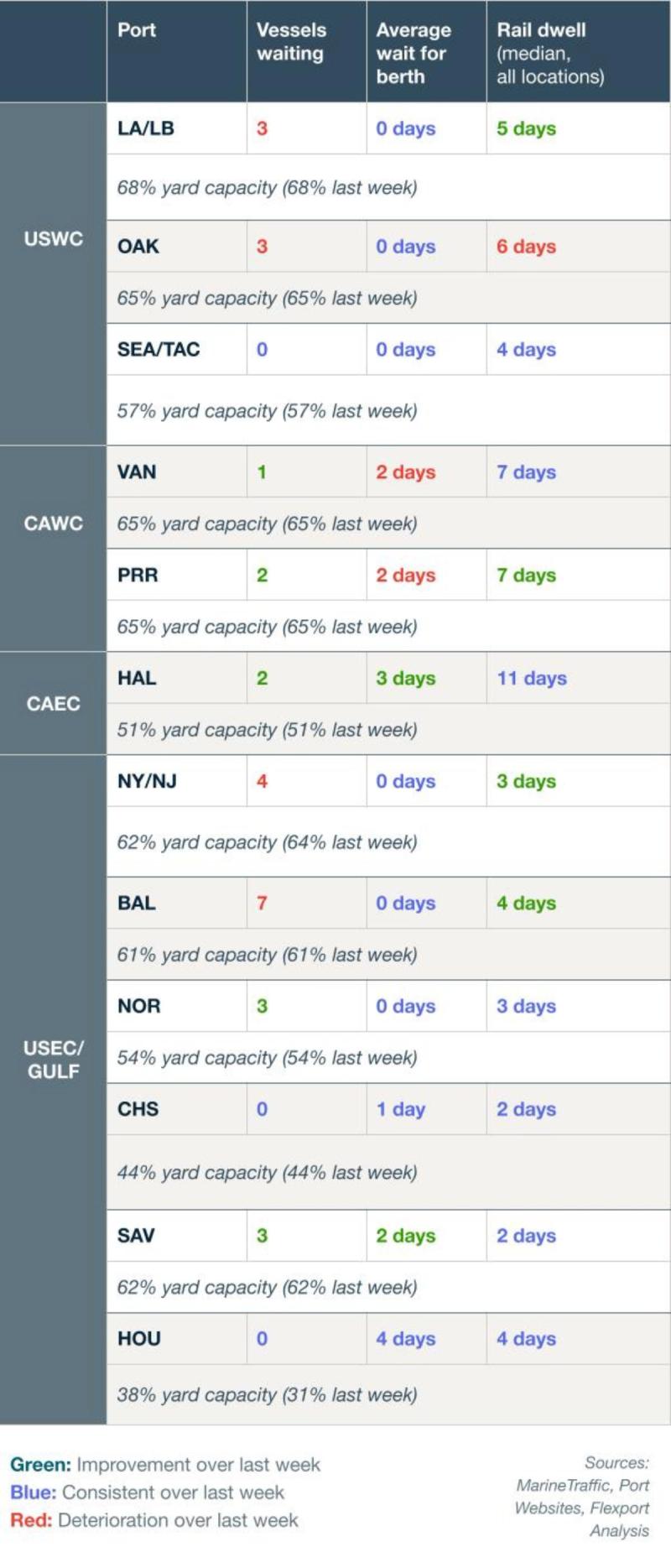
North America Vessel Dwell Times
Webinars
Tariff Trends 2026: Expert Insights on the Evolving U.S. Tariff Landscape
Wednesday, April 22 @ 9:00am PT / 12:00pm ET
Tariff Trends 2026: An Urgent Briefing on Section 232 Changes
Available On-Demand
North America Freight Market Update Live
Available On-Demand
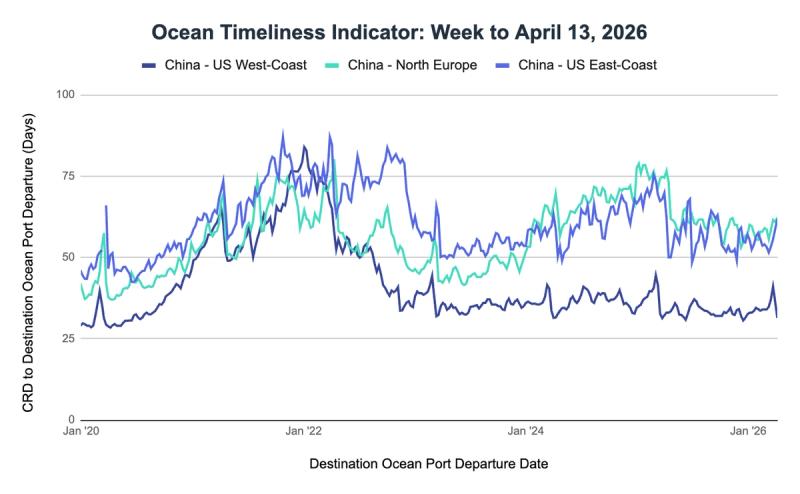
Ocean Timeliness Indicator
Transit time increased from China to the U.S. East Coast and from China to North Europe, and decreased from China to the U.S. West Coast.
Week to April 13, 2026
Transit time decreased from 36.4 to 31.4 days from China to the U.S. West Coast; increased from 58.6 to 61.8 days from China to the U.S. East Coast; and increased from 60.9 to 62.3 days from China to North Europe.
See the full report and read about our methodology in the Flexport Ocean Timeliness Indicator.