Trends to Watch
Talking Tariffs
- Federal Circuit Issues Temporary Stay on Section 122 Ruling: On May 12, the U.S. Court of Appeals for the Federal Circuit issued a temporary stay that freezes the Court of International Trade (CIT)'s recent ruling against President Trump's 10% Section 122 tariff. With the stay in effect, U.S. Customs and Border Protection (CBP) will continue to apply and collect 10% Section 122 duties for all importers, including the three specific plaintiffs granted relief by the CIT judgment a few days prior.
- The stay follows the Trump administration's appeal on May 8. A day prior, on May 7, the CIT had ruled against President Trump's Section 122 tariff, which took effect shortly after the U.S. Supreme Court struck down IEEPA tariffs in February. In its decision, the CIT held that the Section 122 tariff exceeded the president's statutory authority, stating it relied on current account deficits and trade deficits instead of "balance-of-payments deficits."
- The CIT's ruling is narrow in scope. The court had entered a permanent injunction and ordered refunds with interest only for the three plaintiffs that demonstrated standing as direct importers, while dismissing the remaining state plaintiffs for lack of standing.
- Outlook for the Section 122 Appeal and Potential Refunds: The Trump administration's appeal to the Federal Circuit was expected. However, resolution could take time: the Federal Circuit may take months to reach a final decision, at which point the case could then move to the Supreme Court.
- The 10% Section 122 tariff is set to expire on July 24, 2026, which could reduce the urgency for expedited review at the high court level.
- That said, if the CIT's ruling is ultimately upheld, refunds would likely flow through CBP's existing infrastructure—potentially through the CAPE system already being used for IEEPA refunds. However, it is unclear how far those potential refunds would extend.
- In the meantime, importers can assess their exposure and take action where appropriate. Assess how much you've paid in Section 122 duties since they took effect in February, track your entry liquidation status, monitor the appeal, and more. Check out our blog for more guidance.
- IEEPA Refund Progress via CAPE: CBP has filed another CAPE update with the CIT. As of May 11, 2026:
- 126,237 CAPE declarations have been submitted since CAPE's launch on April 20, 2026. Of those, 86,874 passed file validations.
- 15,123,221 individual entries with IEEPA duties passed entry-specific validations and were accepted for the removal of IEEPA duties. 8,338,081 of those accepted entries have been liquidated and/or reliquidated without IEEPA duties.
- The anticipated refund and interest amount for those ~8.3 million entries is ~$35.46 billion (principal plus interest). Only a portion of processed entries have been consolidated and transmitted to the Department of the Treasury for payment; the rest are still being consolidated by importer of record and liquidation date.
- 1,880 refunds are stuck because the importer or their authorized designee has not provided their ACH account information. Importers should confirm that their ACH details are on file to avoid delays.
- U.S. Extends EU Tariff "Deadline": In a May 7 Truth Social post, President Trump announced that he would give the EU until July 4 to follow through on its trade deal commitments and "cut their tariffs to zero." If the EU does not do so, President Trump indicated that he would bring tariffs on the EU to "much higher levels."
- President Trump had announced on May 1 that he planned to increase the tariff rate on EU cars and trucks from 15% to 25% the following week, but did not provide an exact timeline. It is unclear whether that increase would apply only to completed autos, or both completed autos and auto parts.
Ocean
TRANS-PACIFIC EASTBOUND (TPEB)
- Capacity and Demand:
- This week is the most constrained from a capacity standpoint, with only 78% of usual capacity deployed. Consequently, carriers are restricting Named Account (NAC) space to prioritize higher-margin Freight All Kinds (FAK) volume.
- Demand remains strong. With additional blank sailings announced for next week, we expect these conditions to persist into early June and drive an increase in operational volatility, including rolls.
- We recommend proactive planning for time-sensitive cargo, including FAK or premium service levels for urgent shipments.
- Freight Rates:
- While FAK space remains available, rate increases are materializing on May 15 due to tightening capacity. With the next few weeks expected to remain constrained, shippers should prepare for potential further increases in the first half of June. However, we may see some relief by late June amid structural overcapacity.
- Emergency bunker surcharges (EBSs) remain in effect, but have stabilized. The next review is scheduled for the end of May. Adjustments are tied to fluctuating oil prices, and hence challenging to predict.
- A few carriers are implementing Peak Season Surcharges (PSSs) on May 15 and May 21. We anticipate broader PSS implementation on June 1, given current booking trends and high vessel utilization.
FAR EAST WESTBOUND (FEWB)
- Capacity and Demand:
- European demand remains subdued, while structural overcapacity on the Far East-Europe trade persists.
- However, carriers have announced blank sailings that will effectively remove 12% of available capacity for the last two weeks of May. Space is filling up quickly, particularly for the Ocean Alliance.
- Operations: We continue to see congestion across key European hubs:
- Rotterdam: Yard utilization is at 80-88%, with barge wait times at 48 to 72 hours.
- Hamburg: Yard utilization is at ~89%, with vessel wait times of ~2 days.
- Antwerp-Bruges: Yard utilization is at 70-80%, with berth delays of 1 to 2 days.
- Root Causes of Operational Challenges:
- Slow cargo evacuation: Late consignee pickups and warehouse saturation due to tariff front-loading have led to delays.
- Low water in the Rhine: Reduced barge capacity is driving queues of 48 to 72 hours at Rotterdam and Antwerp, with overflow spilling onto road and rail.
- Alliance schedule gaps: Realignments in January of 2026 disrupted calling windows; off-schedule arrivals are breaking terminal yard planning.
- Hamburg pilot strikes: The Ver.di union's Elbe stoppages have created a persistent vessel queue overhang at the HHLA Container Terminal Altenwerder (CTA).
- Outlook:
- Rhine drafts are recovering through May and June, which may offer modest near-term relief on barge pressure. However, because July to October historically brings the worst low-water conditions, the situation should be closely monitored.
- Simultaneous Cape and Suez arrivals will overwhelm terminals, compounding the current situation. The approaching summer holidays could potentially further degrade operational efficiency.
- Freight Rates:
- The Shanghai Containerized Freight Index (SCFI) remains broadly stable, with a slight upward trend.
- Carriers are pushing Freight All Kinds (FAK) rate increases for the second half of May, primarily driven by artificial space constraints rather than organic demand. The market is shifting from a "steady decline" to "cautious stabilization."
TRANS-ATLANTIC WESTBOUND (TAWB)
- Capacity and Demand:
- Vessel utilization remains elevated, and carriers are reporting load factors exceeding 94%. This is driven both by moderate blank sailings (~6% through Week 21) and stable demand.
- Due to high utilization, we recommend planning proactively for urgent cargo and booking in advance to ensure space availability.
- Operations:
- Yard utilization levels mentioned in the FEWB section are also impacting the Trans-Atlantic trade.
- Critical container and chassis shortages persist across Germany, Benelux, Austria, Hungary, and Slovakia into Week 21.
- Freight Rates:
- Carriers have pushed rate increases due to the capacity situation.
INDIAN SUBCONTINENT TO NORTH AMERICA
- Capacity and Demand:
- Major ports in Northwest India, including Mundra and Nhava Sheva, continue to face congestion stemming from the ripple effects of the Middle East conflict. This volatility has become the baseline and is expected to persist for the foreseeable future. Find the latest ocean market updates on our Middle East escalation blog.
- However, the market is showing signs of softening. With very few blank sailings, capacity is currently outpacing demand for May. Consequently, departure timelines have shortened, indicating that backlogs are clearing. The trade is slowly stabilizing into a new normal.
- Freight Rates:
- In line with market normalization, freight rates have decreased slightly for May validities.
Air
- Find the latest updates on global air freight operations on our Middle East escalation blog.
- North China:
- Trans-Pacific Eastbound: The market has returned to a quiet, post-holiday state this week. Demand remains flat, with no signs of a meaningful cargo surge following the holiday break. Anticipated post-holiday restocking activity has yet to materialize, leaving the market in a holding pattern. Capacity and pricing remain stable week over week.
- Far East Westbound: Demand remains flat, with no notable post-holiday pick-up in cargo volumes to European gateways. Capacity and demand appear well balanced at current levels. Barring any fresh demand catalyst, the market is expected to remain range-bound in the near term.
- South China:
- Trans-Pacific Eastbound: Demand dipped slightly last week due to factory holidays, and is expected to remain at a similar level this week.
- Far East Westbound: Demand continues to soften, with rates expected to stabilize in the near term.
- Taiwan:
- Market demand remains relatively stable compared to previous weeks.
- Fuel surcharge increases implemented in May have maintained elevated rates across most carriers.
- Shippers are advised to book at least 7 days in advance to secure space.
- Vietnam:
- Market demand has softened slightly.
- Rates remain relatively stable, particularly out of Ho Chi Minh City (SGN).
- Capacity is increasingly available at origin, while transit times remain unchanged at approximately 6 to 8 days for both TC1 and TC2 destinations.
- Cambodia:
- Rates remain stable, while space remains limited. Transit times are unchanged compared to last week.
- Early bookings are strongly advised.
- South Korea:
- Demand and rates are holding steady compared to the previous week.
- Malaysia:
- Demand is softening slightly, which has improved capacity availability.
- However, market rates remain stable. Lower pricing may be accessible via longer-transit routing options.
- To secure space and mitigate volatility, shippers are encouraged to finalize all bookings 7 to 10 days in advance.
- Thailand:
- Market conditions remain stable compared to last week.
- Space remains tight at connecting hubs. Some backlog into the U.S. is expected to clear by the end of this week.
- Rates are largely unchanged.
- Indonesia:
- Market demand remains stable.
- Rates to the Trans-Pacific are still volatile. Meanwhile, rates to Europe are slightly lower compared to the previous week but come with longer transit times.
- Capacity is limited but manageable with prior booking 7 to 10 days before the cargo ready date.
- India:
- Market demand has softened slightly.
- Rates remain relatively stable, with a slight reduction compared to previous weeks.
- Capacity has improved compared to the last few weeks, while transit times remain unchanged at approximately 6 to 8 days for both TC1 and TC2 destinations.
- The Broader Indian Subcontinent:
- Space and market conditions remain volatile and are consistent with last week.
- Shippers are strongly advised to book 5 to 7 days in advance, especially for large shipments. Any urgent shipments should be booked as express to ensure space to TC1 and TC2 destinations.
(Source: Flexport)
Please reach out to your account representative for details on any impacts on your shipments.
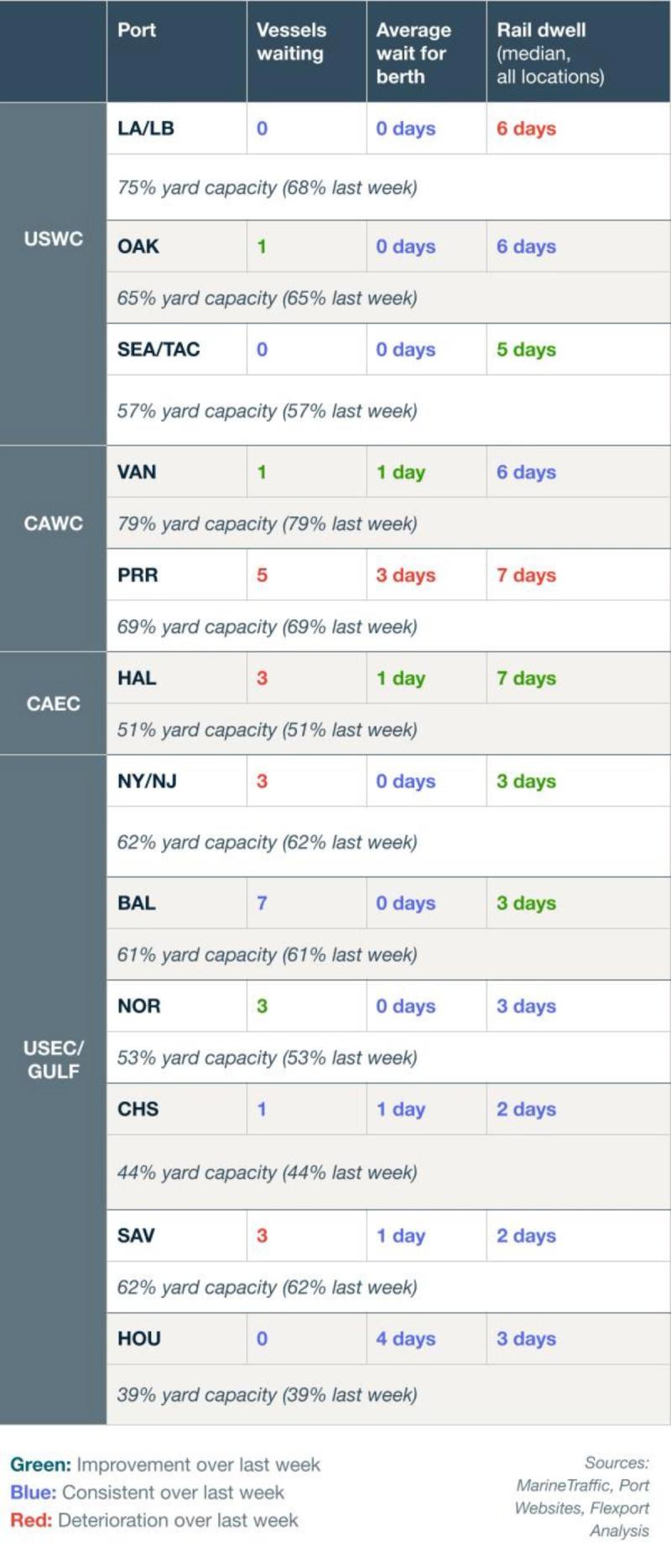
North America Vessel Dwell Times
Webinars
Tariff Trends 2026: Expert Insights on the Evolving U.S. Tariff Landscape
Wednesday, May 20 @ 9:00am PT / 12:00pm ET
Logistics for the AI Era: How to Move the World's Most Critical Infrastructure
Available On-Demand
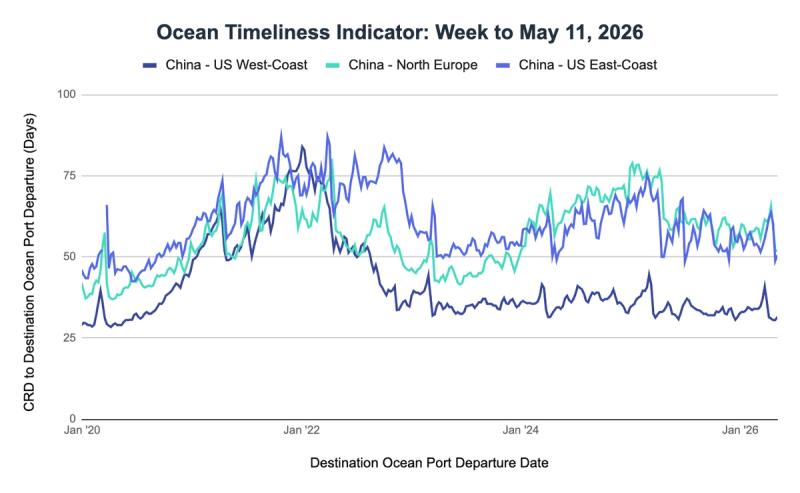
Ocean Timeliness Indicator
Transit time increased from China to the U.S. West Coast and from China to the U.S. East Coast, and decreased from China to North Europe.
Week to May 11, 2026
Transit time increased from 30.5 to 31.5 days from China to the U.S. West Coast; increased from 48.8 to 50.5 days from China to the U.S. East Coast; and decreased from 52.1 to 51.8 days from China to North Europe.
See the full report and read about our methodology in the Flexport Ocean Timeliness Indicator.