Trends to Watch
Talking Tariffs
- Section 232 Duties Reduced to 15% for Taiwanese Auto Parts and Wood Products, Retroactive to May 1: The Department of Commerce published a Federal Register notice on May 27 implementing certain tariff-related elements of the U.S.-Taiwan trade and security agreement. The notice modifies Section 232 tariff treatment for some Taiwan-origin goods, effective retroactively for goods entered for consumption, or withdrawn from warehouse for consumption, on or after 12:01 a.m. EST on May 1, 2026.
- Key changes include:
- Taiwan-origin automobile parts, timber, lumber, and wood derivative products subject to Section 232 tariffs will now face a maximum all-in duty rate of 15%.
- For covered products with a Column 1 duty rate of at least 15%, no additional Section 232 duty will apply.
- For covered products with a Column 1 duty rate below 15%, the combined Column 1 duty rate and Section 232 duty will equal 15%.
- Taiwan-origin civil aircraft components will no longer be subject to derivative Section 232 steel, aluminum, or copper tariffs.
- Refunds will be available for duties collected on covered entries from May 1, 2026 onward and will be processed under CBP's standard post-entry procedures.
- The U.S. and Taiwan also signed a separate reciprocal trade agreement in February, but that agreement has not yet entered into force and is not being implemented through this notice.
- Key changes include:
- Section 232 Metal Tariffs Removed from Taiwanese Civil Aircraft Components: The same May 27 notice eliminates derivative Section 232 steel, aluminum, and copper duties on a defined list of civil aircraft components (covering all aircraft other than military and unmanned aircraft) that are products of Taiwan and meet the criteria of General Note 6 of the HTSUS. The new HTSUS heading 9903.96.03 governs this treatment.
- The covered HTS codes span HTSUS Chapters 73 (iron and steel articles), 74 (copper), 76 (aluminum), and a broad range of machinery and equipment provisions in Chapters 84 and 85, including hydraulic equipment, compressors, heat exchangers, transformers, and electrical apparatus used in aircraft assembly.
- To qualify, the article must be classifiable in a listed provision, be a product of Taiwan, and satisfy the civil aircraft criteria under General Note 6. The relief does not extend to military aircraft or unmanned aircraft systems components.
- Importers of Taiwanese aerospace supply chain components should review current entries and pending shipments against the enumerated HTS list for potential refund eligibility back to May 1, 2026.
- CAPE Refund System: Nearly 50,000 Initial Rejections, 54% of Accepted Entries Processed: In a document filed May 26 with the Court of International Trade, Brandon Lord, executive director of CBP's Office of Trade's Trade Programs Directorate, reported that nearly 50,000 attempts to initiate refunds through the Consolidated Administration and Processing of Entries (CAPE) system faced initial rejections during the tool's first month of operation. Accepted file submissions through May 22 cover approximately 15.9 million entries that included IEEPA tariffs, and about 54% of those accepted entries have been liquidated or reliquidated without IEEPA duties.
- The three primary causes of failed file validations: (1) the importer of record or filer on the CAPE submission does not match the original IOR or broker on the entry; (2) the entry number does not exist or is the wrong length; and (3) the requester did not follow the CSV template published in the Automated Commercial Environment (ACE).
- Submissions that pass initial file validation can still be rejected at a secondary stage. Main causes include: the entry date falling past the reliquidation deadline; the entry lacking the HTSUS number for IEEPA tariffs; and the entry having already been filed on a prior CAPE submission.
- CBP has completed an additional $60 billion in refunds over the past two weeks, forwarding those amounts to the Treasury Department for disbursement. Separately, 4,185 submissions are otherwise ready for payment but cannot be processed because the broker or importer has not established a bank account with CBP to receive funds.
- The filing did not address when CBP expects to expand CAPE to entries that liquidated more than 80 days ago or to entry types outside phase one scope. Phase one currently covers approximately 63% of entries that owed IEEPA tariffs.
- Importers and brokers with pending CAPE submissions should verify IOR consistency, confirm entry numbers against CBP records, and validate CSV formatting against the ACE template before resubmitting. Filers who have not yet set up a bank account with CBP should do so promptly to avoid payment delays. The Flexport Audit Your Customs Broker tool can help identify IEEPA-eligible entries and flag duty discrepancies ahead of submission.
Ocean
TRANS-PACIFIC EASTBOUND (TPEB)
- Capacity and Demand:
- Capacity is back above 90%; however, the cumulative effect of prior blank sailings, combined with rising demand, continues to constrain available space across all gateways. Some strings are experiencing rollings as a result.
- Demand is surging, with June space filling rapidly across Pacific Southwest (PSW), Pacific Northwest (PNW), and U.S. East Coast (USEC) gateways. Looking ahead to weeks 23 and 24, blank sailing activity is expected to be elevated before easing from week 25 onwards. Shippers are encouraged to book 3–4 weeks ahead, and those with urgent cargo are encouraged to consider Premium service levels to secure space.
- Freight Rates:
- Rate increases from May 15 are holding. Carriers have announced a larger-than-usual rate increase effective June 1, driven by tightening space and rising demand; this increase is broadly expected to stick across all TPEB gateways.
- Emergency Bunker Surcharges (EBSs) remain active for May, with a further increase anticipated for June 1; review is expected by the end of May.
- All carriers are rolling out a Peak Season Surcharge (PSS) on fixed contract levels effective June 1, with a further PSS increase on June 15 considered likely given continued capacity tightening and rising spot rates.
FAR EAST WESTBOUND (FEWB)
- Capacity and Demand:
- Demand surged in late May, with importers and retailers front-loading shipments to secure June space ahead of capacity tightening. Routes via the Cape of Good Hope continue to absorb an estimated 5–6% of global available capacity, and carriers are maintaining strict capacity discipline through concentrated blank sailings; keeping the market firmly supply-constrained.
- The longer lead times, driven by Cape diversions, and as demand out of Asia increases, equipment shortages are emerging at major origin ports.
- Mega-vessel arrivals at Northern European ports (Rotterdam, Hamburg, and Antwerp) push yard utilization to 85–90% and create multi-day barge and feeder delays; the risk of rolled cargo is rising as June sailings confirm.
- Shippers are encouraged to book well in advance and confirm space early and to consider premium offers for urgent cargo.
- Operations:
- Singapore: Vessel berthing delays are intensifying as congestion builds.
- Chinese base ports: Origin delays persist, with vessel bunching and terminal congestion driving extended wait times across major ports.
- Freight Rates:
- The Shanghai Containerized Freight Index (SCFI) for Far East Westbound (FEWB) Northern Europe rose for a fourth consecutive week, up almost 5% week-on-week. The Mediterranean lane posted a further gain of 2% in the same period. June Freight All Kinds (FAK) rates have climbed approximately 30% compared to May levels.
- Carriers are implementing FAK rate increases compounded by Emergency Bunker Surcharges (EBSs) and Peak Season Surcharges (PSSs). With space filling rapidly and capacity tightly managed, market conditions are firmly in carriers' favour.
TRANS-ATLANTIC WESTBOUND (TAWB)
- Capacity and Demand:
- Vessels on the Trans-Atlantic Westbound (TAWB) trade are sailing above 90% utilised across Northern Europe and Western Mediterranean origins. Carriers have implemented selective blank sailings, ~6% of capacity, to manage space heading into mid-year. Shippers are encouraged to book 3–4 weeks ahead to secure space.
- Operations:
- Exports from Northern European ports are impacted by the same issues mentioned under Northern European import topics: terminal capacity is challenged by the mega vessels resulting in higher yard utilization and hence congestion.
- Southern European gateways face elevated risk, with Genoa reporting berth delays of approximately 4 days and Valencia absorbing diverted volumes from congested northern ports.
- Schedule reliability across the trade stands at approximately 62%, the lowest of any major East-West trade, with average delays for late vessels exceeding 6 days.
- Equipment:
- Critical container and chassis shortages persist across all key TAWB origins, including Germany, Benelux, Austria, Hungary, and Slovakia, expected to continue through at least week 23.
- Freight Rates:
- Spot rates have remained elevated following a sharp mid-April spike of approximately 50%. Active surcharges include Emergency Fuel Surcharges (EFSs) and Peak Season Surcharges (PSSs) across Northern Europe and Mediterranean origins, with additional surcharges on select Mediterranean lanes.
- Rate increases for June 1 have been announced across the TAWB trade. Shippers are encouraged to book early, and those with urgent cargo are encouraged to consider Premium service levels given current space constraints and port congestion risks.
INDIAN SUBCONTINENT TO NORTH AMERICA
- Capacity and Demand:
- Demand is increasing heading into June, with carriers reporting rising vessel utilization on Indian Subcontinent (ISC) to North America lanes and booking windows closing earlier than usual.
- Cargo moving to the U.S. West Coast (USWC) is particularly affected, as these shipments move on Trans-Pacific Eastbound (TPEB) service strings that are entering peak season with high utilization. If demand holds, space will tighten and rates are expected to rise. Shippers are encouraged to book ahead and confirm space as early as possible.
- Freight Rates:
- A Peak Season Surcharge (PSS) effective June 1 has been announced for ISC to the U.S. West Coast (USWC) lanes. No equivalent PSS has been announced for ISC to the U.S. East Coast (USEC) at this time.
- Emergency Bunker Surcharges (EBSs) remain in effect for May, with June validity under review. Shippers on USWC lanes are encouraged to engage their freight partners now to lock in space and pricing ahead of the June 1 changes.
Air
- Find the latest updates on global air freight operations on our Middle East escalation blog.
- North China (PVG/PEK) Rates rose week-on-week across trans-Pacific and Europe-bound lanes, with the U.S. West Coast recording the steepest increase. Demand is driven by electronics, consumer goods, e-commerce, and ocean-to-air conversions; aircraft maintenance events and flight cancellations have further tightened available lift. Space on premium lanes is being committed faster than usual. Book early.
- South China (HKG/SZX/CAN) A charter airline withdrew operations this week, reducing available capacity on the route. TPEB rates rose week-on-week on month-end demand, while the Europe market is absorbing additional ocean-to-air conversion volumes. Space is constrained across both trans-Pacific and westbound lanes. Secure bookings in advance.
- Taiwan (TPE) Month-end demand is building. LAX/SFO flights are full through June 3, and U.S. East Coast capacity is fully committed. Space denial risk is high for short-lead bookings. Book at least 7 days in advance.
- Vietnam (SGN/HAN) Demand picked up sharply in the final week of May, pushing rates higher as shippers competed for space. Most carriers are fully booked through May 30. June cargo should be confirmed now.
- Cambodia (PNH) Market demand and rates are stable week-on-week. Book five business days in advance to secure space.
- Korea (ICN) Demand and rates are stable. Book at least two days before departure.
- Malaysia (KUL) Demand and rates are stable week-on-week across both TPEB and FEWB lanes. Finalize bookings 5–7 days ahead to avoid volatility.
- Thailand (BKK) Demand surged into the month-end, compounded by a long holiday window from May 30 to June 1. Capacity at BKK and connecting hubs is fully committed; several carriers stopped accepting new bookings to clear existing queues. Terminal congestion is ongoing, with first available dates at some airlines now sliding to June 5. Shippers with urgent cargo should explore alternative routings and book express where possible.
- Indonesia (CGK) Market conditions are stable; space and rates are unchanged week-on-week. Book 5–7 days before cargo ready date.
- India (BOM/DEL/MAA/BLR) Rates are broadly stable with a modest decrease from recent weeks, and available capacity has improved compared to earlier in May. Transit times remain 6–8 days for the Americas, Europe and Africa destinations.
- Broader ISC (Bangladesh, Sri Lanka, Pakistan) Conditions remain volatile. Book 5–7 days in advance, particularly for large shipments. Urgent cargo should be booked as express to secure space to the Americas, Europe and Africa.
- Transatlantic (Europe to the U.S.) EU jet fuel supply constraints are expected to keep airfreight costs elevated through summer 2026. Gulf Cooperation Council suppliers account for over half of EU jet fuel imports, and no near-term resolution is in sight. Alaska Air Cargo has expanded its European network with a new daily Seattle–London service, adding belly capacity on the lane.
- U.S. Exports (US to Key International Markets) U.S. cargo carriers have petitioned the administration to suspend jet fuel taxes in response to war-driven fuel cost increases; no decision has been announced. Some logistics providers are reporting early signs of shippers evaluating a shift from air to ocean on cost-sensitive export lanes.
(Source: Flexport)
Please reach out to your account representative for details on any impacts on your shipments.
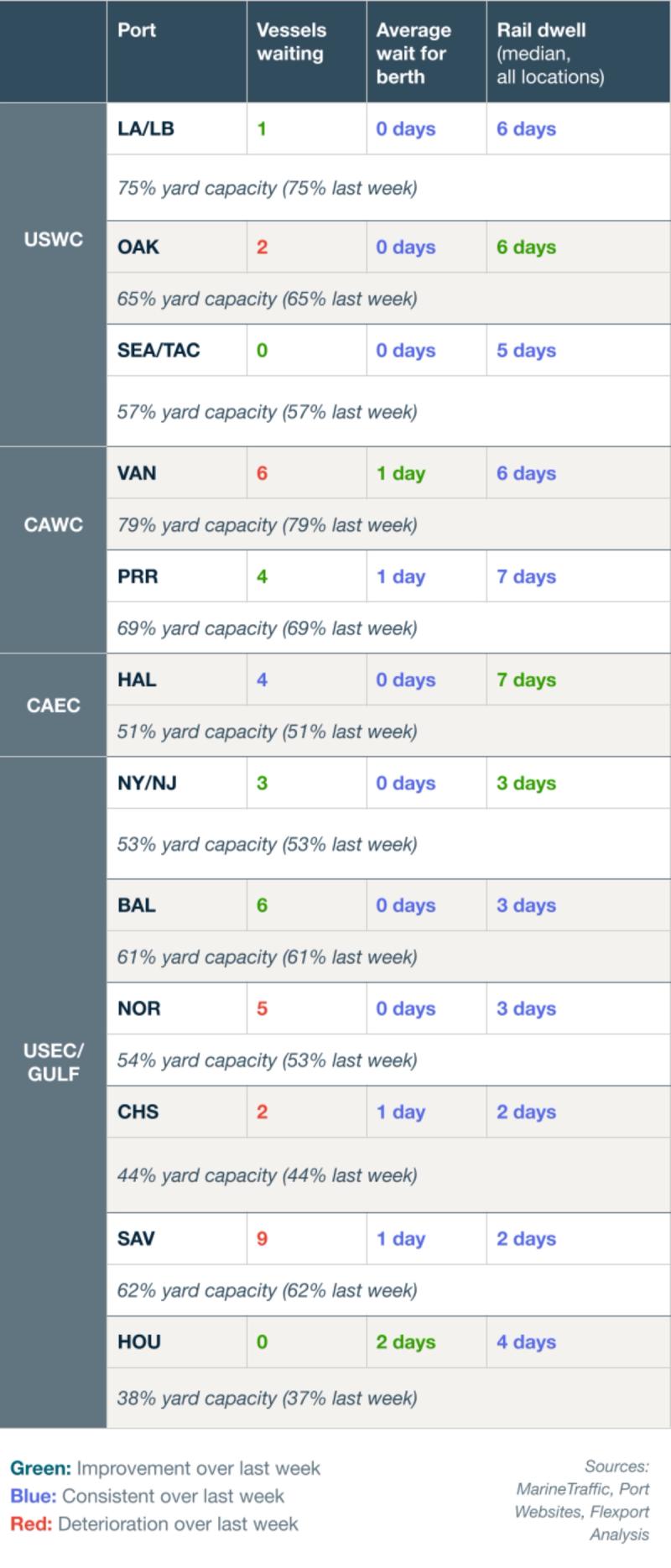
North America Vessel Dwell Times
Webinars
CAPE Explained: Refunds, Common Issues & Next Steps for Importers
June 3 @ 9:00 am PT / 12:00 pm ET
Flexport Customs Webinar: CPSC eFiling Is Almost Here. Are You Ready?
June 4 @ 9:00 am PT / 12:00 pm ET
Tariff Trends 2026: Expert Insights on the Evolving U.S. Tariff Landscape
Available On-Demand
Ocean Timeliness Indicator
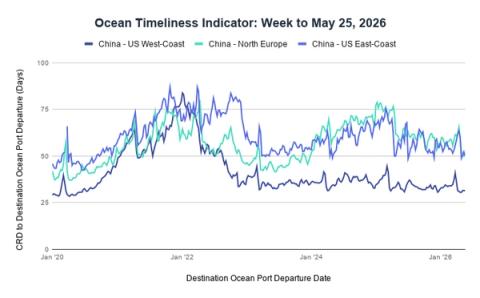
Transit time remained stable from China to the U.S. West Coast, increased from China to the U.S. East Coast, and decreased from China to North Europe.
Week to May 25, 2026
Transit time remained stable at 31.5 days from China to the U.S. West Coast; decreased from 52.3 days to 50.2 days from China to the U.S. East Coast; and decreased from 51.8 to 50 days from China to North Europe.
See the full report and read about our methodology in the Flexport Ocean Timeliness Indicator.