Trends to Watch
Talking Tariffs
- Guidance on Post Summary Corrections (PSCs) for CAPE Submissions: U.S. Customs and Border Protection (CBP) has indicated that entries that are accepted and attached to a CAPE claim are not eligible for PSCs. However, unliquidated entries rejected from CAPE submission can be corrected via PSC, and then submitted on a subsequent CAPE declaration. Entries for which a PSC has already been filed can still be accepted on a CAPE declaration.
- Importers should identify all errors before submitting a refund request in CAPE. In an audit of entries filed by other brokers, Flexport found an average error rate of 20%—meaning some importers are leaving 20% of their total refund on the table, while also exposing those entries to potential punitive action from CBP.
- Flexport's Trade Advisory team can help customers identify the full impact of any errors and correct entries prior to CAPE submission. Flexport has also created a dedicated CAPE Task Force to manage the entire filing process on behalf of customers.
- Learn more about CAPE and Flexport's guidance on our blog.
- Other CAPE Developments: CBP launched CAPE Phase 1, the first version of the CAPE system for IEEPA refunds, on April 20. CAPE can be accessed via a new tab in the Automated Commercial Environment (ACE) Portal. Refunds are issued via ACH direct deposit to the importer of record (IOR) or the designated notify party.
- CAPE Phase 1 covers entries that are either still unliquidated or that liquidated within the preceding 80 days. CBP estimates that Phase 1 addresses approximately 63% of eligible entries.
- CBP intends to expand CAPE's coverage in future system phases to cover finally liquidated entries that are reliquidated without IEEPA duties. Other entry types excluded from Phase 1 include drawback entries, reconciliation entries, entries under protest, and more.
- Expected refund timelines vary by entry status: unliquidated entries or those liquidated within the past 80 days can expect refunds approximately 60 to 90 days after CAPE acceptance. Entries with suspended, extended, or under-review status, as well as warehouse entries, will receive refunds once the entry liquidates.
- CBP is expected to file another update with the Court of International Trade (CIT) on April 28, 2026. The update is expected to cover progress made via Phase 1. CBP indicated last week that no timeline has been set for the launch of Phase 2.
- Procedures for Adjustments to Section 232 Tariffs on Canadian and Mexican Steel and Aluminum: On April 22, the Department of Commerce published a notice detailing tariff adjustment procedures for certain producers of Canadian- and Mexican-origin steel and aluminum. Eligible suppliers may submit documentation to request a reduced duty of 25%, as opposed to the existing 50% rate.
- Eligibility: These tariff adjustment procedures are available to producers of Canadian- or Mexican-origin steel or aluminum, who commit to new U.S. steel or aluminum production for use in U.S. automobiles or medium- and heavy-duty vehicles (MHDVs). The steel or aluminum must qualify for preferential treatment under the USMCA, and must be smelted and cast or melted and poured in Canada or Mexico.
- The reduced 25% rate applies only to quantities equal to the newly committed U.S. production capacity.
- Eligible producers may begin submitting documentation today (April 23). Approved companies must provide quarterly reports summarizing shipment totals, import volumes, and values. If the Department of Commerce determines that a company has failed to meet its commitments, the relevant imports will be liquidated or reliquidated at the full tariff rate.
- President Trump Appears to Walk Back Previously Suggested Iran-Related Tariff on China: In an April 15 Truth Social post, President Trump indicated that China had "agreed not to send weapons to Iran." A few days prior, on April 12, President Trump had indicated that he would impose a 50% tariff on Chinese goods if China supplied Iran with military weapons.
- President Trump initially introduced the idea of an Iran-related tariff in an April 8 Truth Social post, where he announced that he would immediately impose a 50% tariff on any country supplying weapons to Iran. He did not specify which statutory mechanism would be used to impose the duty.
- Other Recent Developments:
- As of April 6, 2026, steel, aluminum, and copper imports are subject to modified Section 232 rate structures. Many articles that are mostly composed of steel, aluminum, or copper are now subject to a flat 50% tariff, while derivative products listed in the Annex I of the proclamation are subject to a 25% tariff. Duties are now assessed on the full value of the imported product instead of the metal content alone. Check out the full list of changes on our blog, and calculate your updated duty impacts and landed costs with the Flexport Tariff Simulator.
- Upcoming Section 232 tariffs on certain pharmaceutical products will take effect on July 31, 2026 for certain large companies, and on September 29, 2026 for smaller companies. The U.S. will apply a capped 100% tariff on patented drugs from companies that have not agreed to most-favored-nation (MFN) drug pricing. Companies that reshore manufacturing to the U.S., companies that agree to MFN drug pricing, and certain trading partners are eligible for reduced duty rates. Find more details on our blog.
Ocean
TRANS-PACIFIC EASTBOUND (TPEB)
- Capacity and Demand:
- A late April volume surge, combined with increased blank sailings next month, are driving a cargo rush ahead of the May Day holiday (May 1). Named Account Contract (NAC) space is tightening on certain strings.
- Equipment:
- 40' HC equipment supply has tightened at certain origins, but there are no major concerns overall.
- Freight Rates:
- Floating rates are holding through April, with some carriers extending current pricing into early May.
- Emergency bunker surcharges (EBSs) are in effect. Carriers are adjusting May 1 bunker surcharges and have introduced inland fuel surcharges (IFSs).
- Carriers have pushed back Peak Season Surcharges (PSSs) to the second half of May, and may postpone them further to June 1.
FAR EAST WESTBOUND (FEWB)
- Capacity and Demand:
- As the European Central Bank (ECB) cuts its GDP growth forecast and raises inflation projections, the outlook for European retail demand remains subdued as high energy costs and inflation continue to erode consumer purchasing power.
- Sluggish demand has been partially offset by a surge in Chinese electric vehicle, battery, and solar component exports.
- In response to softened demand, carriers are continuing to implement blank sailings on the Asia-Europe route, averaging nearly four blank sailings per week.
- Operations:
- Qingdao: Given dense fog and vessel bunching, wait times now average 48 hours.
- Singapore: Average wait times are currently holding at 24 hours.
- Antwerp, Hamburg, and Rotterdam: These hubs remain under heavy pressure. Consolidated mega-ship arrivals are overwhelming terminal throughput, resulting in inland dwell times of 2 to 3 days for connecting barge and rail services.
- Freight Rates:
- Spot rates have continued to soften. The Shanghai Containerized Freight Index (SCFI) for North Europe dropped to $1,501 in Week 17, given weak underlying consumer demand and new vessel capacity entering the market.
- Carriers are supporting an elevated price floor with blank sailings and emergency bunker surcharges (EBSs).
TRANS-ATLANTIC WESTBOUND (TAWB)
- Capacity and Demand:
- Vessel utilization remains elevated at 94%+ across Northern Europe and the West Mediterranean.
- Network capacity is still down 10–15%. Across the trade, the blank sailing rate stands at approximately 9% for Weeks 17 to 18.
- April volumes are projected to decline 7.1% year over year due to tariff-related headwinds, following a strong Q1 pull-forward in which March U.S. imports increased 12.4% month over month.
- Operations:
- Yard utilization remains elevated across Northern European hubs: Rotterdam at 84-90%, Hamburg at 85-89%, and Antwerp at 80-85%.
- Bremerhaven is experiencing berth delays of 1 to 3 days, as well as rail closures through the middle of the year.
- Genoa is facing delays of 3 to 4 days.
- Equipment:
- Container, chassis, and rail wagon shortages persist across Germany, Benelux, Austria, Hungary, and Slovakia. Cross-border procedures are adding to inland dwell times.
- Freight Rates:
- Spot rates from Northern Europe to the U.S. East Coast surged after emergency bunker surcharges (EBSs) and Peak Season Surcharges (PSSs) took effect on April 8.
- Carriers have announced further General Rate Increases (GRIs) for late April to May across Northern European and Mediterranean origins.
INDIAN SUBCONTINENT TO NORTH AMERICA
- Capacity and Demand:
- Major ports in Northwest India, including Mundra and Nhava Sheva, continue to see increased congestion driven by second-order impacts of the Middle East conflict. This trend is expected to persist. Find the latest ocean market impacts on our Middle East escalation blog.
- To the U.S. East Coast: The market is showing signs of stability, with shipments being loaded within a normal time frame. April has seen fewer blank sailings than March.
- To the U.S. West Coast: Capacity remains available. However, intra-Asia feeder capacity involving India and Asia-to-Middle-East routes is facing operational delays.
- Freight Rates:
- Rate levels remain stable after repeated increases between March and early April. Those increases were driven by stronger demand from India, blank sailings in March, and rising fuel costs in early April.
- If capacity remains available on base-port-to-base-port lanes, rates may decrease slightly into May.
Air
- Find the latest updates on global air freight operations on our Middle East escalation blog.
- India:
- Rates are expected to ease slightly as capacity improves. Existing backlogs are actively being cleared.
- Shippers are advised to book 3 to 5 days in advance.
- Bangladesh:
- Space to the U.S. and Europe remains tight but manageable.
- Rates are highly volatile and may shift daily due to regional instability and fuel scarcity. Shippers are advised to confirm rates at the time of booking.
- Sri Lanka:
- Space to the U.S. and Europe is tight but manageable.
- Rates are volatile and may change daily due to ongoing regional disruptions and fuel supply constraints. Shippers are advised to confirm rates at the time of booking.
- Pakistan:
- Demand is stabilizing, primarily driven by textile exports.
- Carriers are operating with limited capacity and are subject to sudden cancellations due to air space restrictions.
- Some carriers have begun accepting more bookings, though overall capacity remains relatively limited. Shippers are advised to confirm space at the time of booking.
- North China:
- Trans-Pacific Eastbound: Traditional cargo demand remains consistent with last week's levels, and is expected to remain strong through the weekend. While base rates have held steady, fuel surcharges (FSCs) have increased again. Overall market rates may continue to rise leading up to Golden Week. Shippers are advised to plan ahead and secure capacity early.
- Far East Westbound: Overall demand has softened compared to previous weeks, leading to a slight surplus in available capacity. Despite the drop in volume, total market rates remain elevated due to another round of FSC increases.
- South China:
- Trans-Pacific Eastbound: The market continues to experience strong momentum this week. Supply has tightened further due to flight cancellations, which are compressing available capacity and driving upward pressure on rates.
- Far East Westbound: The market remains stable this week. Demand to major European gateways is holding at consistent levels, with no rate changes week over week.
- Taiwan:
- Overall market conditions remain similar to last week, but are expected to surge toward the end of the month. The ongoing Middle East conflict, as well as FSC increases since the beginning of April, continue to keep rates high and volatile across U.S. and European lanes.
- Shippers are advised to book at least 7 days in advance across all lanes.
- Vietnam:
- Cargo demand from Hanoi (HAN) decreased slightly last week, resulting in modest rate adjustments. Rates are expected to hold at current levels or increase, depending on fluctuations in demand.
- Available carrier capacity remains stable. However, shippers are encouraged to book 7 days in advance to maintain transit times.
- Cambodia:
- Demand is stable, with rates consistent with last week's levels.
- Connecting hub airports are experiencing congestion. Tight connection schedules have led to partial arrivals for some shipments.
- Both Trans-Pacific Eastbound and Far East Westbound lanes remain active, subject to space availability. Shippers are advised to book 7 to 10 days in advance.
- South Korea:
- Rates remain relatively stable compared to last week.
- On U.S. lanes, lead times from booking to uplift are currently running 4 to 7 days.
- Space is particularly tight for shipments bound for San Francisco (SFO) and Canada.
- Malaysia:
- Demand for space continues to surge, extending transit times across the U.S. and European sectors. Carriers are reporting price increases and anticipated delays beyond April 25.
- Volatile fuel costs are driving rate increases across Trans-Pacific Eastbound and Far East Westbound lanes.
- Shippers are encouraged to account for longer lead times and place bookings 7 to 10 days in advance.
- Indonesia:
- Space out of Jakarta (CGK) remains tight.
- Rates remain volatile. Currently, carriers are not accepting agreement or contract rates on Trans-Pacific Eastbound or Far East Westbound lanes.
- Shippers are encouraged to submit bookings 7 days prior to the cargo ready date (CRD).
(Source: Flexport)
Please reach out to your account representative for details on any impacts on your shipments.
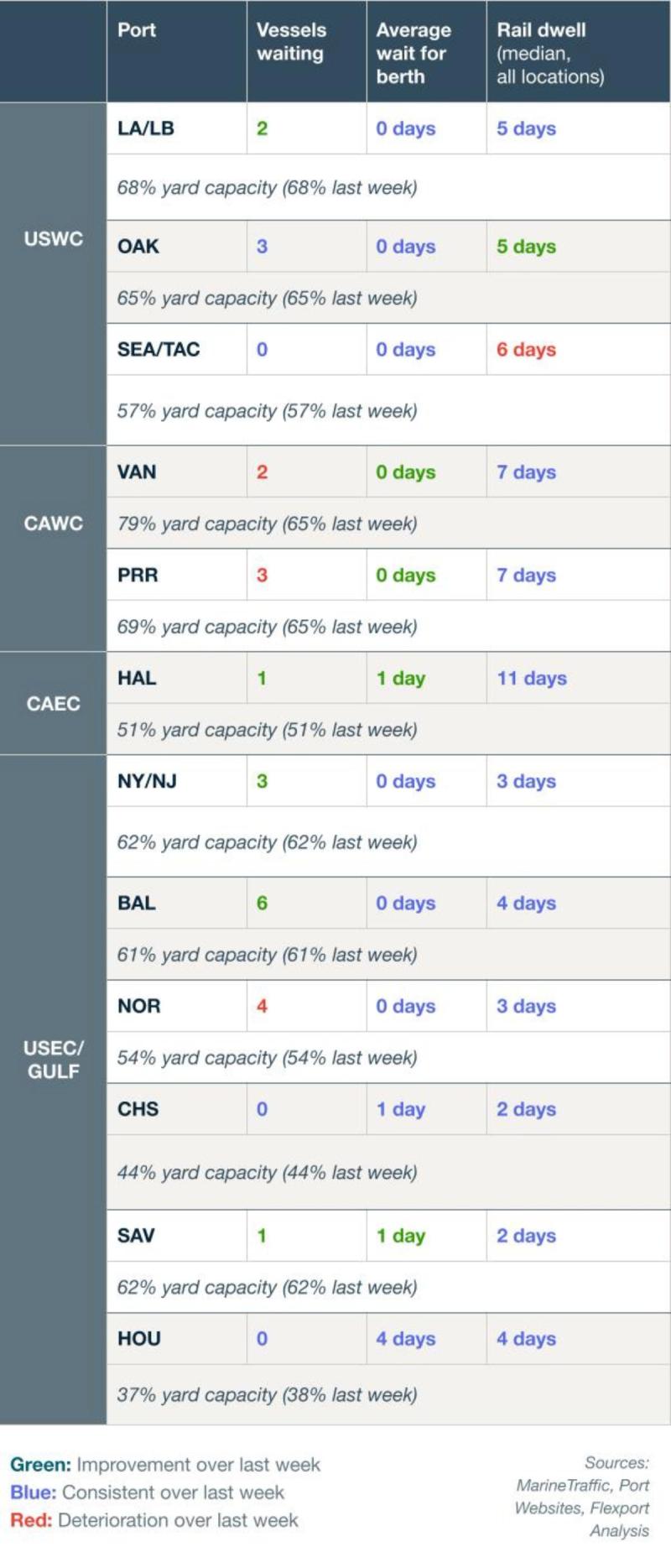
North America Vessel Dwell Times
Webinars
How to Cut Your Supply Chain Emissions & Costs with Data-Driven Insights
Wednesday, April 29 @ 8:00am PT / 11:00am ET / 16:00 BST / 17:00 CEST
North America Freight Market Update Live
Thursday, May 14 @ 9:00am PT / 12:00pm ET
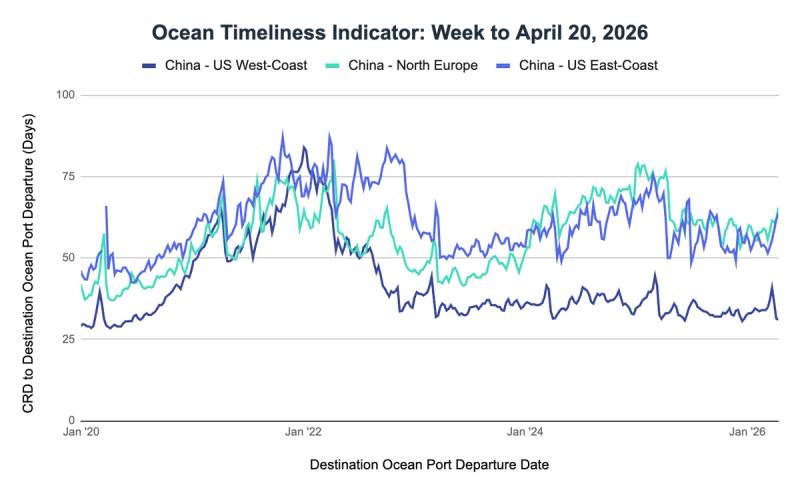
Ocean Timeliness Indicator
Transit time increased from China to the U.S. East Coast and from China to North Europe, and decreased from China to the U.S. West Coast.
Week to April 20, 2026
Transit time decreased from 31.4 to 31 days from China to the U.S. West Coast; increased from 61.8 to 63.6 days from China to the U.S. East Coast; and increased from 61.9 to 65.5 days from China to North Europe.
See the full report and read about our methodology here.