Trends to Watch
Talking Tariffs
- CAPE's First-Week Filing Outcomes: As of April 26, only 63% of CAPE declarations have passed initial file validation. Of the 13.3 million entries on those validated declarations, about 2.1 million entries—nearly 16%—were then rejected after failing entry-specific validations. Meanwhile, entries filed by Flexport have seen a much lower CAPE rejection rate: 2.6%.
- Flexport has minimized our rejection rate through strategic, proactive preparation. Before submitting CAPE declarations, we organize and manage customers' Automated Commercial Environment (ACE) data, remove any entries that did not qualify for CAPE Phase 1, and run our Audit Your Broker tool to automatically identify and address potential issues. And even after entries may have been accepted, Flexport anticipates that additional issues may arise and could result in further rejections once U.S. Customs and Border Protection (CBP) removes IEEPA HTS codes and recalculates duties.
- Importers are advised to audit their entries as soon as possible, before submitting refund requests in CAPE. For rejected entries, Flexport encourages importers to get started on protests and Post Summary Corrections (PSCs) as soon as possible to maintain entry eligibility and ensure timely refunds.
- Importers should also monitor protest deadlines for entries already filed in a CAPE declaration, in case CBP rejects them or flags any issues during the review process.
- Importers should also monitor liquidated entries that are at least 80 days post-liquidation but within the 180-day protest window. CBP has yet to issue guidance on these entries, which are expected to be addressed in a later phase of CAPE. CBP has not announced a timeline for the implementation of CAPE Phase 2.
- Flexport's Trade Advisory team can help customers identify the full impact of any errors and correct entries prior to CAPE submission. Flexport has also created a dedicated CAPE Task Force to manage the entire filing process on behalf of customers. Learn more about CAPE and Flexport's guidance on our blog.
- Refund Timelines and Other CAPE Developments: CAPE Phase 1 officially launched on April 20, 2026. Per an April 28 update filed with the Court of International Trade (CIT), CBP anticipates that it will issue its first refund on or around May 11, 2026.
- Looking at the broader picture, CBP has indicated that about 21% of total entries have been accepted for the removal of IEEPA duties through CAPE, and about 3% have been liquidated through CAPE and are in the refund stage of the process. Refunds will be issued via ACH direct deposit to the importer of record (IOR) or the designated notify party.
- CBP previously indicated that unliquidated entries or entries that liquidated within the past 80 days could expect refunds approximately 60 to 90 days after CAPE acceptance. Entries with suspended, extended, or under-review status, as well as warehouse entries, will receive refunds once the entry liquidates.
- PSCs: Last week, CBP stated that entries that are accepted and attached to a CAPE claim are not eligible for PSCs. Meanwhile, unliquidated entries rejected from CAPE submission can be corrected via PSC, and then submitted on a subsequent CAPE declaration. Entries for which a PSC has already been filed can still be accepted on a CAPE declaration.
- New Section 232 Exclusion for Products with 0% Steel, Aluminum, or Copper Content: The Department of Commerce has created a new exclusion for goods subject to Section 232 duties but contain 0% steel, aluminum, or copper content. This exclusion applies retroactively to April 6, 2026, when the modified steel, aluminum, and copper tariffs took effect.
- This exclusion exempts items with 0% metal content in Chapters 72, 73, 74, and 76 from 25% or 50% Section 232 duties. Products with less than 15% metal content were already excluded from Section 232 duties, provided that they fell outside of Chapters 72, 73, 74, and 76.
- The primary use case of the new exclusion involves products made of iron or cast iron that are not classified as "steel" for HTS purposes. These include bars, rods, and pipes and pipe fittings of ductile iron.
- This exclusion is now reflected in the Flexport Tariff Simulator when sliding all metal content values to 0%.
- Procedures for Adjusting Tariffs on Canadian and Mexican Steel and Aluminum: On April 23, the Department of Commerce began accepting documentation for tariff adjustment requests from certain producers of Canadian- and Mexican-origin steel and aluminum. Eligible suppliers may request a reduced Section 232 duty of 25%, as opposed to the existing 50% rate.
- Eligibility: Producers of Canadian- or Mexican-origin steel or aluminum, who commit to new U.S. steel or aluminum production for use in U.S. automobiles or medium- and heavy-duty vehicles (MHDVs), may submit documentation for the reduced duty rate. The steel or aluminum must qualify for preferential treatment under the USMCA, and must be smelted and cast or melted and poured in Canada or Mexico.
- The reduced 25% rate applies only to quantities equal to the newly committed U.S. production capacity.
- Approved companies must provide quarterly reports summarizing shipment totals, import volumes, and values. If the Department of Commerce determines that a company has failed to meet its commitments, the relevant imports will be liquidated or reliquidated at the full tariff rate.
- Potential Tariff on the U.K. Related to Digital Services Tax: On April 23, President Trump indicated that the U.S. may impose a "big tariff" on U.K. goods if the U.K. does not eliminate its digital services tax.
- President Trump did not specify an exact rate for the potential duty, but stated that it would be "more than what [the U.K. is] getting from its digital services tax." During the 2025-2026 tax year, the U.K. collected about £944 million ($1.27 billion) in digital services taxes from tech companies.
Ocean
TRANS-PACIFIC EASTBOUND (TPEB)
- Capacity and Demand:
- We are seeing a seasonal surge in demand ahead of the May holiday season and as new contracts come into validity.
- While the overall market outlook indicates that space is available, we are seeing certain string- or origin-specific bottlenecks. Named Account Contract (NAC) space is tightening. Additionally, with carriers pushing blank sailings and new contracts being implemented and executed on, we anticipate more disruptions compared to previous weeks.
- Equipment:
- 40' HC equipment supply has tightened at certain origins due to the slight uptick in demand and carriers prioritizing high-paying cargo to growth markets like Africa and Latin America.
- Freight Rates:
- Floating rates are holding steady through the end of April. Some carriers are extending current rate levels into early May, while others have implemented modest rate increases.
- Emergency bunker surcharges (EBSs) remain in effect, and are currently being reviewed every two weeks. EBSs have been extended to feeder services at indirect port-of-call origins, and inland fuel surcharges (IFSs) are also in effect. The situation remains fluid as oil prices develop.
- Some carriers are also considering new bunker strategies overall, including monthly bunker terms.
- Carriers have again delayed Peak Season Surcharges (PSS): the next revision will take place in the second half of May, and some carriers have already indicated that they are considering pushing to June 1. This confirms the overall market situation of supply outstripping demand, despite the modest demand uptick at the moment.
FAR EAST WESTBOUND (FEWB)
- Capacity and Demand:
- Eurozone consumer demand remains subdued, weighed down by weak consumer confidence and elevated energy costs. Post-Golden-Week restocking patterns will be a key signal for the second half of May.
- Between April 20 and May 24, approximately 9% of sailings are blank. These blank sailings, along with slow steaming, have resulted in an effective capacity reduction of approximately 15-16%.
- The Red Sea remains off limits for most carriers, with Cape of Good Hope routings absorbing 15-20% of fleet utilization. However, CMA CGM's new Ocean Rise Express (OCR) service, a direct weekly string connecting Japan and South China to Northern Europe, called Jeddah on April 26. This marks the first FEWB service to transit the Suez since the beginning of the Red Sea crisis.
- Freight Rates:
- After peaking at $1,703 in Week 14, the Shanghai Containerized Freight Index (SCFI) has declined to $1,497 in Week 18 (-$4 WoW).
- Carriers have extended April rate levels into the first half of May. MSC has announced a Freight All Kinds (FAK) rate increase for the second half of May, pending market conditions.
- Rates remain broadly stable, supported by ongoing capacity reductions.
TRANS-ATLANTIC WESTBOUND (TAWB)
- Capacity and Demand:
- Vessel utilization remains elevated at over 94%.
- Network capacity is still down 10-15%. Carriers are continuing to implement blank sailings through Weeks 17 to 21.
- The National Retail Federation (NRF) projects flat import volumes through June. Demand faces potential disruptions in late July, when the U.S.'s Section 122 tariff expires.
- Operations:
- All major Northern European ports—including Antwerp-Bruges, Rotterdam, Bremerhaven, and Hamburg—are congested, with yard utilization ranging from 75-90% and delays of 1 to 4 days.
- Genoa continues to face delays of 3 to 4 days.
- Global schedule reliability stands at approximately 62%. Shippers are encouraged to book with 3 to 4 weeks of lead time.
- Equipment:
- Critical container and chassis shortages are expected to continue through next week across Germany, Benelux, Austria, Hungary, and Slovakia.
- Freight Rates:
- Spot rates from Northern Europe to the U.S. East Coast are consistent with previous weeks.
- Carriers implemented Peak Season Surcharges (PSSs) on April 8.
INDIAN SUBCONTINENT TO NORTH AMERICA
- Capacity and Demand:
- Major ports in Northwest India, including Mundra and Nhava Sheva, continue to see increased congestion driven by the trickle-down impacts of the Middle East conflict. This trend has become the norm. Find the latest ocean market impacts on our Middle East escalation blog.
- To the U.S. East Coast: The market continues to stabilize, with shipments being loaded within a normal time frame. April has seen fewer blank sailings than March, which was characterized by supply constraints. The May outlook for blank sailings remains minimal.
- To the U.S. West Coast: Capacity remains available. However, intra-Asia feeder capacity involving India and Asia-to-Middle-East routes continues to face operational delays.
- Freight Rates:
- For May validities, rates are decreasing slightly on base-port-to-base-port lanes. Carriers aim to increase utilization across vessels and service strings.
Air
- Find the latest updates on global air freight operations on our Middle East escalation blog.
- North China:
- U.S. West Coast gateways: Demand remains strong, driven by AI server shipments, ecommerce activity, and ocean-to-air cargo conversions. These factors are driving sustained capacity pressure and maintaining elevated rates. As the upcoming May holiday further tightens the window for available space, the market does not anticipate any rate relief in the near term.
- U.S. East Coast gateways: Heading into the May holiday period, demand remains robust as shippers continue to secure capacity ahead of the break. Rate levels are holding steady week over week, with no signs of softening.
- South China:
- Trans-Pacific Eastbound demand remains strong ahead of Golden Week, across both general cargo and ecommerce.
- Market rates are expected to soften during China's traditional long holidays (April 29 to May 6).
- Far East Westbound demand is stabilizing, with rates expected to follow suit.
- Taiwan:
- Market demand is stable toward the end of the month.
- Rates remain elevated due to carrier fuel surcharge increases, which will take effect in May.
- Shippers are advised to book at least 7 days in advance.
- Vietnam:
- Demand has been declining since mid-April, and the upcoming long holiday is expected to drive a further sharp drop in the near term. Electronic components remain a key driver of continued activity.
- Outbound space has improved compared to recent weeks. However, connecting capacity remains constrained due to the ongoing Middle East conflict.
- Transit times for both Far East Westbound and Trans-Pacific Eastbound lanes are running 6 to 8 days.
- Cambodia:
- Rates remain elevated following the Khmer New Year holiday, despite a decrease in demand.
- Outbound capacity from origin remains significantly limited, sustaining elevated price levels.
- South Korea:
- Rate levels are stable, but space is currently tight.
- Shippers should anticipate booking-to-departure delays of approximately 2 to 3 days for Europe, 3 to 5 days for the U.S., and 4 to 7 days for Canada.
- Malaysia:
- Persistently strong demand and volatile fuel costs are driving extended transit times and price increases across U.S. and European lanes. This trend is expected to persist well beyond April 30.
- Capacity remains tight across all carriers.
- Shippers are advised to budget for longer lead times and finalize all bookings at least 7 to 10 days in advance.
- Thailand:
- Market demand is broadly stable. However, expect short-term spikes ahead of the upcoming long holiday and the end of the month.
- Capacity remains extremely tight, with nearly all space already booked. Early booking is essential.
- Indonesia:
- Rates remain elevated and unchanged since last week.
- Available capacity is currently constrained as a large project shipment occupies significant space.
- Space will remain tight over the coming week. Shippers are advised to book at least 7 days prior to the cargo ready date (CRD).
- Indian Subcontinent:
- Rates have eased slightly compared to recent weeks, but remain volatile.
- Shippers are advised to book 3 to 5 days in advance. Urgent shipments should be booked as express to ensure space.
(Source: Flexport)
Please reach out to your account representative for details on any impacts on your shipments.
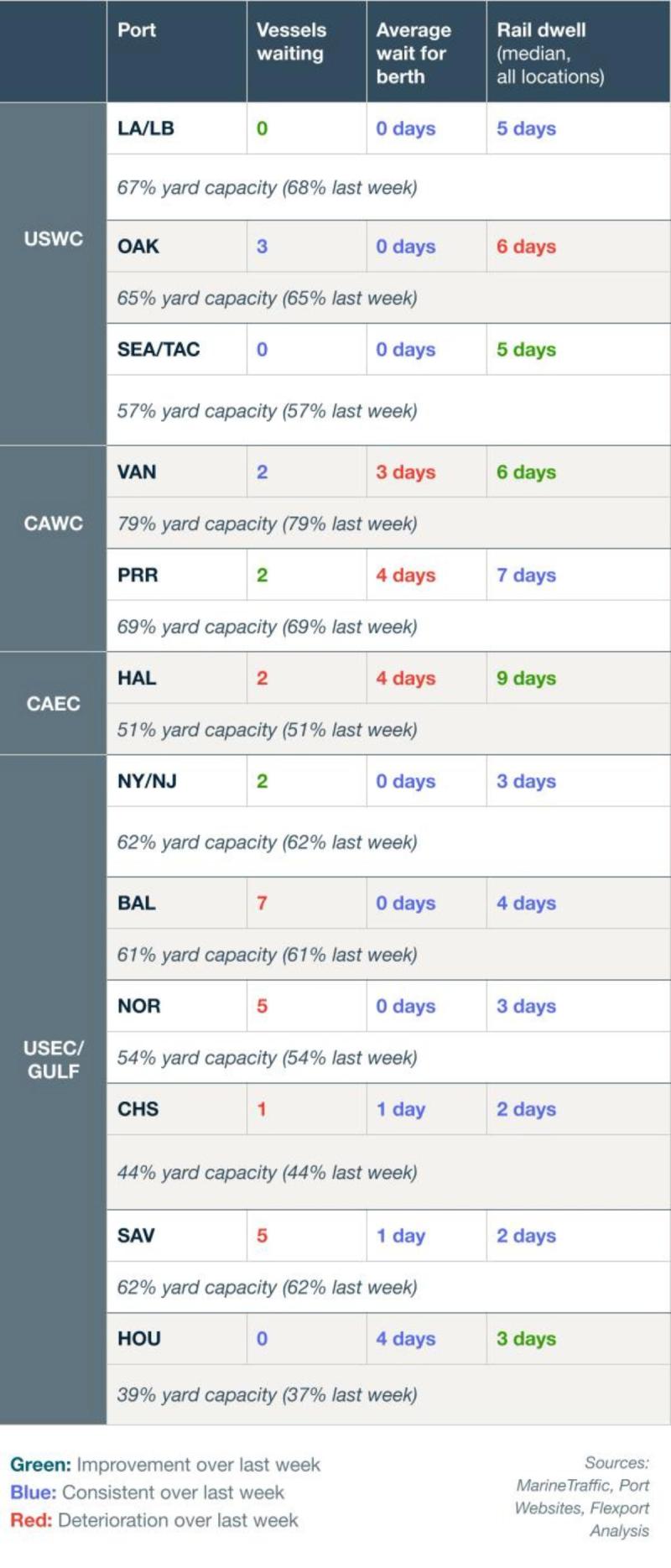
North America Vessel Dwell Times
Webinars
European Freight Market Update Live
Tuesday, May 5 @ 15:00 BST / 16:00 CEST
Logistics for the AI Era: How to Move the World's Most Critical Infrastructure
Wednesday, May 6 @ 9:00am PT / 12:00pm ET
North America Freight Market Update Live
Thursday, May 14 @ 9:00am PT / 12:00pm ET
Ocean Timeliness Indicator
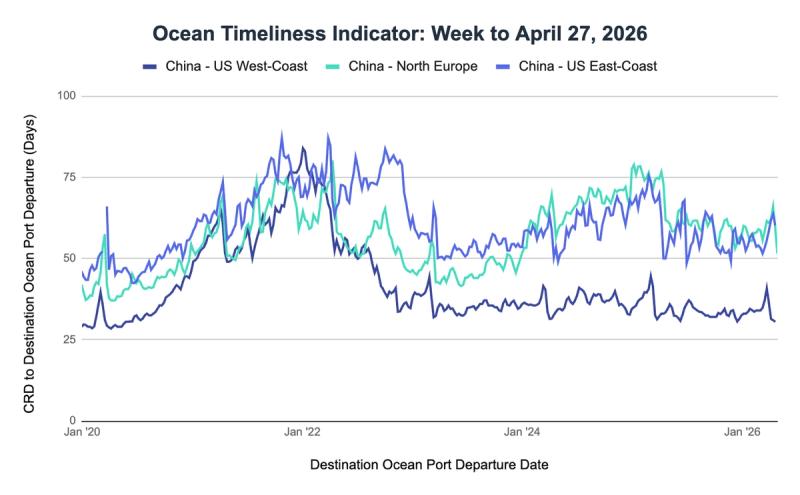
Transit time decreased from China to the U.S. West Coast, China to the U.S. East Coast, and China to North Europe.
Week to April 27, 2026
Transit time fell on all three lanes, decreasing from 31 to 30.5 days from China to the U.S. West Coast; 63.6 to 60.2 days from China to the U.S. East Coast; and 65.9 to 59.5 days from China to North Europe.
See the full report and read about our methodology here.