Trends to Watch
Talking Tariffs
- Trump Signs Executive Order Overhauling Customs Enforcement: President Trump signed an executive order on June 3 directing a sweeping reform of U.S. customs enforcement, with a focus on tightening importer of record (IOR) requirements, expanding disclosure obligations, and increasing penalties for noncompliance.
- Within 180 days, the Department of Homeland Security (DHS) must revise IOR eligibility rules to require minimum domestic asset or bonding levels, mandate beneficial ownership and business affiliation disclosures, and update the IOR registry to remove inactive registrants and establish risk-based compliance tiers.
- Foreign IORs face significantly heightened requirements: they will be prohibited from filing informal entries and, for formal entries, will no longer be permitted to rely on continuous bonds unless CBP determines revenue protection is assured. Foreign IORs filing formal entries must also be validated under the Customs Trade Partnership Against Terrorism (CTPAT) program or use a CTPAT-validated licensed customs broker.
- Within 90 days, CBP must establish new import disclosure and certification requirements, including supply chain and production method disclosures, foreign tax and business identifier reporting, and submission of any documentation the foreign exporter provided to its own customs authority prior to export.
- The order also directs DHS to establish a minimum penalty floor of at least 50% of the assessed penalty for customs violations (absent exceptional national security circumstances), eliminate mitigation for repeat offenders, increase audits, and impose maximum penalties on customs brokers who fail due diligence obligations or repeatedly represent noncompliant clients.
- Within 45 days, DHS must submit legislative recommendations to strengthen customs enforcement further. A full report on the order's effectiveness is due to the President within one year. Importers, customs brokers, and freight forwarders should assess their IOR structures and bonding arrangements now in anticipation of new regulatory requirements. Read our blog for a full breakdown, and join our webinar on June 5 to learn more.
- U.S. Appeals CIT's IEEPA Refund Order, Moves to Block CBP Commissioner Testimony: On June 2, the Department of Justice formally appealed the Court of International Trade's (CIT) April 17 order directing U.S. Customs and Border Protection (CBP) to refund duties collected under the International Emergency Economic Powers Act (IEEPA), escalating the legal battle to the U.S. Court of Appeals for the Federal Circuit.
- The government argues the CIT's universal injunction, which covers all importers including those who never filed suit, is unlawful under the Supreme Court's recent ruling in Trump v. CASA, which limits courts' authority to issue such broad injunctive relief.
- Simultaneously, the DOJ filed a mandamus petition seeking to block Judge Richard Eaton's order compelling CBP Commissioner Rodney Scott to appear in person at a June 9 hearing. The government contends this order violates established precedent requiring "extraordinary circumstances" before a high-ranking executive official can be compelled to testify.
- The government offered CBP Executive Assistant Commissioner Susan Thomas and Executive Director Brandon Lord as substitutes; Judge Eaton denied the request without explanation.
- The DOJ acknowledged that CBP has refunded approximately $85 billion of the roughly $166 billion collected under IEEPA, and that a programmatic enhancement to the CAPE (Customs Automated Processing Engine) system is underway to handle remaining entries, though the bulk of refunds processed to date have gone to large importers.
- Upcoming deadlines: Briefs in response to the court's show-cause order are due June 4 (VOS Selections); the government's deadline to appeal the refund order in Euro-Notions is June 8; Commissioner Scott's directed hearing is June 9; a CBP progress report to the court is due June 10 (Euro-Notions). Importers with entries nearing their protest deadline should continue filing to preserve refund rights; the two-year statute of limitations means there is no urgency to file at the CIT, but doing so preserves maximum optionality.
- Section 232 Tariff Relief Extended to Agricultural, HVAC, and Mobile Industrial Equipment: President Trump signed a proclamation on June 1 amending Section 232 tariffs on select steel, aluminum, and copper derivative products, with changes taking effect at 12:01 a.m. ET on June 8 and running through December 31, 2027.
- Agricultural equipment (e.g., combines, harvesters) and residential HVAC equipment will move from the standard 25% Section 232 derivative tariff to a temporary 15% rate under Annex III.
- Mobile industrial equipment and machinery (e.g., bulldozers, forklifts) will be eligible for a 15% all-in rate, inclusive of most-favored-nation (MFN) duties, when imported from countries that have signed trade agreements with the U.S. (including Japan, South Korea, Taiwan, the U.K., and the EU, among others).
- Mobile industrial equipment qualifying for USMCA treatment will have the 25% tariff applied only to non-U.S. content, with a 15% floor on the total Section 232 rate.
- The threshold for goods considered to be made "entirely" of U.S. steel, aluminum, or copper, and thus eligible for the 10% rate, has been lowered from 95% to 85% domestic metal content.
- Two new product categories are being added at the standard 25% derivative rate: steel racks and aluminum lithographic plates, also effective June 8. Importers of all affected equipment categories should confirm HTS classification against the proclamation's Annex lists before that date to determine which rate applies.
- USTR Proposes 25% Section 301 Tariffs on Brazilian Imports: The Office of the U.S. Trade Representative (USTR) released its Section 301 investigation report on Brazil late June 1, recommending 25% tariffs on a broad swath of Brazilian goods, though the proposal includes more than 1,600 HTS exemptions spanning dozens of chapters.
- USTR found Brazil engaged in unfair trade practices across six areas: digital trade and electronic payments, preferential tariff treatment for third countries, anti-corruption enforcement, intellectual property protection, ethanol market access, and illegal deforestation.
- Many of Brazil's largest U.S. export categories are excluded from the proposed tariffs, including petroleum and coal products, coffee, beef, orange juice, nuts, aircraft and parts, chemical wood pulp, iron and steel (covered by Section 232), and heavy construction equipment.
- The proposed rate of 25% is half the 50% combined IEEPA rate previously applied to Brazil, and analysts note the broad exemption list suggests the administration is weighing inflation and U.S. manufacturing input cost concerns.
- Brazil's President Lula da Silva issued a formal statement rejecting the findings, citing the U.S. goods trade surplus with Brazil of $14.46 billion in 2025 (rising to $40.5 billion including services), and warning of potential retaliatory measures if tariffs are imposed.
- The proposed tariffs are not yet in effect. A public comment period is open through July 1; a public hearing is scheduled for July 6; Brazil has until July 15 to take "responsive action" before the administration can proceed. Importers sourcing from Brazil should review the USTR's exempt HTS list against their product portfolios now, and those with non-exempt goods should consider submitting comments by the July 1 deadline.
- USTR Proposes Section 301 Tariffs on 85+ Countries Over Forced Labor Practices: The Office of the U.S. Trade Representative (USTR) released a new Section 301 investigation proposing tariffs on imports from 46 trading partners that either lack a ban on forced labor or fail to enforce one, with a tiered rate structure based on each country's trade relationship with the U.S.
- Countries without an enforceable forced labor ban, including China, India, Vietnam, Brazil, Japan, South Korea, and dozens of others, would face a proposed 12.5% Section 301 tariff. Countries that have a forced labor ban or an existing trade agreement with the U.S., including Canada, Mexico, the EU, the U.K., Taiwan, and Malaysia, among others, would face a lower proposed rate of 10%.
- The proposal includes significant carveouts: USMCA goods, DR-CAFTA goods, critical minerals, Section 232-covered goods, semiconductors, chemicals, civil aircraft parts, beef, and goods categorized as "naturally unavailable resources" would all be exempt.
- USTR is also proposing a textile and apparel quota mechanism under which a set volume of textile imports from certain partners could enter at the reduced Section 301 rate, tied to the volume of U.S.-produced fiber and cotton inputs that partner exports back to the U.S. Imports above that threshold would be subject to the full 10% or 12.5% rate.
- These tariffs are not yet in effect. Analysts expect they could go into effect around July 24, which is also when the current Section 122 tariff (10%) is set to expire, suggesting the administration may use the Section 301 rates as a replacement mechanism.
- Upcoming deadlines: Requests to testify at the USTR hearing must be submitted by June 22 via docket USTR-2026-0266 at comments.ustr.gov; written comments are due July 6 via docket USTR-2026-0265; in-person hearings are scheduled for July 7. Importers across a wide range of supply chains should assess exposure now given the breadth of countries covered.
Ocean
TRANS-PACIFIC EASTBOUND (TPEB)
- Capacity and Demand:
- Capacity has stabilized heading into June, but strong demand is driving higher utilization across the trade lane, with some strings experiencing rollovers.
- Additional capacity, including the return of select services such as MSC Pearl and extra loaders, is being deployed into Pacific Southwest (PSW) gateways. While this provides some relief, all gateways continue to fill rapidly and are expected to remain fully committed through June.
- Shippers are advised to book 3 to 4 weeks in advance and consider premium service options to secure space for time-sensitive cargo.
- Freight Rates:
- The June 1 rate increase is holding firm. Carriers are signaling a further increase on June 15, driven by sustained high vessel utilization through June and potentially into July.
- Emergency bunker surcharges (EBSs) remain in effect for June, with additional increases likely.
- All carriers have implemented Peak Season Surcharges (PSSs) on fixed contract levels effective June 1, with a further PSS adjustment on June 15 considered likely given continued capacity tightening and rising spot market rates.
FAR EAST WESTBOUND (FEWB)
- Capacity and Demand:
- The current cargo rush is being driven by shippers pulling forward bookings ahead of mid-June Peak Season Surcharge (PSS) implementations and an expected July 1 bunker fuel adjustment, not just standard summer restocking.
- While the number of announced blank sailings for June has decreased, making baseline capacity appear stable on paper, active vessels remain heavily oversubscribed due to front-loaded demand.
- Cape of Good Hope diversions continue to absorb approximately 5.3-6% of total global capacity. Combined with longer transit times, this has reduced empty container availability at Asian origin ports and increased cargo rollover risk, even on non-blanked sailings.
- Freight Rates:
- As a result of the peak conditions, spot rates have surged, with a sharp single-week increase. Major carriers are pushing base rates even higher for the second half of June.
- Carriers are implementing a PSS effective early to mid-June. Overall shipping costs are expected to remain at elevated levels throughout the month as carriers maintain strict capacity discipline.
TRANS-ATLANTIC WESTBOUND (TAWB)
- Capacity and Demand:
- Northern European vessel utilization remains above 94%, despite April imports falling 11% year over year. Carriers are blanking approximately 17% of trans-Atlantic capacity, concentrated in Weeks 22 to 23, and ongoing port congestion is slowing vessel turnarounds.
- West Mediterranean utilization sits near 93%, with selective blank sailings. Some loops are already fully booked through June.
- Capacity on Far East–Mediterranean lanes has tightened approximately 5% on a four-week rolling basis, though underlying overcapacity continues to limit upside.
- Currently, June schedules are suggesting more capacity will be available compared to May, which is anticipated to soften the conditions.
- Northern European ports remain congested; this includes extended waiting times at key hubs like Rotterdam, Hamburg, Bremerhaven and Antwerp/Zeebrugge.
- Mediterranean ports are under similar pressure. Genoa is seeing berth delays of approximately 4 days, and Valencia is absorbing diverted volumes.
- Equipment:
- Critical container and chassis shortages persist across Germany, Benelux, Austria, Hungary, and Slovakia, and are expected to continue through peak season Weeks 24 to 25.
- Freight Rates:
- Spot rates from Northern Europe to the U.S. East Coast have plateaued following a significant Q2 increase. Rates could soften in June as returning capacity outpaces demand, with bunker costs continuing to support a rate floor.
- Carriers on West Mediterranean and East Mediterranean origins have active surcharges in place, including Peak Season Surcharges (PSSs), General Rate Increases (GRIs), and Rate Revision Increases (RRIs).
- An Equipment Freight Surcharge on dry containers from West Mediterranean and East Mediterranean origins has been in effect since March 16 and remains in place until further notice.
INDIAN SUBCONTINENT TO NORTH AMERICA
- Capacity and Demand:
- To the U.S. East Coast: Demand is increasing and vessel utilization is rising, raising the likelihood that carriers will implement rate increases and Peak Season Surcharges (PSS). Blank sailings are removing capacity in Weeks 24 and 25, and MSC has canceled its INDUS EXPRESS service string, which is expected to further constrain capacity in the coming weeks ahead of a potential Indian subcontinent peak season.
- To the U.S. West Coast: Demand is increasing and vessel utilization is rising, raising the likelihood that carriers will implement rate increases and PSS.
- Freight Rates:
- To the U.S. East Coast: Space has become less available, and market rates are expected to increase.
- To the U.S. West Coast: Rates are increasing. All Indian subcontinent cargo moving to the U.S. West Coast transits on mainline Trans-Pacific Eastbound (TPEB) service strings, which are seeing high utilization as the TPEB market enters peak season.
Air
- Find the latest updates on global air freight operations on our Middle East escalation blog.
- India:
- Rates edged slightly lower compared to recent weeks, and capacity availability at origin has improved.
- Transit times remain at 6 to 8 days for both the Americas and Europe, Middle East, and Africa lanes.
- Book 5 to 7 days in advance.
- Indian subcontinent (Bangladesh, Sri Lanka, and Pakistan):
- Rates and space remain volatile. Book 5 to 7 days in advance.
- Route urgent shipments as express to secure space on the Americas and Europe, Middle East, and Africa lanes.
- North China:
- U.S. West Coast demand eased this week following last week's month-end surge, with ecommerce and project cargo flows normalizing. Rates are softening on the West Coast as a result.
- U.S. East Coast demand held firm, with rates remaining elevated heading into the first full week of June.
- Europe-bound rates pulled back at the start of June following last week's volume push, as ocean-to-air conversion flows partially unwound.
- Book 5 to 7 days in advance for both Trans-Pacific and Europe-bound lanes.
- South China:
- A cargo backlog, ongoing ecommerce demand, and FIFA World Cup 2026 pre-tournament cargo flows are pushing rates higher week over week on both U.S. West Coast and U.S. East Coast lanes.
- Despite a fuel surcharge reduction, the floating market rate rose, keeping the overall rate in line with end-of-May levels.
- Europe-bound rates ticked up as maritime disruptions continue to drive ocean-to-air conversions.
- Space is tight. Book 5 to 7 days in advance.
- Taiwan:
- Rates and demand are tracking close to last week's levels and remain at the high end of the current market range.
- Last-minute bookings face longer transit times due to constrained space.
- Book 5 to 7 days in advance.
- Vietnam and Cambodia:
- Demand continued to rise in the first week of June on both Trans-Pacific and Europe-bound lanes.
- Capacity is tight at origin and at connection hubs.
- Book 5 to 7 days in advance.
- South Korea:
- Demand and rates softened week over week, offering some relief compared to recent weeks.
- Book 4 to 6 working days in advance.
- Malaysia:
- A post-holiday demand pickup is underway, with capacity expected to tighten in the coming days.
- Rates are holding steady. Book 5 to 7 days in advance to secure space before conditions tighten.
- Thailand:
- Demand held strong through the month-end. Several carriers suspended new bookings this week to work through existing backlogs.
- Bangkok airport terminals are congested, with some delays at cargo acceptance.
- Rates remain at the high end of the range. Book 7 to 10 days in advance.
- Indonesia:
- Demand is stable.
- Space is limited but manageable for shipments confirmed 7 to 10 days before the cargo-ready date.
- Transatlantic (Europe to U.S.):
- Lufthansa Cargo, SWISS WorldCargo, and SAS Cargo each reduced fuel surcharges effective June 1, continuing a pattern of declining surcharges on European carriers over the past couple of weeks.
- KLM Cargo is relocating its operations within Amsterdam Schiphol Airport. No disruptions have been reported, but customers should monitor for updates during the transition period.
- No capacity disruptions are reported at CDG, FRA, or LHR heading into the week of June 5.
(Source: Flexport)
Please reach out to your account representative for details on any impacts on your shipments.
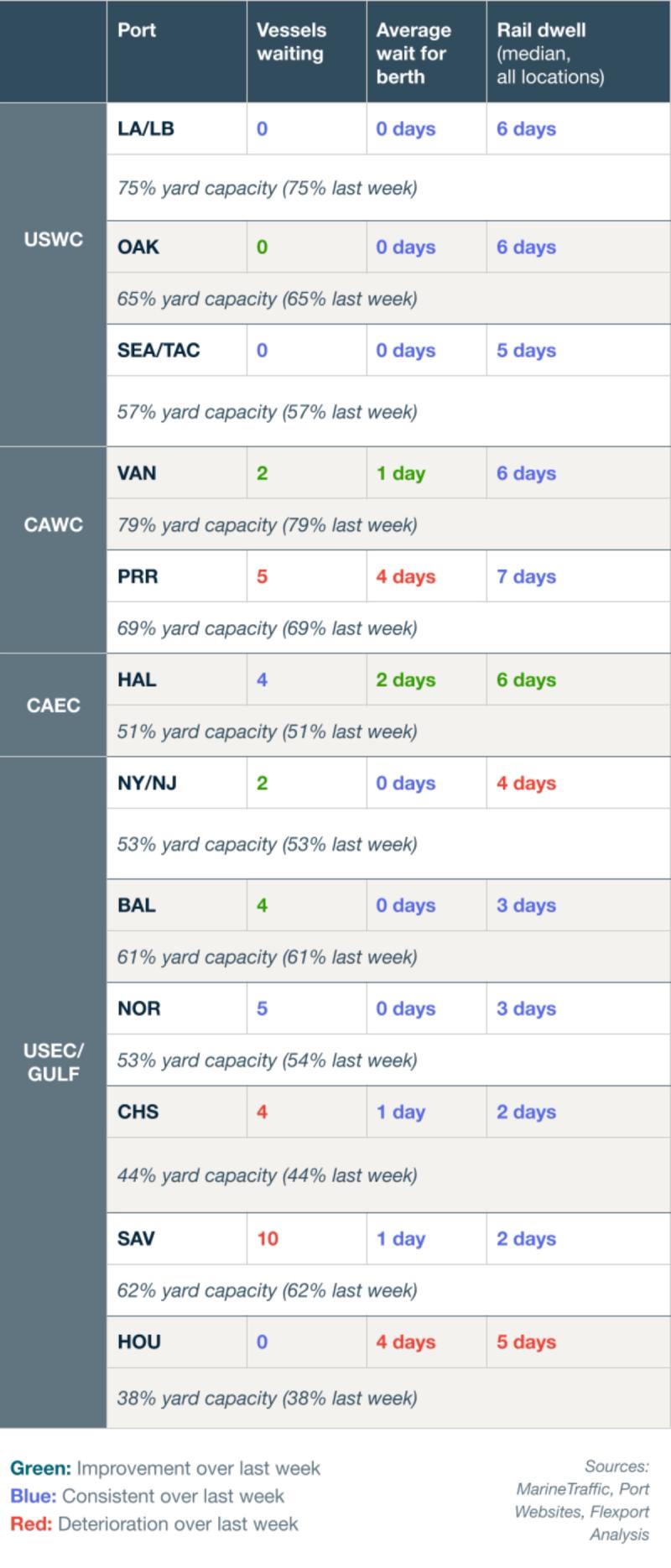
North America Vessel Dwell Times
Webinars
Breaking Down Trump's Executive Order on Foreign Importers of Record
Friday, June 5 @ 9:00 am PT / 12:00 pm ET
North America Freight Market Update Live
Thursday, June 18 @ 9:00 am PT / 12:00 pm ET
CAPE Explained: Refunds, Common Issues & Next Steps for Importers
Available On-Demand
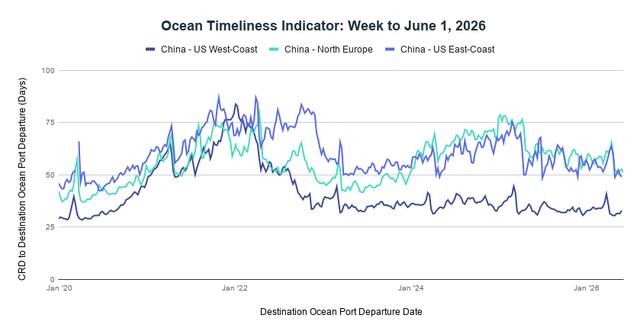
Ocean Timeliness Indicator
Transit time remained stable from China to the U.S. West Coast, increased from China to the U.S. East Coast, and decreased from China to North Europe.
Week to June 1, 2026
Transit time increased from 31.5 days to 32.9 days from China to the U.S. West Coast; decreased from 50.2 days to 49 days from China to the U.S. East Coast; and decreased from 52.1 days to 52.7 days from China to North Europe.
See the full report and read about our methodology here.