Trends to Watch
Talking Tariffs
- Russia Sanctions Bill Passes the House, Sets Up Possible 100% Tariffs on 15 Countries: The House passed the bill 262-159, handing the president power to hit up to 15 countries with tariffs as high as 100%: nations ranking among the five largest purchasers of Russian oil or gas, or among the five most active in helping Russia dodge sanctions.
- On the energy-purchase side, likely targets include China, India, Turkey, Hungary, Slovakia, the United Arab Emirates.
- Shadow-fleet tracking by multiple groups, including the European Parliament, has linked these flag states to Russian sanctions evasion: Oman, Gabon, Panama, Liberia, Malta, Eswatini, the Cook Islands, the Marshall Islands, Cameroon, Seychelles, Samoa, China, and Azerbaijan.
- It's not guaranteed this actually results in new duties. Similar Russian-oil-related authority was invoked once before under the International Emergency Economic Powers Act (IEEPA), and only one country, India, ended up with a tariff, set at 25% at the time. Importers with exposure to any of the countries listed above should watch for a presidential decision rather than assume the worst case is locked in.
- This would also allow the president to levy tariffs of up to 500% on Russian-origin products.
- These actions are to be taken within 30 days.
- CAPE Phase 3 Gets a Restart Date: Oct. 6: A court filing set Oct. 6 as the date CBP will deploy the third phase of its Consolidated Administration and Processing of Entries (CAPE) system, covering finally liquidated entries for plaintiffs whose cases resulted in a court-ordered reliquidation.
- Anyone who gave CBP a valid importer of record number by July 30 qualifies to submit CAPE declarations once Phase 3 opens on Oct. 6.
- If your IOR number reached CBP after that July 30 cutoff, expect a separate set of instructions from the agency on how to proceed.
- This resolves the open question from recent weeks about when Phase 3 would actually launch. Importers who've been waiting on this should start preparing their CAPE declarations now so they're ready to file as soon as the window opens.
Ocean
TRANS-PACIFIC EASTBOUND (TPEB)
- Capacity and Demand:
- Carriers are deploying capacity in full as peak season runs longer than forecast.
- September is on track to be the busiest import month of the year at major U.S. ports, with volumes forecast at 2.31 million twenty-foot equivalent units (TEU), 9.6% above last year.
- Los Angeles handled 955,907 TEU in August, 6% above its five-year average, closing its busiest three-month stretch on record. Long Beach posted its busiest August ever at close to 920,000 TEU, up 2% year over year.
- Capacity reductions start from the week of September 28 and build through October, reaching close to 18% of scheduled capacity in the week of October 12. Carriers are matching supply to the Golden Week factory shutdown and the demand step-down that follows, not responding to a space shortage.
- October U.S. import arrivals are forecast at 2.11 million TEU, 1.7% below last year.
- Freight Rates:
- Rates moved higher. Asia-to-U.S. East Coast spot rates rose 8.55% week over week, and Asia-to-U.S. West Coast rates rose 3.53%, with the major indices pointing the same way.
- East Coast gains continue to outpace the West Coast, reflecting Panama Canal transit restrictions tied to low water levels that limit all-water routing capacity.
- The China port congestion noted above is still removing effective capacity from the lane.
- Recommendation:
- Shippers with October cargo should confirm sailings now and expect fewer options in the second and third weeks of the month.
- Shippers should also build extra buffer into cargo-ready dates out of Shanghai, Ningbo, and Yantian, and secure space early.
FAR EAST WESTBOUND (FEWB)
- Capacity and Demand:
- Capacity is deployed in full through September. Larger reductions follow in mid-October, with blank sailings reaching 20% of scheduled capacity in the week of October 12 and 17% the week after.
- Carriers are protecting rate levels through the Golden Week lull rather than reacting to a space shortage.
- More capacity is returning to standard Suez Canal routing: Maersk and Hapag-Lloyd are moving four more Gemini Cooperation services back to Suez from the Cape of Good Hope, with the first switch taking effect September 19 and further changes on September 21 and September 24.
- These join two services already using the route and cover Asia-Northern Europe, Asia-Mediterranean, and India-Europe trades. More than a quarter of Asia-Europe capacity is expected to transit the Red Sea in September.
- The shift is furthest along on Asia-Mediterranean, where roughly 35% of headhaul capacity now moves through Suez, against about 6% on Asia-Northern Europe.
- The changes depend on Red Sea security conditions holding, and Houthi forces recently took control of territory on the Bab el-Mandeb Strait, the southern gateway to the Red Sea. We will keep monitoring.
- Freight Rates:
- Rates continue to fall. Asia-to-Northern Europe rates declined 3.78% week over week, and Shanghai-to-Rotterdam and Shanghai-to-Genoa rates both moved lower.
- Shorter Suez voyages add effective capacity, and post-peak demand is easing, so both factors push in the same direction. Levels remain above where they sat before peak season, so the decline is gradual.
- Congestion at Northern European hubs, noted above, continues to affect inland delivery schedules.
- Recommendation:
- Shorter transit times are becoming available on part of the network, so shippers should confirm routing at the time of booking rather than assume either path.
- Shippers loading in October should book 14 days ahead and gate in early.
TRANS-ATLANTIC WESTBOUND (TAWB)
- Capacity and Demand:
- The TAWB market softened into Q3 2026 across North Europe and Mediterranean origins; carriers kept withdrawing capacity through August, yielding slow but steady rate gains even as export volumes to the US, Canada and Mexico remained under pressure from soft demand.
- Vessel utilization on TAWB trade remains highly elevated, with carriers reporting load factors exceeding 94% across NEUR and WMED origins.
- Freight Rates:
- TAWB spot rates reaching ~$3,000/FEU (NEUR–US East Coast) in September as per Xeneta, the highest level since April 2023. Carriers announced new rate increases in October.
- Northern Europe and Mediterranean gateways remain tight on space, and yard congestion at Rotterdam, Antwerp, and Hamburg, described above, is keeping berth waiting times elevated.
- Recommendation: Shippers should book 4 to 5 weeks ahead on U.S. East Coast and Gulf routings to secure allocation and avoid rolling.
INDIAN SUBCONTINENT TO NORTH AMERICA (ISC)
- Capacity and Demand:
- Space on this corridor remains tight, and no capacity additions are expected in the near term.
- Demand is running at peak-season levels against reduced capacity, and the corridor is absorbing spillover at key ISC ports from the Strait of Hormuz closure.
- Nhava Sheva, India's largest container port near Mumbai, grew 13.6% in the first half of the year, and Colombo, Sri Lanka's main transshipment hub, grew 11.9%. They were the only two of the world's 30 largest ports to exceed 10.5%.
- That growth comes from Gulf transshipment redirected away from the Strait of Hormuz, and it is adding congestion at both.
- South India and Sri Lanka to the U.S. East Coast is the most constrained route. Carriers have cut booking intake and omitted calls at Colombo, where cargo from South India transships to mainline services, thus backlogs are building there. East Coast space is likely to stay tight well into the fourth quarter.
- Congestion at Mundra, India's second-largest container port in Gujarat, continues after a change to empty container depot rules restricting off-site storage, which limits equipment repositioning across northern India.
- Freight Rates: Peak Season Surcharges continue to increase in the market and FAK rate levels are above $10K/40' for core lanes NWI to USEC.
- Recommendation: Shippers on this corridor should book 4 to 5 weeks ahead, push shipper to confirm CRD as early as possible, and consider U.S. West Coast options where the destination allows.
Air
Middle East tensions renew fuel surcharge pressure as Asia-Pacific lanes brace for peak season squeeze.
- North China (PVG/PEK):
- General cargo demand is picking up on Apple's new product cycle and AI infrastructure equipment, offsetting a continued slide in ecommerce volumes. Rates are holding flat week over week.
- Demand to Europe is rising, with London Heathrow accelerating faster than Amsterdam and Frankfurt. Expect a modest rate increase into the UK gateway and a smaller move into continental Europe.
- China's Mid-Autumn Festival and National Day holidays, both approaching in the next 2 weeks, are being watched as the next rate driver.
- South China (HKG/SZX/CAN):
- Transpacific demand held flat week over week as airlines added planned fourth-quarter capacity, easing pressure on space.
- Hong Kong-to-Europe tonnage rose for a third straight week, though volumes remain well below year-ago levels following July's end of the EU's low-value import exemption.
- Ad hoc charter space to Los Angeles is available through the fourth quarter.
- Taiwan (TPE):
- U.S.-bound demand is steady week over week, with rates starting to firm on continued AI and semiconductor-driven volume.
- Book 5 to 7 days ahead of departure to secure space.
- Vietnam (SGN/HAN):
- Capacity is critical heading into peak season. Space to Los Angeles is unavailable until September 24.
- Rates out of Hanoi are rising as peak season demand builds ahead of Apple's product cycle.
- Korea (ICN):
- Shippers are front-loading cargo ahead of next week's Chuseok holiday, though the peak-volume bump shippers expected has not yet materialized.
- Demand and rates to the U.S. and within Asia are little changed week over week. Europe-bound demand and rates rose.
- Malaysia (KUL):
- A surge in inbound volumes is congesting hubs and tightening capacity on transpacific routings.
- Book 5 to 7 days ahead of departure. European lane rates have softened.
- Thailand (BKK):
- The market is stable heading into peak season, with airlines able to add ad hoc capacity on request.
- A fuel surcharge increase took effect September 1. Book 5 to 7 days ahead of departure.
- Indonesia (CGK):
- Jakarta's CGK airport has reopened after a volcanic ash closure tied to the Mount Anak Krakatau eruption, but congestion is lingering as the backlog clears.
- Space out of CGK is booked full through the end of this week. Submit bookings 7 to 10 days ahead of cargo-ready date, or route through Surabaya or Denpasar to bypass the congestion.
- India (BOM/DEL/MAA/BLR):
- Demand keeps climbing as shippers shift cargo from ocean to air to bypass bottlenecks on India-to-U.S. ocean lanes.
- Book 5 days ahead of departure to secure space.
- Broader Indian subcontinent (Bangladesh, Sri Lanka, Pakistan):
- Sri Lanka: Schedules are reliable outside of 2 carriers. Fuel surcharges are easing even as Middle East carrier space tightens on rising perishables volume.
- Bangladesh: The EU lane is reliable with open space, while the U.S. lane is tighter.
- Pakistan: Schedules are reliable, but rates are elevated and airlines are quoting only 1 to 2 days of rate validity.
- Transatlantic (Europe to U.S.):
- Air France-KLM Martinair Cargo is raising its temporary war risk surcharge again, effective September 18, citing rising oil and fuel prices and continued monitoring of the Middle East conflict.
- Transatlantic pricing is showing early signs of firming after a soft summer driven by abundant belly capacity, though rates remain well below levels seen before the conflict escalated earlier this year (Source: Flexport).
(Source: Flexport)
Please reach out to your account representative for details on any impacts on your shipments.
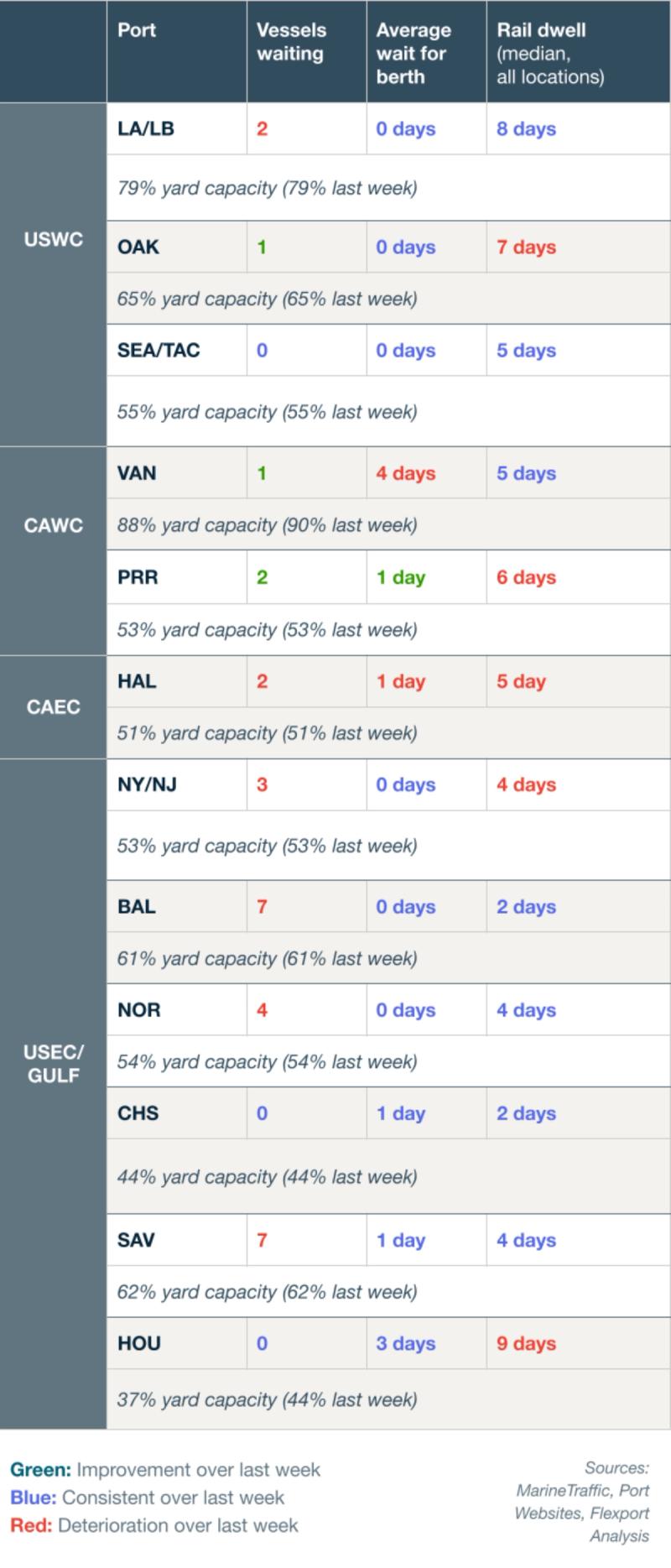
North America Vessel Dwell Times
Webinars
Flexport 2026 Fall Technology Release Live Broadcast
Tuesday, September 29 @ 9:00am PT / 12:00pm ET / 17:00 BST / 18:00 CEST
Tariff Trends 2026: Expert Insights on the Evolving U.S. Tariff Landscape
Available On-Demand
North America Freight Market Update Live
Available On-Demand
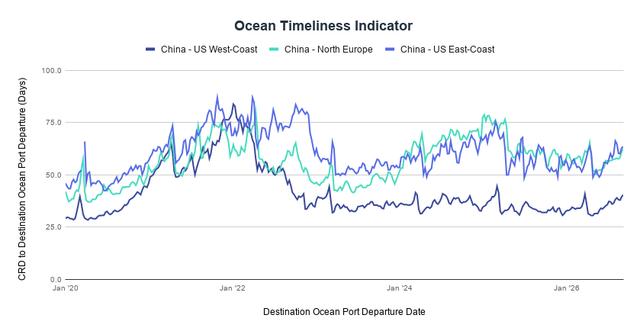
Ocean Timeliness Indicator
Transit time increased from China to the U.S. West Coast but decreased to the U.S. East Coast and North Europe.
Week to September 16, 2026
Transit time was largely stable. It increased from 40 days to 41 days from China to the U.S. West Coast, but decreased by 1 day to both the U.S. East Coast (from 64 to 63 days) and North Europe (63 to 62 days).
See the full report and read about our methodology in the Flexport Ocean Timeliness Indicator.