Trends to Watch
Talking Tariffs
- Canada Import Restrictions Take Effect, Triggering Customs Filing Errors: The U.S. restrictions on a range of Canadian goods announced earlier this month, covering large motorcycles, dairy products, and direct-to-consumer alcohol, officially took effect on September 29.
- Entries filed under the affected Harmonized Tariff Schedule (HTS) codes are now rejected outright, with U.S. Customs and Border Protection's (CBP) system returning the message "HTS Not Allowed for Country of Origin," per Flexport's trade compliance team.
- The restricted list includes motorcycles over 800cc displacement (HTS 8711.50.00), along with whey, molasses, non-alcoholic beer, and canned, bottled, and kegged beer, wine, brandy, and rum sold direct to consumer. Bulk alcohol in large vats and casks remains exempt.
- Flexport's Tariff Simulator has been updated to reflect the current code list, so importers and brokers can confirm classification before filing rather than finding out at the border.
- China Tariff Reductions Will Require Formal Section 301 Review Before Taking Effect: Speaking this week, U.S. Trade Representative Jamieson Greer confirmed that planned rate cuts covering 77 Chinese import categories classified as non-sensitive can't move forward until the agency works through Section 301's required public input process.
- The list under consideration leans heavily toward everyday consumer goods: small kitchen and household appliances (microwaves, toasters, coffee and tea makers, food processors, hair clippers and shavers, flat irons), home textiles (blankets, bed and table linens, wall hangings), children's products such as high chairs, infant walkers, play yards and non-connected toys, and a long tail of sporting goods, games, holiday decor, and novelty items.
- A recent White House release pairs this U.S. import list with a parallel list of U.S. products China would consider for reciprocal, reduced tariff treatment, though neither government has published a timeline or specified what the new rates would actually be.
- Flexport's trade compliance team sees echoes of the Section 301 exclusion process from the first Trump administration, where comment periods routinely stretched on before any rates changed.
- In practice, that means importers with exposure in these categories shouldn't expect near-term relief. Comment periods like this one have historically run for months, and the review could still leave some products untouched.
- New Steel Pact Targets Transshipment Through Country-of-Origin Disclosure: A new multilateral effort aims to close a longstanding gap in how steel's origin gets verified. Major steel importing economies, representing 55% of the world's steel trade, will start requiring exporters to identify the country where each shipment's steel was actually melted and poured, instead of simply citing wherever it was last processed or finished. The United States, Canada, Mexico, Japan, South Korea, Turkey, Australia, Argentina, Brazil, South Africa, and sixteen European countries are among the participants.
- Finishing steel briefly in a third country to mask its true origin and dodge origin-specific duties is a familiar workaround, and melt-and-pour disclosure is designed to close that gap.
- The move adds to a broader multilateral push against transshipment that U.S. Customs and Border Protection (CBP) and the Department of Commerce have both pressed in recent months.
- Companies importing steel should plan for new documentation requirements and start checking now whether they can trace melt-and-pour data through their own supply chains.
Ocean
TRANS-PACIFIC EASTBOUND (TPEB)
- Capacity and Demand:
- Carriers deployed capacity in full last week and are doing so again this week.
- Blank sailings build to approximately 8% of capacity in the week of October 5 as carriers correct for the Golden Week holiday, before easing back below 5% for the remainder of the month.
- Last week's port congestion out of China is adding further near-term schedule uncertainty.
- Demand remains firm.
- Freight Rates:
- Container rates on this lane are at their highest level since mid-2022, supported by resilient import demand and the effective capacity loss from Asian port congestion.
- Carriers have announced a further rate increase effective October 1, timed to the pre-holiday cargo push.
- Shippers should add buffer to cargo-ready dates out of Shanghai and Ningbo through the Golden Week period and secure space early, given both congestion and firm rates.
FAR EAST WESTBOUND (FEWB)
- Capacity and Demand:
- China port congestion is heavily affecting origin schedules on FEWB, and carriers are deploying capacity in full through mid-October.
- The Golden Week correction here lands later; blank sailings build to roughly 9-10% of capacity in the last week of October before easing into November.
- Schedule Reliability:
- Schedule reliability is the bigger issue here. Global on-time arrivals fell to 49.9% in August, the lowest level since September 2022, as congestion at Asian ports continues to disrupt sailing schedules broadly.
- Freight Rates:
- Rates have eased for roughly 12 straight weeks, down close to 30% to Northern Europe and closer to 40% to the Mediterranean since the start of July.
- Carriers have announced rate increases effective October 19 to try to halt that slide, though soft demand and capacity still returning from Suez routing will make those increases hard to sustain.
- Shippers should select services based on demonstrated schedule performance and build extra buffer into arrival planning through the fourth quarter.
TRANS-ATLANTIC WESTBOUND (TAWB)
- Capacity and Demand:
- Blank sailing activity cleared the 7% materiality threshold last week and eased back this week. Another spike looks likely in the week of October 19, clearing 13% of capacity, before dropping back to routine levels.
- Carriers continue trimming Europe-to-U.S. capacity while shifting tonnage toward Canada, where direct capacity is running well above year-ago levels even as total capacity serving the U.S. has declined around -6.6% YoY.
- The underlying demand is soft. This reflects carriers managing utilization to defend rate levels, rather than a demand-driven squeeze. Vessel utilization remains elevated, with load factors reportedly exceeding 90% on North Europe and West Mediterranean origins.
- Freight Rates:
- Westbound spot rates have roughly doubled since the Iran conflict began and have held above recent norms for more than a month.
- Almost all carriers are reporting that their ships are running full. In order to secure space, we recommend booking 4 to 5 weeks in advance.
- Operations:
- Water levels on the Rhine, Central Europe's main inland waterway, fell to their lowest point on record this week, effectively halting barge traffic through southern Germany and Switzerland and pushing freight costs on alternative routes to several times normal levels.
- Shippers moving cargo through the Rhine corridor should plan for rail or road alternatives and add several days to inland transit estimates.
INDIAN SUBCONTINENT TO NORTH AMERICA
- Capacity and Demand:
- Available space on this corridor remains constrained.
- Congestion continues at Nhava Sheva, India's largest container port near Mumbai, where gate-in turnaround times for trucks are running close to 20 hours.
- Port congestion also continues at Colombo, the ISC region's main transshipment hub for non-direct lanes, and is expected to persist.
- Major ISC to USEC services continue to use a combination of Cape of Good Hope and Suez Canal routings.
- The energy crisis in Pakistan and Bangladesh has deepened. More than half of surveyed Bangladesh garment factories now report canceled or reduced orders, and most have partially halted production as fuel and power shortages bite.
- Shippers moving on this corridor should book 4 to 5 weeks ahead and confirm routing at booking, since transshipment delays through Colombo are adding real variability to transit times.
Air
- North China:
- Demand is flat this week. Neither the final week of September nor the Golden Week run-up is producing the seasonal pickup sometimes seen ahead of the holiday, and ecommerce volume remains a non-factor.
- General cargo demand is rising as shippers push cargo out before the holiday, but new charter capacity is absorbing that pressure and keeping rates steady.
- Europe-bound demand stays flat, extending the plateau seen over the past two weeks. Carriers are cutting rates ahead of Golden Week to stimulate volume.
- South China:
- Trans-Pacific demand is rising week over week, but rates have moved only slightly higher as supply remains ample.
- Flight cancellations tied to the National Day holiday may keep rates at current levels into next week.
- Europe-bound (FEWB) demand continues to soften, keeping rates at low levels.
- Taiwan:
- A four-day holiday is lifting U.S.-bound demand compared with last week, while Europe capacity has loosened slightly.
- Shippers are advised to book 5 to 7 days in advance to secure space.
- Vietnam:
- Trans-Pacific demand remains high, with outbound capacity from Hanoi tight on quarter-end pressure.
- Europe-bound demand is unchanged week over week, and rates stay at elevated levels.
- Korea:
- Demand is flat compared with last week, with the Chuseok holiday behind and two more holiday periods ahead, October 3 to 5 and October 9.
- U.S. East Coast capacity is loose on an oversupply of charter capacity from co-loaders.
- U.S. West Coast (LAX) space is tightening as a second carrier has entered the route at a lower rate, pushing the two into price competition.
- Malaysia:
- Heavy inbound volumes are creating hub congestion that is limiting outbound capacity, particularly on Trans-Pacific lanes.
- Shippers are advised to book 5 to 7 days ahead to secure space and avoid transit delays.
- Thailand:
- Bangkok has declared disaster zones after severe flooding affected roughly 52,000 households as of September 27.
- BKK airport remains open, but the flooding has caused ground-handling staffing shortages and taken cargo carts out of service.
- Expect delays in cargo acceptance and pickup.
- India:
- Heavy terminal congestion this week is delaying shipment handovers. Demand rose over the past week as more shippers air-lift ocean cargo to bypass maritime bottlenecks, keeping India-to-U.S. trade lanes busy. Shippers are advised to book 5 days in advance.
- Trucks are waiting up to 72 hours outside the Mumbai air cargo complex, with daily offload volume running several times the normal forecast.
- Shippers are advised to book 5 days in advance on Trans-Pacific lanes.
- Indian Subcontinent (Bangladesh, Sri Lanka, Pakistan):
- Sri Lanka schedules are on time outside of two carriers, while Middle East carriers are tightening space as perishable volumes rise.
- Bangladesh's Europe schedule is reliable with open space, while its U.S. lane is tighter.
- Pakistan's schedule is reliable, but rates are elevated, and carriers are quoting only 1 to 2 days of rate validity.
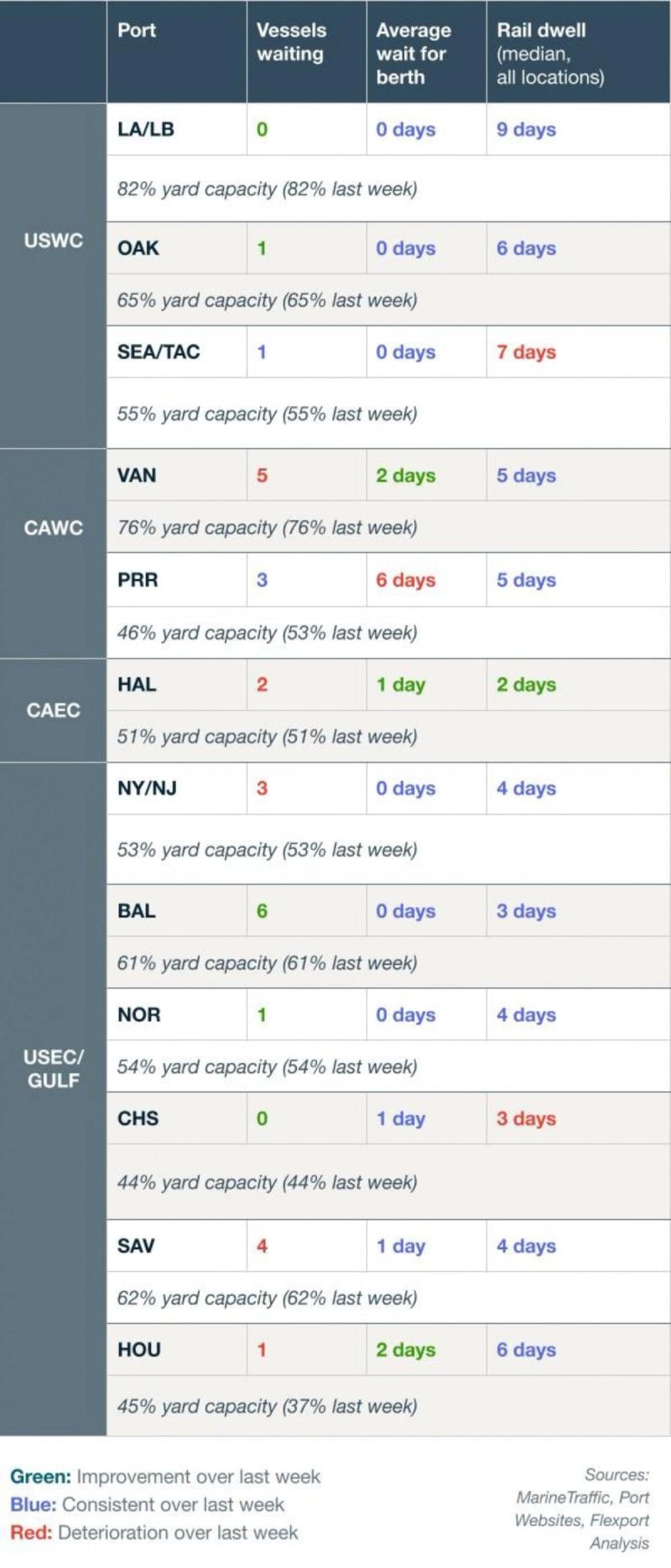
North America Vessel Dwell Times
Webinars
North America Freight Market Update Live
Thursday, October 8 @ 9:00am PT / 12:00pm ET
Flexport 2026 Fall Technology Release Live Broadcast
Available On-Demand