Ocean Freight Market Updates
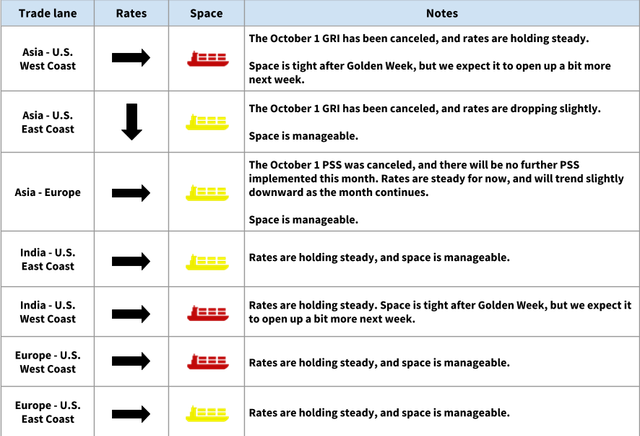
Blank sailings this week . . .
Carriers announced many blank sailings this week (as is typical during and after Golden Week).
. . . will lead to high demand next week
Normal schedules will resume next week, with increased demand after 2 weeks of blank sailings; this will likely result in some cargo being rolled.
Air Freight Market Updates
The peak before the super-peak
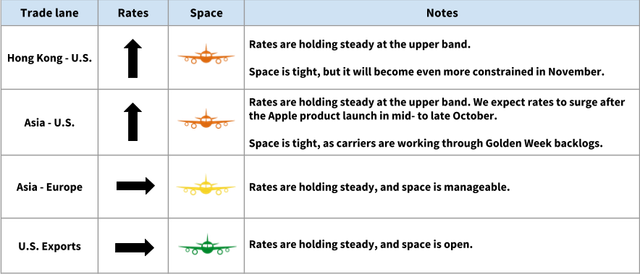
Air rates are high, and capacity is tight. We’re in peak season, but rates will go up further -- there will be a “super-peak” in November, with higher rates and even tighter capacity.
Another fuel surcharge increase for cargo out of Hong Kong
Air carriers have announced another fuel surcharge increase for cargo ex-Hong Kong. Beginning November 1, the fuel surcharge will be $0.16/kg, up from $0.09/kg. This increase, as set out by the Hong Kong Civil Aviation Department, corresponds with the rising price of oil.
Other Freight Market Updates
Amazon holiday cutoff dates
Amazon announced its inventory cutoff dates for Black Friday, Cyber Monday, and Christmas:
- Black Friday and Cyber Monday: Inventory due by November 7
- Christmas: Inventory due by December 1
More details are available here.