European Freight Market Update Live
Watch the on-demand recording of the European Freight Market Update Live from 13 October: air and ocean capacity, where rates are heading into peak, the return to Suez and key customs deadlines.
Couldn't load video
European Freight Market Update Live
The below transcript has been generated by an AI system and may contain inaccuracies, errors, or omissions. While efforts have been made to ensure the accuracy of the content, the AI-generated transcript should not be considered fully reliable or definitive record.
Jannik Amstutz
Hello, everyone, and thank you for attending today's European Freight Market Update. My name is Jannik, and I'm a senior manager ocean freight at Flexport. Before we dive in, we'll go over a few quick housekeeping notes to help everyone get oriented. On your screen, you will see a sidebar to the right of the main stage where you can submit questions. At the end of the presentations, we will host a q and a and answer a few audience questions, so be sure to get your questions in early. In the same sidebar, you will see a tab labeled docs. This is where you can download a copy of today's slides. Okay.
Now a brief legal note before we kick it off with the actual content. Please keep in mind that all information provided in the session is based on the situation at this current time and may not be customized to your specific business requirements. We always recommend reaching out to a Flexport expert to to discuss your particular situations. So here's today's agenda. As usual, Arno will kick it off with the latest informations on air freight. I will continue with the ocean market updates, and, we are going to close today's market update with Jamie reviewing key customs developments and provide overall recommendations to keep your freight moving. Now let's kick it off. Arno, we're waiting for the latest updates on air freight.
Arno Hausch
Hey, guys. It's Arno again, head of air freight for the DACH region, and I'm, welcome you to the to the dark period of the year q four, which was designed for freight forwarders like us to, be busy and not spend too much time outside. So let's kick it off with the global air freight market update. So the market remains robust, and, shout out here to Neil from who said the world needs air freight. Thanks for that. It's exactly what we see in the market, and we see continuous growth in volume as, as we head into the q four peak season. Rates remain elevated in a global... On the global scale from... By 25%, driving by Asia Pacific with 23% above last year's rates. The whole market is driven by a strong trans... Transpacific air freight demand where we still see, the AI and data centers and semiconductors demand basically getting my... Most of the capacity and, also carriers adopt to that and deploy more capacity to on the Transpacific.
They do that traditionally for the peak season, but here, it's also now very much specifically on this AI and data center demand. Capacity all over is, staying firm at 4% growth. Asia Pacific, 3% growth. We had some, globally, some good news. We had the maiden flight of the Airbus a three fifty freight day from Toulouse, which went pretty well. And we also have the extended production of the triple seven, for Boeing, which, would have ended 2027, but has now been extended. And so the production also for the triple seven freighters can continue throughout next year. That's not catching up with all the production delays they have at the at the airline... At at Boeing or at Orbos, but it's still a relief in terms of a long term capacity increase. The past two weeks have shown a slight drop in demand. That's traditionally because of Golden Week. But we here also saw that out of Asia Pacific, the rates were not declining. They were increasing by 5%. So we start peak season, now from a quite high, elevated level. Let's go just to the next slide where we look into Asia into Europe.
So Asia into Europe market. After the shock in, in July where ecommerce was completely vanished, from from this lane, We still... We see now that, the volumes are stabilizing and are just now minus 10% versus last year out of China and Hong Kong. Here, mainly the traditional ecom hubs out of, Central China as well as in Europe, Liege, Budapest, and Madrid have seen declines in capacity, adopting to this new much, much, much lower ecommerce demand. But, overall, we see that the market is picking up here again. Load factors out of Asia to Europe are still at 82%. Everything above 80% is a buyer's... Is is a seller's market. Excuse me. And now anticipating that, more demand comes into the market, we expect that it could be potentially an unmuted peak. Everybody was talking about a muted peak. It's... There's a... There are a few signals that, also direct us in the direction of an unmuted peak, where we then still see on, yeah, critical lanes like Vietnam and Taiwan that, the rates will further accelerate upwards and increase even more, coupled with a very high fuel... Jet fuel at the moment.
So, the peak of April where jet fuel reached its $210 per barrel is just around the corner. We had a $190 per barrel. And with everything, what is developing in The Middle East, now with the rear... Riyadh Airport closure and also the new threats from, towards Iran to to basically continue, the conflict, are all signs that are not seeking for and relaxing of the fuel price and and the jet fuel, market. Now we shift our view from, the Asia to Europe from... And onto the Transatlantic, here in particular from Europe into The US. Winter schedule is just around the corner, which means we, it's expected that 25% of the capacity will be removed from the market. It's belly capacity that is going traditionally into tourist destinations. This capacity from mainly US carriers gets redeployed, to LatAm and... Or into The Caribbean, instead of, going into Europe.
That means also all the demand is getting more concentrated to the traditional air freight hubs more like the likes of Amsterdam, Frankfurt, Schalligold, but also Munich, where then demand from outer stations increase and also then the demand for the local markets, increase, which means as a result that rates go further up. The jet fuel didn't have that high impact on the Transatlantic yet, but it will basically now, play a more important role when capacity is, at a load factor of 80% instead of the very low 66%, of the summer schedule. Now carriers will further adopt and and add also the full cost into the calculation of the airfreight pricing on the Transatlantic. What we also see is that, due to the high demand on the Transpac and also the high demand on the Transpac into LATAM, that cargo is getting routed via Europe to LATAM. And that's more topic for the LATAM destinations. But, you know, if you're shipping on these lanes, this also has an, has an impact on the rates. And then, yeah, of course, everybody heard about it. Buenos Aires, airports runway closure is, is also scheduled for end of this month. So there we also see an increasing demand for pre rushing cargo in and also, like, less capacity on that lane means higher rates as always. Let's go to the recommendations for the rest of the year.
Monitor jet fuel. Not much you can do about it, but, at least keep your CFO and your finance department, aware of that the fuel price is, impacting your overall air freight cost. Check-in with your forwarders and constantly ask for freight market updates on your top five, top 10 lanes. How is capacity developing? How is load factor developing? Because... And when a lane tightens, it takes usually one or two weeks or two... Three weeks to that before the rates are fully impact... Getting fully impacted and increased. So, also, there, you can see signs, and and read read the market developments and adjust to that. There are certain lanes which are impacted more in this, q four, which Taiwan, Vietnam, and Thailand, which I said. Focus on these lanes more when you when you prepare for scenarios. Implement the scenario planning. Also ask for contingency plans with your forwarder. So check with them what options they have. If Vietnam now doubles the output and you need to find alternative solutions, alternative routings, Ask for that proactively. Don't be surprised and catch them in November when the rates are high, and then you need to buy spot capacity.
Out of the blue, really ask for preparations of your forwarders. Tier your cargo, which means give priority to the very important orders. In our platform, you're pretty pretty good can can select POs in in single shipments and assign them to different service levels. But do that, use that, and, basically, deprioritize, cargo that can have longer lead time by asking for deferred service, deferred solutions, meaning deferred routings, deferred carriers, also carriers who are not having that high of a service and and schedule reliability. Make use of that to, to basically lower the impact on your p and l and steer your demand. If you have regular volumes on a certain lane, try to steer it. Try to get, like, to a weekly, fixed cargo ready date for your forwarder that helps them to plan much better and to secure capacity also in in peak times. Then Black Friday, it was always the big, warning sign. Black Friday is this year, the November 17. We don't expect that high of an impact for the Black Friday this year because ecommerce basically vanished from the market and all the all the, all the buyers online, not using, air freight in that extent that he did before with the T Mobile machines who were basically flooding the market, within within a few weeks. There was everything, related to air freight. I now hand it over to Ocean Freight. And, Jannik, the stage is yours.
Jannik Amstutz
Thank you very much, Arno. Some of the key takeaways I will touch upon are the rates are starting to turn, carriers are coming back to Suez, and the outlook for the twenty twenty seven ocean carrier bringing a wave of new ships into the market. So let's kick it off with the first slide and the usual index updates. North Europe is up after the golden week. So the week 41 STFI index is sitting at 2,274 US dollar per TEU. That's 75 US dollar above, the week before, and that marks the first increase on, the STFI index to North Europe after twelve weeks of declining rates. The Mediterranean up only $6 up to $3,002 per TEU, basically, a stop and a drop and confirming the rate levels, pre or during going week. And on Transpacific, the rates stay incredibly high. So we have, 7,584 US dollar per 40 foot to the West Coast, and the East Coast stays five digits at 2,500 US dollar per per 40 foot.
The big question is if the summer cooling is officially over. We have exactly the same turning point for the STFI if I correspond to North Europe as last year. So, week 41, the week after golden week, marked the first increase after several weeks of of a drop. And the question is now if this is going to repeat and if the indeed sales are going to rise for the next couple of weeks, or if we have, like, an outlier. As per Blenksailings and Golden Weeks, the the carrier bookings are are looking, apparently pretty good. Vessel utilization is good. So there is a chance that for the upcoming weeks, the STFI is going to increase to Europe. Maybe, one event that could, change that direction a little bit, we are going to discuss this on the next slide.
Ocean freight carriers are gradually returning, through to SUS. They do that in stages, so we don't have, like, a full reopening of the, SUS, Canada, and every single service transiting. The updated numbers for the first eight months of 2026 show that the container tonnage is up by 54% versus last year, same, period in 2025. We need to mention that this increase is still only 25% of the total capacity that was transiting through Suez in 2023. So we are still far behind the, let's say, normal transits that we that we saw before that. Compared with September, the return is no longer just on the eastbound services or the services to East MET. Carriers are adding structural westbound services. That is the, change over the last couple of weeks. So, for example, to the Mediterranean, Ocean Alliance is shifting the MET three service with 13, departures in both directions, so westbound and eastbound, and for now is expecting seven days of less transit time than rerouting around Cape Of Hope.
For North Europe, one of the last services that was announced to transit both ways through Suez is Premier Alliance's FE one service. The first ship that is going to transit through Suez on a westbound service is vessel O and E continuity. Right now expected to leave Southeast Asia on the October 19. Of course, this is subject to changes. On the India to The United States East Coast, we have, from CMA, CGM, or Premier Alliance, the indirect service that is also going to return, to Suez transits from mid October onwards. Overall, it has to be said that this is, a momentum for now, So carriers continue to monitor the situation, pretty closely. I mean, Arno Hausch just mentioned it not far away from from the Strait Of Suez, in the Strait Of Hormuz. The situation is slightly different. We see attacks on on vessels there, and the situation is is is pretty intense. Let's move to the next slide, to, talk about the ocean freight, capacity.
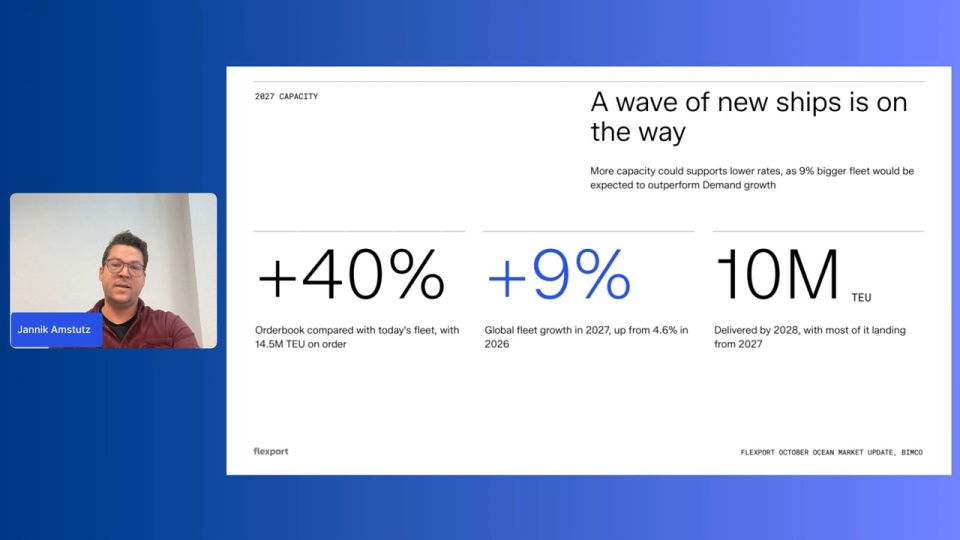
For 2027, or overall over the next, couple of years, the ocean freight carrier have 14,500,000 TEU in order. This is roughly 40% of two days fleet capacity. And, a majority of those new TEU are expected to hit the market in next year, so in 2027. We talk about roughly 9%. To compare this with, 2026, so this year, we are expecting roughly 4.6%, additional fleets, so half of what should come to the market next year. If we compare this to the volumes, from January to July this year, the global container volumes are up 5.1%. So pretty close to the capacity that additionally is coming into the market for 2026. Now if we compare that to the 9% fleet growth for next year, what's in the books, those additional capacities could support declining rate levels as the growth in container volumes around 9% would be very ambitious for 2027.
We are two weeks into q four, so let's move to the next slide and have a look at at least some predictions or story lines for the next year. We do have, definitely, topics that could could, push the rates further up or at least, remain pretty elevated. I think what we saw, this year on a very tough way is that climate continues to disrupt supply chains. We had on one side of of the planet basically too much, water in terms of typhoons and floods that were heavily disrupting, Southeast Asian and especially also Chinese ports and and, port operations. On the other side in Europe and also in in North America, we have the heat waves and droughts. So the Rhine River was really, like, on the lowest levels, that were ever recorded. We have the El Nino, which we talked about already, like, last month's freight market update. So those types of of climate changes and and climate disruptions will continue to really stress the supply chains, around the world.
Another topic, I've already mentioned it quickly that will definitely put pressure on rate levels, is the whole Middle East situation. The fuel prices are not coming to to levels where they have been in the first quarter of twenty twenty six. So, with with the levels being as they are right now, we we would definitely assume that the bunker prices and the and the fuel for for your ocean freight in the first quarter of next year is going to stay elevated if you compare it to the first quarter in twenty twenty six. We also have topics that that could push rates down. This is for sure. One topic we just discussed, it's it's the the capacity and the additional capacity that should come to the market, for next year. And, also, a slowly reopening of the Suez Canal will even push this capacity in the market just because the the transit times will get shorter. And as such, we have more capacity flowing into the market, that could move the containers around the world. This is clearly not everything, in in regards to predictions for for next year. Flexport is going to host, a larger webinar at the end of the of the year where you can register and get the latest updates on the predictions for for 2027.
Let's move to the last slide for ocean freight and and have a look at the recommendations. It continues after Golden Week, after the supply and China get back to work. Make sure that you continue to to secure your space early and and make sure that, you avoid premium products that remain pretty high in terms of price. So if you need really, like, short term space that might be difficult, we always, try to recommend to book in smaller lots. It simply provides a lot of shipments of being rolled over and and, remain in China for, what usually in ocean freight is another week. Stay close to the supplier, especially after them restarting work after going week. Reconfirm the cargo ready dates. Make sure the orders are placed, and booked correctly. And last but not least, especially with the with the reopening of the sewers, it's incredibly important to understand when you are going to need your goods and also where they are. So two different topics here. With the reopening, there's a chance that you will get twice the the orders at the same time in North Europe in the MET, because you have one vessel transiting around Cape Of Hope and, the the vessel after on the same service transiting through sewers. So, make sure communication here is clear. You have the warehouse capacities, and you can, work on on the goods that are on the water. That's for ocean freight. Make sure to log in your your questions, for the q and a later. But before that, I'm Jamie for customs.
Jamie Houlihan
Thanks, Jannik. Hi, everyone. Jamie Houlihan, customs director here at Flexport. I'm gonna be going through a a a brief update on some, customs, let's say, update and some, let's say, homework and stuff you need to really get ready for for January this year. So on this slide, I have a a little title of, new rules saying trends. So it... It's it's basically a list of certain key dates, with certain regulatory updates, that you need to know about. The first is, the flat, 3, euro, duty per line on the on the declaration. That's something that, is is catching people out, for, ecommerce shipments. So, really, this is, as we see most, every country tackling, b to c, ecommerce, differently, we see kind of the same trend. We see a deincentivization, of these flows to try and promote companies to use, let's just say, more domestic or domestically fulfilled, supply chains. So we've seen this introduced as as of July 1. We're also going to see... And it's not on this it's not on this, timeline, but we're also gonna see a... An introduction of a handling fee on top of the the the the flat €3 per per line, being introduced to further, deincentivize, this this program.
Next, you'll see on the November 1 before we go to October because it's on the same trend for ecommerce shipments, product identifiers becoming mandatory. So they have been optional up to this point. The advice has been to many importers to make sure that, you have introduced it already, kinda tested the waters with it, and are ready for this day. If you haven't, it's important to make sure that you have some sort of identifier. Three key types. You know, you have your, QR codes. You have your, potential unique, reference numbers or other identifiers. There are a list of other identifiers that you may use, but it's important that we do truly believe this will be something really enforced, at the, at the at the product level. So important that you stay ahead of it.
As of the October 1, we had the the, the impact to certain steel products, pipes, stainless steel products, other other articles in that in in that chapter. Essentially, what's happened is you will need to supply the, melted smelted, and poured, countries of origin, so the country where those those, functions happened. Those will have to go... They... Those have to go on the declaration. So you... If you are an importer of this, you've probably already seen that impact of being asked those questions. If not, there is a potential. We do actually see it with, some companies we work with that you might have very, very small unique parts of your supply chain where this is going to happen. Maybe you haven't even imported it yet because it's on such an irregular cadence, just make sure to double check if your products fall under it that you are ready to supply that information.
We'll go this... Go into this a little bit more in-depth from the next slide, but EODR enforcement begins, basically January next year, December 3 this year. Really important to stay ahead. I'm gonna go over a little bit more in-depth, what you need to do and when you need to do it. And then UK CBAM, as of January starts. The first reporting period doesn't start, but as... If you were involved with anything to do with CBAM in the EU, it's important to note, start as quickly as possible, make sure to start gathering the the the information you need, work with your some... Your suppliers, and be ready for that first, reporting date and be ahead of the the certificates, that will come come at you.
One trend, and this is why the title is named this, across all these updates and the future updates that we're seeing coming in, you know, coming in the next year or so, whether it's the updates to, the new union custom, union custom code update or you're talking about, forced labor, All these elements require more upstream, data. It means you need to know not only, your your suppliers, which has been from decades old, but you need to know, functions that happen way before the supplier is even part of the process. So, you know, upward vis... Visibility is super important and downward visibility. So, really important that when you're looking at all these trends, it's about being able to gather data, being adaptable to these to these new pieces of legislation, and making sure that you're using data in your in your supply chain also with all, actors, you know, including your customs broker, your freight forwarder, supplier. Every element needs to have, data flowing through it.
If we go to the next slide... Sorry. Back one slide. There's three three major deadlines we're looking at, from a from a perspective of, enforcement that's coming coming in the next couple of months that is is really gonna affect your imports. EODR being the first one. If you are, an importer of EODR products, you've seen a load of different delays in in this enforcement. You've seen loads of changes. These are products such as coffee, rubber, wood, soy, palm oil, main products. As of the December 30, it will be important that you have, a, gathered all the information required, b, have signed up to traces to be able to submit your DDS statements, and, c, have liaised with your broker to ensure they understand how they will receive the DDS statements, how they will input the DDS statements, and those... How those those declarations will look going forward.
One thing that I have noticed working with importers on this is there is gonna be a massive amount of DDS statements that will be supplied at the PO level. So really important that you are, giving this information to your broker in a way that they can manipulate the data to be able to input it on the customs declaration. It does mean there will be multiple DDS statements having to be input on the declaration level, meaning that you need to make sure that you have a watertight process with your broker on how they would declare it, how they will store it, and how they will, have this information for go live. The reason we make such a fuss about EODR compared to, let's say, CBAM is because in the, EODR framework, you can really have your goods stopped at the border. So when, you heard, my colleagues talk about, having goods, flow flow seamlessly, this will actually affect your goods. So if you do not have the DDS statements ready, if you do not provide them correctly to your broker, there is a chance that your goods and your declaration will be held pending that information. So really important you, close the gap, not only from having the DDS statements ready and available in traces, but how your broker will use it and how you will communicate that data over. Again, this goes back to the point I made earlier. This all flows down the the the data trend.
UK CBAM goes goes live. One of the the the key differentiators is, EU CBAM works on a, volume threshold, so 50 ton. The UK has decided to work on a value threshold. That's 50,000 pounds of, of den... Denominal value. The, it's important to note that when it goes live, it's not when the actual reporting timeline goes live. So we have time. You do have time to get ready for it, which is which is great. But one of the main points we're making is if you were not part of, the introduction of, CBAM on the EU, it's important to note that, one learning every importer has had is they wish they got ready earlier. It is really a data gathering game. CBAM has some data elements that the supplier needs to provide that are very, very complex even compared to EDR. So it's really important that you start working already to gather, a, the information, and, b, work on how you're actually gonna gather it through overtime to be ready for that reporting period. You don't wanna get to the reporting period and then start gathering information. It's gonna be a nightmare. So please learn from that.
EU c... CBAM, only call out here is, it's been live for a while. We know that the first reporting period... Well, first, annual declaration and and and certificates that are gonna be bought are coming into effect in the coming months, February. It's important to note what we've noticed a trend at the moment is, the certificate costs have, always increased. So if you look at all the quarters in which since they've been introduced, I think they were introduced around the seventy seventy three year mark. Now they're up to eighty '2. We foresee that that that that cost is just gonna keep on increasing. It's, from speaking to businesses, it's really hard to, quantify that in the future. So forecasting that from a financial perspective is really difficult. You know, they're they're not released, ahead of time. But one trend that you can look towards when you're trying to, future proof, your costs as you look into the future is understand that the likelihood is it going up. We don't really see the trend going down, so, use that as a benchmark as we start to see more and more, quarter, certificate cost being, produced. And then hopefully that can protect you from a from an, a nasty bill coming in, for an amount that you didn't expect. That's it from me. So we're going to the q and a.
Jannik Amstutz
We are. Thanks a lot, Jannik. We have a question for Alfred. Arno, your part, raised some questions. The first one is, is there any specific reason why the online market is going down?
Arno Hausch
Okay. First of all, thanks for the question, and I have to correct something. Of Of course, Black Friday is November 27, not seventeenth. Sorry for that. And, by saying the the online market is going down, it's not that the online market as such is going down. It's basically that the business to consumer drop shipments from Asia and Europe have come were coming to a standstill with the new EU regulations, adding more cost for the importing... Imports, of these drop shipments. So the customer... The shippers that are basically fulfilling from Asia directly to consumer doors, these these elements of the of the trade from Asia into Europe are not based into existence anymore in the scale we had seen before, which were driving in the past at, like, Fridays, like a massive increase in demand from the big two, brands that were dictating this this kind of market. So it's not that online market is going down. It's just that these drop shipments direct to consumer doors from Asia, have stopped.
Jannik Amstutz
Awesome. Okay. Thank you very much. There's a second question. The question is, is it a good idea to run the air freight tender covering both November and December to secure capacity?
Arno Hausch
I would say it's important to stay in close touch with your service provider on certain legs that are impacted or basically exposed to a peak season to prepare for that with, a good forecasting, telling the telling the forwarder or the freight forwarder in... Directly how much capacity you need on a certain trade lane. Make sure that the, the freight for water is also confirming that they hold that space available for you, and that, that also, yeah, gives security to your to your supply. And then you still... If you still have an overflow, which is going above the forecasted, then, find also an agreement there with your forwarder that you are moving these 10%, 15% on the spot market to ensure that the the supply keeps keeps running. But it's not that I would say, do an RFQ just for December, November to secure a rate there. It's more about if you have a quarterly deal, then you anyhow have, like, kind of peak season RFQ running, But make sure that your forecast and that your demand is clearly defined and outlined.
Jannik Amstutz
Alright. Thanks. We have an ocean related question. The question is, which carrier lines is currently performing best in terms of schedule reliability on the Asia to North Europe trade and if we see significant differences. So, overall, schedule reliability in the last month was was the poorest since since more than two years... Since more than two and a half years. It was, like, mainly driven by the by the weather disruptions in in Asia and Southeast Asia. So port closures in Shanghai and Ningbo for for several days. So that that dragged the the reliability itself down heavily. Although we we do see differences, yes, both in scale reliability and also in the port to port transit times. So the question is really, are you looking for the fastest possible option from Asia to North Europe, or is it important that you can predict the arrival in North Europe? I think this is... These are two different topics, and and we have to be, sure that we address the the right one.
In terms of transit times, both schedule reliability, we we need to see that the that the Gemini Gemini corporation, with the hyperbolic spoke system is is working out pretty well. They, depending on the port pairs, show, one of the fastest transit times. And, also, in terms of schedule reliability, they have been, amongst the best. We also have to mention here that the schedule relay... The schedule reliability is still far away from from what ocean freight was used to, pre COVID. So, that's it. If you want to have more details here, reach out to us. We need to or we we can check on the several port pairs. We can, tell you very detailed what are the actual transit times between the different services. And, of course, we need to see how the source transits are going to affect those numbers.
That's it for today. In case we have not answered your questions or you ask questions, we are going to reach out to you offline, so you can be sure that every question will be answered. Everyone is going to receive a link with the recording latest tomorrow. Thanks again, for attending. Have a great day, and see everyone hopefully, in November for the next market update. Thank you.
Related webinars
 Market UpdatesOctober 8, 2026Watch now
North America Freight Market Update Live
Watch the on-demand recording of the North America Freight Market Update Live from October 8: trade lane news, ocean and air capacity, and where rates are heading into peak.
 Market UpdatesSeptember 10, 2026Watch now
North America Freight Market Update Live
Watch the on-demand September 2026 North America Freight Market Update, where Flexport experts cover trade lane news, ocean and air capacity, and rates.
 Market UpdatesSeptember 8, 2026Watch now
European Freight Market Update Live
Flexport's 8 September 2026 European market update: trade lane news, ocean and air capacity, rate movements, and the regulatory changes worth planning around.
 Market UpdatesJuly 8, 2026Watch now
The Capacity Squeeze Nobody Budgets For: Air Cargo 2026–2030
The 777X slipped to 2027, so the widebodies due for freighter conversion are still flying passengers. Atlas Air's CCO on what the delivery crisis does to rates through 2030.