
Trends to Watch
Talking Tariffs
- CBP’s Interim Final Rule Puts Foreign Importers of Record Behind a CTPAT Gate Starting January 5: A new interim final rule from U.S. Customs and Border Protection (CBP), scheduled for publication in the Federal Register on November 6, changes who can enter goods as a foreign importer of record (IOR). Beginning January 5, 2027, a foreign IOR can enter goods for consumption on its own behalf only if it is validated under the Customs Trade Partnership Against Terrorism (CTPAT) program, and one that isn’t validated has to route its entries through a licensed customs broker that is.
- Validation is a higher bar than applying to CTPAT or being certified. CBP officers visit the facility to confirm that the paperwork filed is accurate. When a validated broker files for a foreign party that doesn’t own or purchase the goods, the broker must act as the importer of record for that entry.
- The rule writes a definition of a U.S. IOR into a new part 110 of CBP’s regulations, built around U.S. citizen or permanent resident beneficial owners holding at least 51% of an entity, or direct ownership of significant, unencumbered U.S. real property. A beneficial owner is a person who exercises substantial control over an entity or owns or controls at least 25% of it, a definition aimed at shell companies that hide who actually runs an importer.
- Brokers take on new verification work. Before filing for a client, a broker must review records such as corporate charters and financial statements to confirm the client qualifies as a U.S. IOR, keep those records for five years, and stop filing for clients that don’t qualify unless the broker is itself CTPAT validated. Entries will also carry a new checkbox on CBP Forms 3461 and 7501 stating whether the IOR is a U.S. IOR.
- Broker penalties get tougher. CBP is revising its penalty guidelines so brokers can be pursued under 19 U.S.C. 1592 as well as the license-related remedies in section 1641, where monetary penalties have been capped at $30,000.
- CBP points to $1.16 billion in revenue its audits found lost from foreign IORs between January 2020 and August 2026, of which it recovered about $35.7 million.
- Brokers can request delayed compliance before the January 5 effective date, with full compliance required no later than May 6, 2027, and comments are due within 60 days of publication. Foreign sellers that act as their own importer of record should check their CTPAT status and talk with their broker now about onboarding documentation.
Ocean
TRANS-PACIFIC EASTBOUND (TPEB)
- Capacity and Demand:
- Carriers are deploying full capacity this week and next.
- Blank sailings, or canceled departures, build to about 8% in the week of November 30. Forward schedules are still being finalized.
- U.S. ocean imports are forecast to fall 11% month over month in November, so carriers are matching capacity to softer demand to protect rates, rather than responding to a demand-driven squeeze.
- Space is easier to secure.
- Freight Rates:
- Rates are mixed. One spot index fell 6% to the West Coast and 5% to the East Coast last week, while an index of shipped containers rose 2% on both coasts.
- Market signals suggest further downward pressure.
- Operations:
- Shippers with time-sensitive cargo through Los Angeles and Long Beach should confirm terminal arrangements and pick up containers early, given the strike risk.
FAR EAST WESTBOUND (FEWB)
- Capacity and Demand:
- Carriers are deploying full capacity this week and next.
- Blank sailings build past 7% from the week of November 16 and reach double digits in the weeks of November 30 and December 7.
- Demand is stable, and carriers are canceling sailings to protect rates as shorter Suez routes add capacity.
- Freight Rates:
- Rates rose from mid-October on port congestion and blank sailings. Last week’s moves ranged from unchanged to up 5% depending on the index.
- The November 1 rate increases have not gained traction, and market signals suggest further declines in the coming weeks.
- Operations:
- Shippers should confirm routing at booking, since transit times differ between Suez and Cape services.
- Shippers should allow extra time for Mediterranean cargo around Italy’s November 20 strike.
TRANS-ATLANTIC WESTBOUND (TAWB)
- Capacity and Demand:
- Offered capacity is above standard this week, at 14%, dips 10% in Week 46 on selective blanks, then thins by 11% in Week 48 and 14% in Week 49.
- The winter slack season is starting, and the National Retail Federation (NRF) forecasts U.S. imports down about 11% month over month in November.
- Carriers are trimming capacity to defend rates.
- Shippers with year-end cargo should secure late-November and December space now.
- Freight Rates:
- Spot rates from Northern Europe to the U.S. East Coast were flat as of October 23 (Source: Xeneta).
- Operations:
- Equipment and terminal constraints persist in Northern Europe and the Mediterranean.
- Strikes in France on October 29 and again on November 5, and in Italy on October 30, can delay cargo, and Italy’s general strike on November 20 adds risk.
INDIAN SUBCONTINENT TO NORTH AMERICA
- Capacity and Demand:
- Space has become easier to secure in the last few weeks compared to the constraints earlier in the Peak Season.
- Key metrics for origin lead time continue to show a trend toward normalization.
- As Peak Season demand levels have slowed in the market, additional capacity is active for NWI to USEC in early November due to larger vessels on key services, and a TPEB Extra Loader calling two ISC ports to USEC.
- Feeder constraints from Pakistan, Bangladesh, and Southeast India are seeing relief from the intense congestion and backlog developed over the Peak Season.
- Diwali holidays from November 8 reduce factory output and trucking availability across India for several days.
- Freight Rates:
- Rates continue to ease in line with the wider market to both USEC and USWC.
Air
- North China (PVG/PEK):
- China-to-U.S. West Coast demand is unchanged and holding at a high level, anchored by AI-related equipment. That cargo can absorb higher rates, which keeps West Coast rates elevated and trending up.
- Midwest and East Coast demand is slowing as ecommerce fades. Rates at ORD and JFK began falling in the second half of last week, and added supply is slowing the rate climb.
- Carriers are watching whether Black Friday and Thanksgiving shipments materialize. Nothing visible yet points to a surge large enough to lift Midwest and East Coast rates.
- China-to-Europe is stable, with no change in demand or rates this week.
- South China (HKG/SZX/CAN):
- China-to-U.S. rates are unchanged week over week. Ecommerce and general cargo demand remain solid, and one carrier has pushed its floating rate close to its ceiling.
- Supply grew with a new direct ATL flight for November and December, plus extra LAX and ORD charters.
- China-to-Europe demand is stable. Some European carriers are offering promotions on U.S. space, which is pushing Europe market rates toward peak-season levels.
- Taiwan (TPE):
- U.S.-bound demand is at its peak, and rates are rising, led by AI-related high-tech cargo. Technical issues at some origin terminals have left cargo delayed.
- Europe-bound capacity is nearly full, and rates are climbing. Book 5 to 7 days ahead.
- Vietnam (SGN/HAN):
- U.S.-bound demand remains very high, rates rose again week over week, and carriers expect very limited space through early November.
- Europe-bound demand is stable but expected to rise on general cargo peak-season dynamics. Book at least 10 days before departure.
- Vietnam-to-Europe spot rates rose about 10% week over week in Week 43 (Source: WorldACD).
- Cambodia (PNH):
- Demand is steady, and rates remain high. Space is fully booked through the first week of November, and constraints are expected to ease after November 7.
- Korea (ICN):
- Demand rose again, and peak season has arrived. Korea-to-U.S. spot rates were up about 26% week over week and about 55% year over year in Week 43 (Source: WorldACD).
- U.S. East Coast capacity is relatively loose because co-loaders are oversupplying space. LAX is tighter, and direct LAX rates rose again.
- The Europe lane is full of cosmetics cargo. Book direct options about 1.5 weeks ahead.
- Thailand (BKK):
- Demand keeps its momentum. Carriers report very tight capacity to ORD, JFK, ATL, and IAH, with most space booked this week.
- Rates are still rising, and terminal congestion persists. Book 7 to 10 days ahead.
- Indonesia (CGK):
- Export demand continues to rise. Spot rates to the U.S. are gradually increasing, and fuel surcharges rose about 4% from the prior week.
- Europe-bound rates are stable, though space is worth watching. Book 7 to 10 days before cargo ready date.
- India (BOM/DEL/MAA/BLR):
- Freighter cancellations continue at BOM during a runway revamp. Some freighters moved to NMI, where operational problems caused further cancellations.
- Demand is shifting to AMD and BLR, which are now congested. Terminal congestion at Mumbai and Chennai is delaying shipment handovers, and truckers wait up to 72 hours outside the BOM air cargo complex.
- Shippers are converting ocean shipments to air on India-to-U.S. lanes. Book 5 days ahead, and earlier for cargo ready before Diwali on November 8.
- Indian subcontinent (Bangladesh, Sri Lanka, Pakistan):
- Bangladesh: Europe-bound schedules are reliable with space available. The U.S. lane is tight and less reliable.
- Sri Lanka: All carriers except MU and CX are on schedule. Middle East-based carriers are short of space because perishable volumes are rising.
- Pakistan: Space is tight, and rates remain elevated. Book 3 to 5 days ahead.
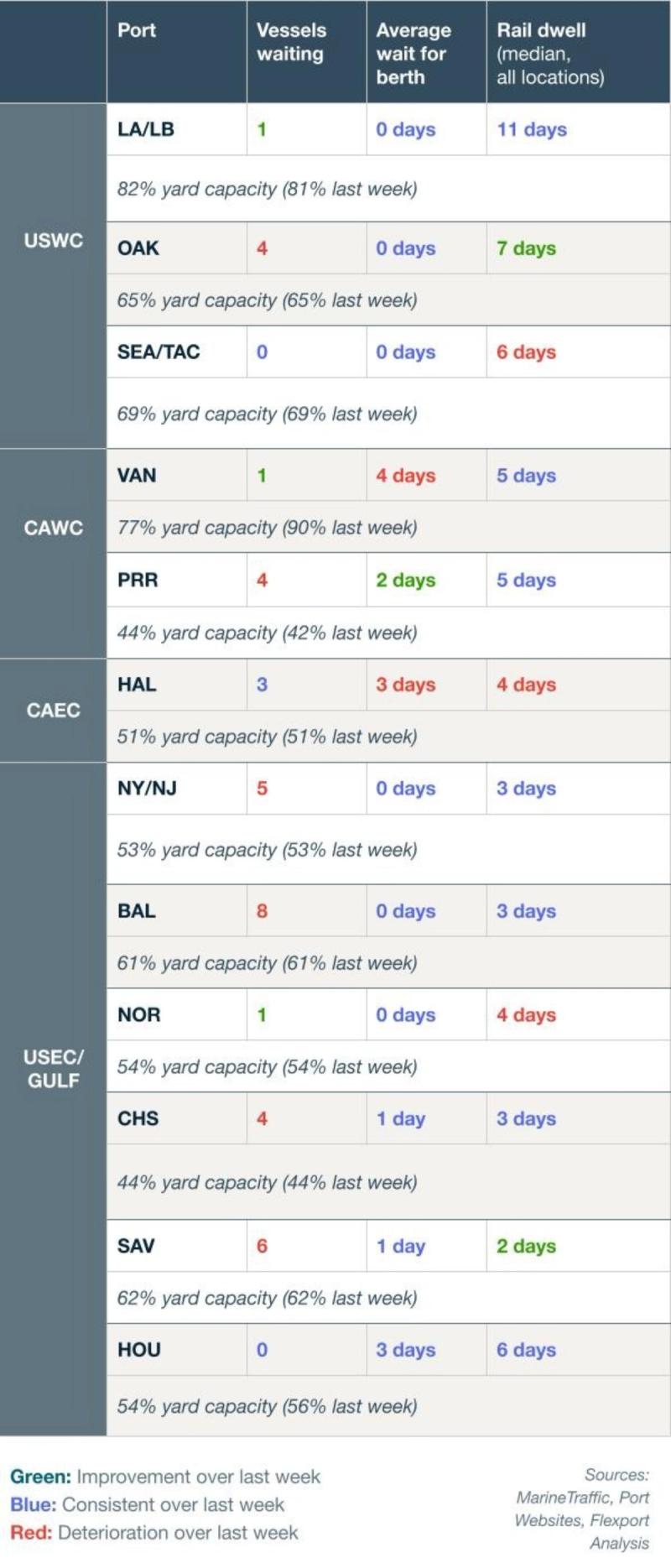
Vessel Dwell Chart
Webinars
North America Freight Market Update Live
Thursday, November 12 @ 9:00am PT / 12:00pm ET
Getting Started with Flexport MCP
Tuesday, November 17 @ 8:00 am PT / 11:00 am ET / 16:00 GMT / 17:00 CET