Trends to Watch
Talking Tariffs
- Section 301 Relief Windows for China and Vietnam Slide Into 2027: Three Section 301 deadlines that fell due this month have been pushed back, which means the related tariffs and fees won’t take effect before early next year. The U.S. Trade Representative (USTR) extended the exclusions for certain Chinese products, the pause on its maritime-sector measures, and its decision deadline in the Vietnam intellectual property case.
- Product exclusions from the original 2018 China Section 301 investigation now run through January 9, 2027, which adds 60 days to the November 9 expiration. The extension covers HTSUS headings 9903.88.69 and 9903.88.70. U.S. Customs and Border Protection (CBP) hadn’t finished programming the new date when the old one passed, so its systems show a brief gap, but importers shouldn’t owe Section 301 duties on covered goods during that stretch.
- The suspension of fees on vessels tied to Chinese shipbuilding, along with the added duties on Chinese ship-to-shore cranes and other cargo-handling equipment, also continues through January 9. USTR linked the longer pause to its continuing talks with Beijing.
- In the Vietnam case, USTR now has until February 28, 2027, to decide whether Vietnam’s intellectual property enforcement warrants a trade response. That is three months past the original November 29 deadline for an investigation USTR opened on May 29, 2026, and tariffs remain one possible outcome.
- The January 9 dates fall one day before the current U.S.-China trade truce is scheduled to end on January 10. Importers with China exposure should plan around January 7 through 10 as a single decision window, and Flexport’s Tariff Simulator can model landed costs with and without the exclusions.
- New CBP Guidance on Foreign Importers of Record Clarifies the Broker Route and What Counts as a U.S. Importer: CBP has posted a set of frequently asked questions and a reference guide for its foreign importer of record (IOR) rule, which takes effect January 5, 2027, and the answers narrow some of the uncertainty that followed the rule’s publication.
- A foreign IOR that hasn’t been validated under the Customs Trade Partnership Against Terrorism (CTPAT) program still has a path: it can hand its filings to a licensed customs broker that holds CTPAT validation. The broker generally files the entry without becoming the importer of record, with the exception of cases where the foreign party doesn’t own or purchase the goods, in which the rule requires the broker to take on that role. Because validation involves an onsite CBP visit to the importer’s facilities, the broker route is likely to be the practical option for most foreign-based importers.
- Foreign ownership doesn’t automatically rule out U.S. IOR status. CBP’s FAQ says a business with no U.S. citizen or permanent resident beneficial owners can still qualify if it is based and incorporated in the United States and holds real property here outright, with a value that stays significant after any debt against it is subtracted. The FAQ puts that bar at $20 million or the total value of the importer’s entries during the prior year, whichever is higher. The rule itself doesn’t state a dollar figure, so this number comes from CBP’s guidance rather than the regulation.
- Debt secured against an asset comes off its value before it counts. In the FAQ’s illustration, machinery in the United States worth $10,000 with a $2,000 loan against it contributes $8,000. The reference guide’s third page lists the documentation CBP will accept as proof of physical domestic assets.
- CBP is taking questions at IORProgram@cbp.dhs.gov. Importers that ship under delivered duty paid (DDP) terms or rely on foreign sellers as importer of record should confirm their status with their broker now, and Flexport will cover the rule in its Tariff Trends 2026 webinar on November 19 at 9:00 a.m. PT / 12:00 p.m. ET.
Ocean
TRANS-PACIFIC EASTBOUND (TPEB)
- Capacity and Demand:
- Carriers are deploying nearly all scheduled capacity.
- Blank sailings are 2.3% of capacity this week and stay below 7% in most coming weeks. The exception is the week of November 30, where blank sailings rise to about 9%.
- Demand is cooling as the extended peak season ends: U.S. port imports are forecast to decline through year-end after September volumes were 12.6% above last year.
- Blank sailings paired with softer demand point to carriers managing capacity to protect rates, rather than a space squeeze.
- Several carriers are also adding larger ships and an extra express loop from China to the U.S. West Coast, which adds effective capacity.
- Congestion at Chinese ports is easing, and average vessel waiting time at Shanghai improved to 35 hours.
- Freight Rates:
- Rates are near their highest since mid-2022 on both coasts, but they have stopped climbing.
- Rates from Shanghai to Los Angeles were flat week over week, and rates from Shanghai to New York fell 3%.
- The Shanghai Containerized Freight Index fell 1.5%, its first decline after 4 weeks of increases.
- Carrier rate increases implemented on November 1 may not fully hold as the slow season starts, and the near-term bias is downward.
- Operations:
- Labor is the main risk to watch. The contract for about 250 port watchmen at Los Angeles and Long Beach was extended a third time, through November 20.
- A stoppage could disrupt terminals that handle a large share of Asia-to-U.S. cargo.
- Rail delays and chassis shortages are also slowing inland moves.
- Shippers should book early for cargo that must clear the West Coast before November 20 and allow extra time for inland delivery.
FAR EAST WESTBOUND (FEWB)
- Capacity and Demand:
- Blank sailings stand at 3.6% this week. Forward weeks swing more: about 11% in the week of November 16 and about 18% in the week of December 7, with other weeks at 8% or lower.
- Schedules are still being finalized, so these figures can keep moving.
- Far East-to-Europe volumes were up 12.2% in the first 7 months of the year, although part of that growth reflects earlier shipping.
- Suez Canal Return:
- Carriers continue to move capacity back to standard Suez Canal routing. Weekly capacity crossing the Red Sea reached about 467,000 TEU in October, roughly half its pre-crisis level.
- The return to shorter routes has freed about 599,000 TEU of nominal capacity in 2026, with more expected in the first half of 2027.
- Shorter transit is an option on part of the network, though the shift is happening carrier by carrier. The situation will continue to be monitored.
- Freight Rates:
- Rates rebounded from early October and reached a 15-week high on October 22.
- Rates have eased since, with the Drewry World Container Index down 1% last week, its second straight weekly decline, and Shanghai to Rotterdam down 2% week over week.
- Carriers filed rate increases for November 1 to 14, but 5 Asia-Europe blank sailings were announced for the following week, down from 8 this week, and the freed Suez capacity means carriers may secure only part of those increases.
- Shippers should expect rates to be stable to softer but negotiable, and plan for late vessel arrivals, as only 4% of Far East-to-Europe arrivals were on time in September.
TRANS-ATLANTIC WESTBOUND (TAWB)
- Capacity and Demand:
- Capacity is deployed in full, with utilization over 94%.
- Blank sailings are 0.7% this week and stay below 7% through the week of December 7, rising to about 9% in the week of December 14, a forecast that may change.
- U.S. imports are easing after the extended peak.
- Freight Rates:
- Spot rates are flat and expected to be stable through November.
- Operations:
- Container and chassis shortages persist across Germany, Benelux, Austria, Hungary, and Slovakia into Week 48, and Northern Europe ports remain congested.
- Shippers should book 3 to 4 weeks ahead and confirm December space early.
INDIAN SUBCONTINENT TO NORTH AMERICA
- Middle East Conflict:
- Shipping attacks resumed in and around the Strait of Hormuz over the weekend of November 8. Two tankers caught fire, and the U.S. struck a vessel that tried to breach its blockade.
- The U.S. has paused further strikes on Iran, but conditions remain unsettled.
- The Strait is the sea passage at the mouth of the Persian Gulf. Ports behind it, including Fujairah and Khor Fakkan, face congestion as importers rush cargo in, and rates from Asia to the Gulf are up about 250% since the start of the year.
- Cargo from India and the subcontinent to North America does not pass through the Strait. Shippers with routings that transship through Gulf hubs should confirm their routing with Flexport.
- Bunker fuel supply is very tight in Singapore and the wider region, which can add cost pressure on long-haul services.
- Shippers should book early and keep routing flexible. The situation will continue to be monitored.
Air
- North China (PVG/PEK):
- China-to-U.S. West Coast demand is rising and space is tight, led by general cargo, project cargo, and AI-related equipment. Rates rose about 10% in 2 to 3 days, and a confirmed booking now means a wait of 6 to 7 days before the cargo flies.
- Midwest and East Coast demand is up modestly, space is less tight than on the West Coast, and rates rose slightly, reversing last week’s softening.
- China-to-Europe demand is rising at all main gateways, up from flat conditions last week, and rates rose week over week. Space is tight to AMS and LHR, while FRA remains the softer gateway.
- Spot rates are expected to rise further on Trans-Pacific lanes before Black Friday and Thanksgiving, with fuel surcharges high and rising (Source: WorldACD).
- South China (HKG/SZX/CAN):
- China-to-U.S. rates eased slightly week over week. Ecommerce and general cargo demand remain solid, and one carrier has pushed its floating rate close to its ceiling.
- Supply grew with a new direct ATL flight for November and December, plus extra LAX and ORD charters.
- China-to-Europe demand is stable. Some European carriers are offering promotions on U.S. space, which is pushing Europe market rates toward peak-season levels.
- Hong Kong-to-Europe volumes fell almost one third year over year in October after the EU ended de minimis exemptions on July 1 (Source: WorldACD).
- Taiwan (TPE):
- U.S.-bound demand is very high this week, and rates are rising. Europe-bound capacity is nearly full, and rates there are rising too.
- Book 5 to 7 days ahead.
- Taiwan-to-U.S. volumes rose 26% year over year in Week 44 (Source: WorldACD).
- Vietnam (SGN/HAN):
- U.S.- and Europe-bound markets are unchanged from last week, with high rates and very tight space. High-tech cargo leads U.S.-bound demand.
- Submit bookings at least 10 days before cargo ready date.
- Korea (ICN):
- Peak-season rates are unstable. U.S. East Coast capacity is relatively loose because co-loaders are oversupplying charters, while LAX is tighter. Direct LAX rates rose again, and space is hard to book.
- The Europe lane is full of cosmetics cargo. Book direct options about 1.5 weeks ahead.
- Korea-to-Europe spot rates rose about 17% over the three weeks to Week 44 on technology and cosmetics demand, and Korea-to-U.S. volumes were up 18% year over year (Source: WorldACD).
- Malaysia (KUL):
- Export volumes are steady, but hub congestion continues to disrupt U.S.-bound routings. Outbound rates are stable.
- Book at least 10 days before departure.
- Thailand (BKK):
- Demand remains high, including some ocean-to-air conversions. Airlines report very tight capacity, and rates remain high.
- A backlog at the main cargo terminal has led its operator to ask airlines to temporarily reduce freighter capacity and limit inbound volume for the next 2 weeks.
- Book 7 to 10 days ahead. Thailand-to-U.S. volumes rose 20% year over year in Week 44 (Source: WorldACD).
- Indonesia (CGK):
- Export demand continues to climb. U.S.-bound spot rates are rising steadily, and Europe-bound rates are holding, though space is tightening.
- Book 7 to 10 days before cargo ready date.
- India (BOM/DEL/MAA/BLR):
- Festive-season demand and ocean-to-air conversions keep India-to-U.S. lanes busy. Middle East and South Asia volumes rose 10% year over year in October, mainly on Indian exports and the later timing of Diwali (Source: WorldACD).
- BOM congestion continues. Truckers wait up to 72 hours outside the air cargo complex, with about 1,000 tons offloaded daily against a normal 200 to 300 tons.
- Book 5 days ahead.
- Indian subcontinent (Bangladesh, Sri Lanka, Pakistan):
- Bangladesh: Garment workers are protesting over the minimum wage. Passenger and freighter schedules at DAC are largely normal, and the pressure point is trucking, not airside operations. If factory output stalls and then restarts, the export backlog could tighten outbound space and bring ad hoc rate pressure or peak surcharges.
- Pakistan: Space remains tight, and rates are elevated. Book 3 to 5 days ahead.
- Transatlantic (Europe to U.S.):
- Europe-to-North America demand rose 11% year over year in August, and the winter schedule that began October 25 has cut frequencies and belly capacity. The TAC Index shows rates up from all origins since early October.
- Italy is hit hardest, with about 35% less capacity than in summer. Milan-to-New York rates have in some cases more than doubled.
- LAX, ORD, IAH, DFW, and ATL are very tight. For Italy origin, book 7 to 10 days before cargo ready date, since a missed flight can mean a week’s delay.
- Europe-origin capacity fell 6% week over week in Week 44, with the largest belly declines on the Transatlantic, and Europe-origin spot rates rose 6%.
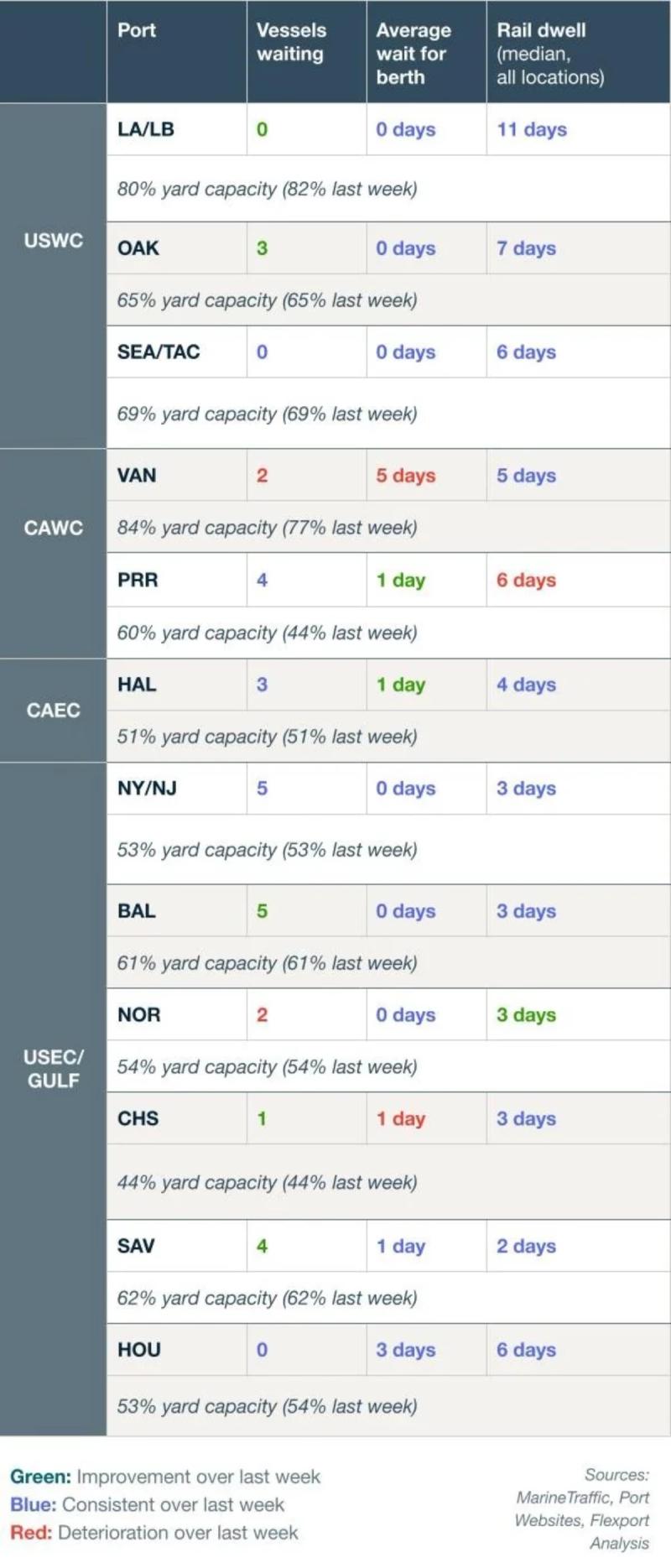
North America Vessel Dwell Times
Webinars
Getting Started with Flexport MCP
Tuesday, November 17 @ 8:00 am PT / 11:00 am ET / 16:00 GMT / 17:00 CET
Tariff Trends 2026: Expert Insights on the Evolving U.S. Tariff Landscape
Thursday, November 19 @ 9:00am PT / 12:00pm ET