Trends to Watch
Talking Tariffs
- Section 338 Product List for Canada Gets Reshuffled Again, With New Duties Starting October 30: An October 23 presidential action changes which Canadian goods face Section 338 duties, and the new list applies to entries on or after October 30. A total of 22 tariff lines come off, among them plywood, plastic wrap, cardboard boxes, and food-related machinery, while about 100 go on, including cocoa products, carpets and other floor coverings, wood panels, coatings, air conditioning units, and some recreational goods.
- The timing matters for anything in transit: a chest-type freezer, for example, owes only Section 232 steel duties on entries through October 29 and then picks up Section 338 duties on top beginning October 30, while plywood moves the other way and stops attracting the 50% Section 338 rate after October 29, per Flexport’s Tariff Simulator.
- The duties stack on top of Section 232 tariffs and apply whether or not a product qualifies for U.S.-Mexico-Canada Agreement (USMCA) treatment.
- This is the second round of list changes since mid-September, when cheese, hides, motorboats, and other items were added and a few large-format spirits were dropped. It also lands while the first lawsuit challenging the tariffs works its way through the Court of International Trade.
- Importers moving Canadian-origin goods should re-run classification against the new annex before shipments land, since the list has shifted in both directions. The Tariff Simulator already reflects the updated product list.
- Wind Turbines Get a Negotiation Track Rather Than New Section 232 Tariffs: An October 22 proclamation closes out the Section 232 investigation into wind turbines without adding a new tariff. The Commerce Department found that turbines and their components pose a national security risk, citing remote-access weaknesses in imported inverters, radar interference, and strain on the electrical grid, and President Donald Trump agreed, but he directed Commerce and the U.S. Trade Representative (USTR) to negotiate with trading partners and report back within 180 days instead of imposing duties.
- Existing Section 232 duties aren’t touched. Turbine components made of steel, aluminum, or copper still pay the tariffs already in place on those metals, and the proclamation states that it doesn’t modify them.
- Other remedies stay available depending on how the negotiations go, and the 180-day update comes due around April 20, 2027.
- Importers of turbines and turbine components should keep classification and metal-content records current, since the existing metals duties continue to apply to those parts in the meantime.
- Robotics and Industrial Machinery Imports Get a Negotiation Mandate Instead of Tariffs, With a 180-Day Check-In: The Section 232 investigation into robotics and industrial machinery ended with a finding but no new duties. Commerce concluded that the amount of robots, factory equipment, and parts coming in from abroad is a national security risk, and the President agreed in an October 28 proclamation, yet the remedy he chose for now is diplomacy: Commerce and USTR are to work out agreements with exporting countries and report back within 180 days.
- Tariffs aren’t off the table for good. The proclamation says the President may revisit duties, quotas, and fees, or set up an incentive program for new U.S. production of robotics and machinery, depending on how the talks go, and he can act sooner if no agreement materializes within the 180 days.
- The administration’s reasoning leans on import dependence and data security. The U.S. relies on foreign sources for most types of robotics and industrial equipment, and the proclamation flags cybersecurity weaknesses in imported systems that sit inside manufacturing and defense operations.
- Importers of industrial equipment should plan around a decision window that closes in late April 2027, when the robotics update comes due, rather than assume the question is settled.
- Latest UFLPA Entity List Update Takes the Roster to 190 Companies: Screening suppliers against the Uyghur Forced Labor Prevention Act (UFLPA) Entity List is about to take a bit longer: the roster is heading to 190 companies, up three, after the Department of Homeland Security (DHS) named additional businesses with ties to Xinjiang in a Federal Register notice.
- Goods made wholly or in part by a listed entity are presumed to involve forced labor and are blocked from entry unless the importer shows with clear and convincing evidence that they don’t.
- The presumption reaches inputs as well as finished goods, so U.S. Customs and Border Protection (CBP) can detain a shipment that contains material from a listed company several tiers upstream, even when the direct supplier isn’t on the list.
- Importers should screen their supplier and sub-tier supplier lists against the updated roster now. The Federal Register notice carries the three added names and their effective date, and Flexport’s Trade Advisory group can help importers work through a UFLPA detention if one occurs.
Ocean
TRANS-PACIFIC EASTBOUND (TPEB)
- Capacity and Demand:
- Carriers deployed record capacity during Golden Week, with weekly Asia-to-U.S. West Coast capacity at 393,000 TEU compared with a normal level below 300,000 TEU.
- Delayed vessels bunched together and sailed as “double sailings,” which canceled out planned blank sailings.
- With the winter slack season starting, carriers are matching capacity to softer demand to protect rates, rather than responding to a demand-driven squeeze.
- Freight Rates:
- Trans-Pacific rates remain above Asia-Europe levels, but the planned November 1 rate increase faces pressure as carriers compete for volume.
- The U.S. has also proposed extending its suspension of added port fees on China-linked vessels to January 9, 2027. The current suspension expires November 10.
- Shippers should add buffer to cargo-ready dates out of Shanghai and Ningbo for the next few weeks and avoid relying on a single sailing.
FAR EAST WESTBOUND (FEWB)
- Capacity and Demand:
- Blank sailings are 8.1% this week, with 3.4% next week and a range of 4.8-11.4% through November.
- Overall deployed capacity to Northern Europe is still expected to reach a record level, so the blanks reflect carriers managing utilization against excess supply, rather than a space shortage.
- Suez Canal Return:
- Capacity continues to shift back to standard Suez Canal routing. About 63% of Far East-to-Europe deployed capacity now sails via Suez: 70% on Far East to Mediterranean and 58% on Far East to Northern Europe.
- MSC resumed Suez transits in August. The Gemini Cooperation of Maersk and Hapag-Lloyd began returning services in Q3, and Maersk aims to return all services by March 2027.
- CMA CGM kept a Suez presence throughout, and Ocean Alliance has restored 6 services.
- Premier Alliance has announced returns, while ZIM has not resumed. Some carriers keep selected Cape of Good Hope services as a hedge.
- Shorter transit times are an option on part of the network, though the shift is happening carrier by carrier, even vessel by vessel, so shippers should confirm routing at booking.
- Ships returning to Suez are also arriving alongside vessels still sailing around the Cape, which adds port congestion.
- Freight Rates:
- Rates on the main Shanghai-to-Northern Europe index were unchanged week over week.
- Carriers’ November 1 rate increase is unlikely to hold as supply outpaces demand. The situation will continue to be monitored.
TRANS-ATLANTIC WESTBOUND (TAWB)
- Capacity and Demand:
- Blank sailings are 7.9% this week, then range from 0% to ~9% over the next 4 weeks. Offered capacity stays 5-16% below standard in most weeks, and selective NEUR-US East/Gulf blanks continue (~5% cancellations).
- Vessel utilization is above 93% out of NEUR and WMED, so capacity is largely deployed.
- Operations:
- Schedule reliability for the largest carrier networks was only 68-69% in August and September, against a 90% goal for the largest network.
- Yards remain tight in Rotterdam, Bremerhaven and Hamburg, and container/chassis availability is limited at inland origins. Shippers should book 3-4 weeks ahead and build extra time between cargo-ready dates and vessel cutoffs.
- Freight Rates:
- The winter slack season and added capacity from the Suez return point to continued pressure on rates. The Suez return is gradual and partial, so the effect on TAWB is likely indirect and slower than on Asia-Europe.
- The situation will continue to be monitored.
INDIAN SUBCONTINENT TO NORTH AMERICA
- Capacity and Demand:
- The Indian Subcontinent to the US extended Peak Season is experiencing downward market pressure leading into the Diwali Holiday in India in November.
- Port congestion and vessel bunching across South and Southeast Asia continue to absorb effective capacity but have shown improvement at key regional hubs Nhava Sheva, Colombo, and Mundra.
- Space on the major service strings ISC to USEC has begun to become more available.
- Origin lead times for getting loaded on time demonstrate further normalization in the market.
- Shippers should continue to book early, allow extra time at origin ports, and confirm routing options for urgent cargo.
- Freight Rates:
- Market rate levels have reduced for back-to-back validity periods for major lanes ISC to USEC, and rates ISC to the WC have begun to soften.
Air
- North China (PVG/PEK):
- West Coast demand shows no sign of fading, with AI-related cargo the main driver, and rates there moved to a higher level this week.
- Midwest and East Coast rates eased for the first time after weeks of tight space at ORD, DFW, and ATL. ATL, DFW, and MIA are the exceptions, with demand and rates holding.
- Asia Pacific to U.S. rates were about 41% above a year ago, and chargeable weight rose 10% week over week (Source: WorldACD).
- Europe demand and rates edged up on general cargo with no volume surge. Asia Pacific to Europe volumes were 16% below a year ago as EU ecommerce measures cut parcel flows. A EUR 2 handling fee on non-EU ecommerce imports applies from November 1.
- South China (HKG/SZX/CAN):
- Trans-Pacific rates rose week over week on solid ecommerce and general cargo demand.
- An extra ORD charter next week pulled ORD market rates down slightly. LAX demand and rates keep climbing on Mexico-bound cargo.
- Hong Kong-to-U.S. tonnage rose 27% week over week, while Hong Kong-to-Europe tonnage was 32% below a year ago.
- Europe demand edged up on Middle East-related flight cancellations, keeping rates on a slight upward path.
- Taiwan (TPE):
- U.S. lanes are at full capacity, and rates are rising with fuel costs and carrier pricing.
- Europe space has tightened compared with recent weeks.
- Book 5 to 7 days ahead to secure space.
- Vietnam (SGN/HAN):
- High-tech cargo demand keeps growing on U.S. lanes, leaving space constrained at elevated rate levels.
- Europe demand is rising on general cargo as peak season builds.
- Cambodia (PNH):
- U.S.-bound flights are fully booked, and most airlines are applying rate upsells, pushing rates higher on rising fuel costs.
- Europe demand is steady week over week while rates continue to climb.
- Korea (ICN):
- Demand rose from last week as peak season arrived.
- Space to LAX on direct service is tight, and direct rates rose week over week, while U.S. East Coast capacity stays looser because co-loaders are oversupplying space.
- Europe lanes are full of cosmetics. Book direct service about 1.5 weeks ahead. Korea-to-Europe tonnage was up 34% week over week and 14% year over year.
- Malaysia (KUL):
- Hub congestion continues to disrupt U.S.-bound lanes even though export volumes are steady.
- Book 5 to 7 days ahead to secure space and limit transit delays.
- Thailand (BKK):
- Demand continues and capacity is tightening, with rates rising.
- Terminal congestion persists. Book 7 to 10 days ahead.
- Indonesia (CGK):
- The market is unchanged from last week: transit hub congestion is disrupting U.S.-bound lanes, export volumes are steady, and rates are stable.
- Confirm bookings at least 5 to 7 days before departure.
- India (BOM/DEL/MAA/BLR):
- Demand increased last week as shippers airlifted cargo for the festive season rush and moved ocean shipments to air to bypass maritime bottlenecks, keeping India-to-U.S. lanes busy.
- India-to-U.S. tonnage was up 34% year over year.
- Book 5 days ahead.
- Indian subcontinent (Bangladesh, Sri Lanka, Pakistan):
- Bangladesh: Schedules on both the Europe and U.S. lanes are less reliable. Space is available for Europe-bound cargo, while the U.S. lane is tight. Bangladesh-to-U.S. tonnage was up 44% year over year.
- Sri Lanka: All carriers except MU and CX are on schedule, and Middle East-based carriers have tight space because of rising perishable volumes.
- Pakistan: Space is tight, and rates remain elevated. Book 3 to 5 days ahead.
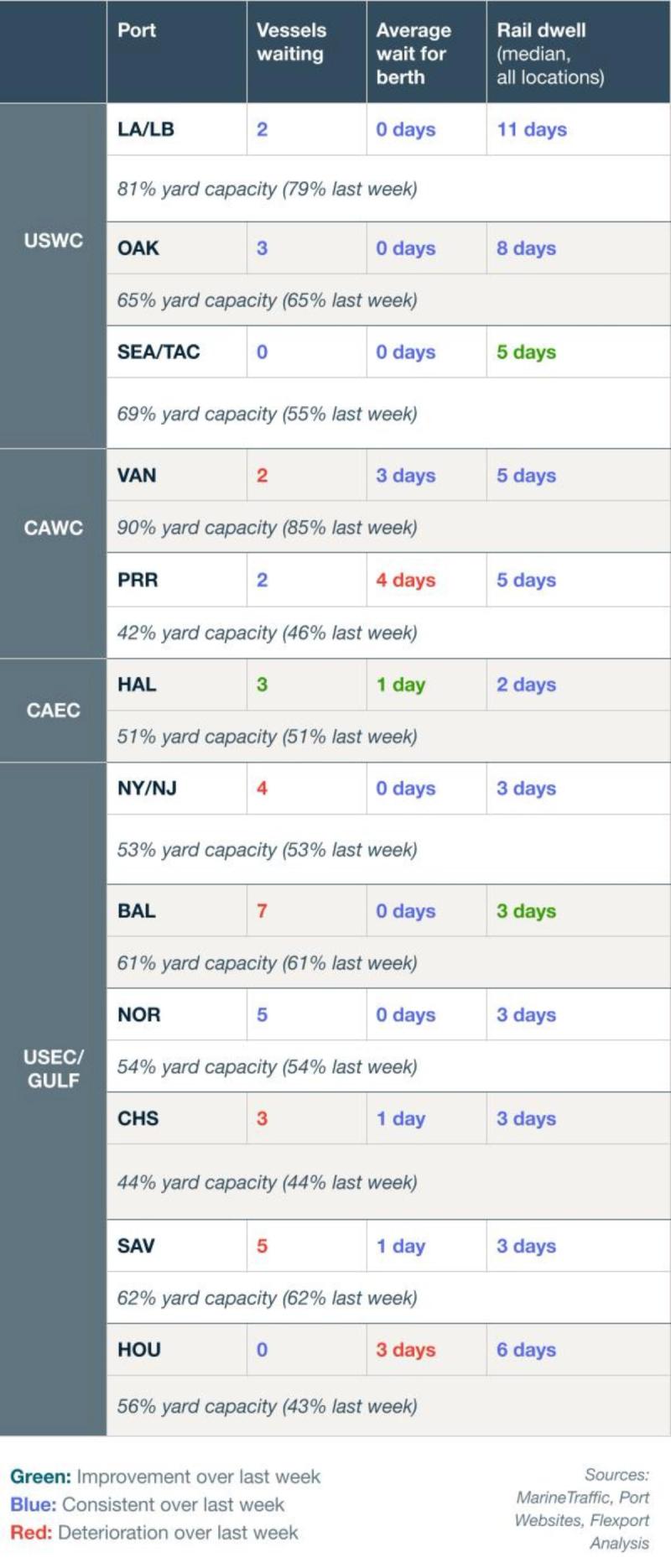
North America Vessel Dwell Times
Webinars
Tariff Trends 2026: Expert Insights on the Evolving U.S. Tariff Landscape
Available On-Demand