
Talking Tariffs
- FMC Proposes a $200,000-Per-Voyage Fee and Import Limits on Spain Over a Port Access Dispute: The Federal Maritime Commission (FMC) has put forward its first concrete remedy in an investigation that's run since December 2024: a $200,000 fee on every voyage a Spanish-flagged vessel makes into a U.S. port, paired with restrictions on five categories of Spanish imports. The case traces back to Spain repeatedly denying docking privileges to U.S.-flagged vessels in the Maritime Security Program (MSP), starting with a trio of Maersk ships turned away in late 2024 over cargo tied to Israel.
- The targeted import categories — perfumes and cosmetics, olive oil and other fats, ceramics, articles of stone, and sugar and confectionery — together represent roughly $3.6 billion in annual U.S. imports from Spain, based on the FMC's own trade figures.
- By the agency's own tracking, Maersk's U.S.-flagged fleet made only six calls at Spanish ports in all of 2026, down from roughly seven a month before the dispute began, with most of that traffic shifting to Tangier, Morocco instead.
- Spain gets a 60-day comment window and the chance to request a hearing before anything is finalized. The FMC also built in room to escalate: if Spain retaliates against the new fees, both the per-voyage charge and the list of restricted goods can grow.
- Importers of Spanish perfumes, olive oil, ceramics, stone products, or confectionery should start contingency planning now and can weigh in during the comment period if the proposal would hit their supply chain.
- Importers Who Over-Ordered Solar Products Are Already Paying for It: Importers who ramped up solar cell and module orders this fall may already be feeling the consequences. Wiley attorney Timothy Brightbill says the number of companies locked out of further shipments ahead of the December 4 deadline is now in the dozens, the result of Commerce and U.S. Customs and Border Protection (CBP) comparing current import volumes against each importer's own history and cutting off anyone who looks like they're stockpiling.
- The mechanism traces to Proclamation 11052, signed August 6, which set hard weekly caps — 2,000 cells and 55 modules — for any importer that registered on or after that date. Go over a cap in a single week, and the bar is immediate, with no warning beforehand.
- Importers that were already established don't face a fixed numeric cap. Instead, regulators are watching whether this year's volumes run far above what each company shipped in 2025 and early 2026.
- All of it is aimed at the same outcome: heading off a stockpiling rush before December 4, when Section 232 minimum import price tariffs on polysilicon, ingots, wafers, cells, and modules take effect.
- A bar from new entries doesn't mean goods are stuck for good. Companies can still route product into a bonded warehouse and wait to enter it for consumption, or request a waiver by email if they can show a legitimate business reason for their volumes. Commerce says it aims to respond within 14 days.
- Brokers who help clients dodge the caps through multiple importer records risk losing their license, so solar importers should sort this out now rather than discover they're barred at the border.
- Mail Filers Get an Extra Quarter Before Entry Type 13 Exclusions Get Enforced: International mail filers have three more months to get their paperwork in order. CBP's Entry Type 13 program, the simplified process for postal shipments, was supposed to start fully enforcing its list of excluded goods on October 22. That enforcement date is now January 20 instead, a 90-day reprieve that CBP says exists to let filers catch up before the stricter rules kick in.
- The underlying program has been running since late July: filers submit a monthly spreadsheet, pay duties by ACH debit, and maintain a continuous bond in ACE eBond rather than filing a formal entry for every mail shipment.
- What's delayed is enforcement of the goods that were never eligible for this simplified track in the first place, including antidumping and countervailing duty merchandise, quota goods, partner-agency-regulated items, alcohol, tobacco, and anything under HTSUS Chapters 98 and 99.
- Shippers moving those excluded categories through the mail should use the extra runway to get formal entry procedures lined up rather than assume this date holds either.
- Experts Doubt the U.S.-EU Tariff Truce Survives the Rest of Trump's Term: Not everyone thinks the U.S.-EU tariff arrangement, which has held European autos and most other goods to a 15% rate since mid-2025, survives the rest of Trump's term. Two risks keep surfacing in recent commentary: a shift in U.S. policy toward Ukraine, and the EU's carbon border tax. A Washington think tank analyst flagged the first risk; someone who spent years negotiating trade deals for the U.S. government flagged the second, and both believe either one could be enough to unwind the truce.
- U.S. policy on Ukraine and the arrangement's tariff terms were never cleanly separated, so any swing in Washington's approach there could change the political math behind keeping the truce in place.
- The EU's Carbon Border Adjustment Mechanism (CBAM), a tariff tied to the carbon content of imports, creates its own friction with an administration that has resisted comparable carbon pricing schemes of its own.
- The arrangement has already drawn criticism in Europe as lopsided: it locked in existing 50% tariffs on steel and aluminum while carving out zero-tariff treatment for aircraft, select chemicals, semiconductors, agricultural goods, and critical raw materials.
- Importers with European supply chains built around the 15% baseline should treat that rate as negotiable over a multi-year horizon rather than fixed, and watch both Ukraine policy shifts and CBAM's implementation timeline as early warning signs.
Ocean
TRANS-PACIFIC EASTBOUND (TPEB)
- Capacity and Demand:
- Deployment continues to be high with a quick rebound post-Golden Week. XLs are entering the market for some additional capacity and to ease roll pools.
- U.S. imports reached 2.55MM TEU in September, a record for the month, with imports from China up 21.2% year over year.
- The Port of Los Angeles handled more than 1MM TEU, its busiest month ever.
- Asian schedule delays are adding uncertainty to arrival dates.
- Freight Rates:
- Rate action has hit a bit of a lull with Golden Week; expect it to pick up as the month goes along.
- Strong import demand is expected to support Trans-Pacific rates into the new year.
- The faster return of capacity to Suez routing could bring additional capacity to the TPEB in 2-4 months before CNY.
- Shippers should add buffer to delivery plans and secure space for late October and November cargo-ready dates.
FAR EAST WESTBOUND (FEWB)
- Capacity and Demand:
- Capacity is deployed in full this week, with blank sailings at 0%.
- Blank sailings are forecast to build to 3.6% the week of October 19 and 6.6% the week of November 2, then reach 13.9% the week of November 9. Forward schedules are still being finalized and these figures can move.
- With Asia to North Europe SCFI going up after 13 straight weeks of decreases and capacity optimization, carriers are cutting sailings to support rate increases effective October 19, rather than responding to a demand squeeze.
- Suez Canal Return:
- Capacity is also shifting back to standard Suez Canal routing gradually. Container ship transits through Suez reached 61 in the week ending October 4, up 154% year over year.
- Carriers are moving at different speeds, and security risks in the Red Sea remain, including cargo insurance that can be hard to secure on short notice.
- Shorter transit times are now an option on part of the network.
- Shippers should confirm routing and insurance terms at booking and plan for the November blank sailings by booking early for those weeks. The situation will continue to be monitored.
TRANS-ATLANTIC WESTBOUND (TAWB)
- Capacity and Demand:
- Capacity is largely deployed in full, with blank sailings at 4.3% this week.
- Selective blanks persist on North Europe–U.S. East Coast/Gulf loops through weeks 42–43 (approximately 10–13% cancellations). The week of October 19 peaks at 19.4% of scheduled capacity, then falls to 1% or less through mid-November.
- To secure space and equipment — especially for inland origins or Mediterranean ports — forwarder guidance recommends booking 3-4 weeks in advance during peak months. This lead time helps ensure timely shipments, avoids rollovers, and keeps surcharges manageable.
- Operations:
- German port strikes were averted after dockworkers accepted a new contract.
- Low water on the Rhine is still delaying barge cargo to major gateways; shippers with inland European origins should allow extra time.
- Freight Rates:
- Rates are holding steady into late October.
INDIAN SUBCONTINENT TO NORTH AMERICA
- Capacity and Demand:
- Available space to the U.S. East Coast is improving as carriers have upsized capacity on the trade before Diwali.
- Asian port congestion and low schedule reliability continue to affect departure and arrival dates on this corridor, especially for cargo transshipping through Colombo.
- Shippers should book the added November sailings early and keep delivery buffers in place.
Air
- North China:
- Demand to the U.S. picked up as Golden Week ended, with general cargo and e-commerce restocking ahead of Black Friday and Christmas. Rates rose 5-10% versus the holiday week.
- Space is tight into ORD, DFW, and ATL, with rates elevated. The U.S. West Coast is tightening more slowly.
- China-to-U.S. tonnage grew 17% year over year in September. Rates are expected to keep rising through October.
- Europe-bound demand is recovering gradually, with rates up mildly week over week. Mainland China-to-Europe tonnage fell 2% year over year in September, an improvement from a 9% year-over-year decline in July.
- South China:
- U.S.-bound rates rose week over week as e-commerce and transitional cargo returned after the National Day holiday. Space is fully booked until the next departure window.
- Europe-bound demand remains soft, and rates are low. Hong Kong-to-Europe tonnage was down 24% year over year in September after the EU removed de minimis exemptions on July 1.
- Taiwan:
- U.S. space is full this week, and rates rose, partly on higher fuel costs. Book 5 to 7 days ahead.
- Europe capacity is more stable than in recent weeks.
- Vietnam:
- Space to the U.S. and Europe remains tight on demand for high-tech and manufacturing components. Book 5 to 6 days before cargo ready date.
- Rates held flat week over week.
- Korea:
- Demand is flat week over week. The pre-holiday volume push is lighter than last year.
- U.S. East Coast capacity is relatively loose on co-loader oversupply. U.S. West Coast space is tighter. Europe is full on cosmetics, so book 7 days ahead.
- Malaysia:
- Hub congestion continues to delay U.S.-bound cargo, though export volumes are steady. U.S.-bound rates are stable, and Europe-bound rates softened slightly.
- Book 5 to 7 days before departure.
- India:
- Mumbai freighter cancellations tied to a runway revamp, plus a partial shift to Navi Mumbai, are cutting lift. Cargo is diverting to AMD and BLR, which are now congested.
- Terminal congestion at Mumbai and Chennai is delaying handovers. Truckers face waits of up to 72 hours outside the BOM air cargo complex.
- Shippers are moving ocean cargo to air on India-to-U.S. lanes to avoid maritime delays. Book 5 days ahead.
- Indian Subcontinent (Bangladesh, Sri Lanka, Pakistan):
- Pakistan: Space is tight, and rates are higher week over week. Book 3 to 5 days ahead.
- Bangladesh: Europe-bound schedules are reliable with space available. U.S.-bound space is tight, and schedules are less dependable.
- Sri Lanka: Carriers are on schedule except MU and CX. Base rates are stable, and fuel surcharges are easing. Gulf-based carriers have limited space on rising perishables volume.
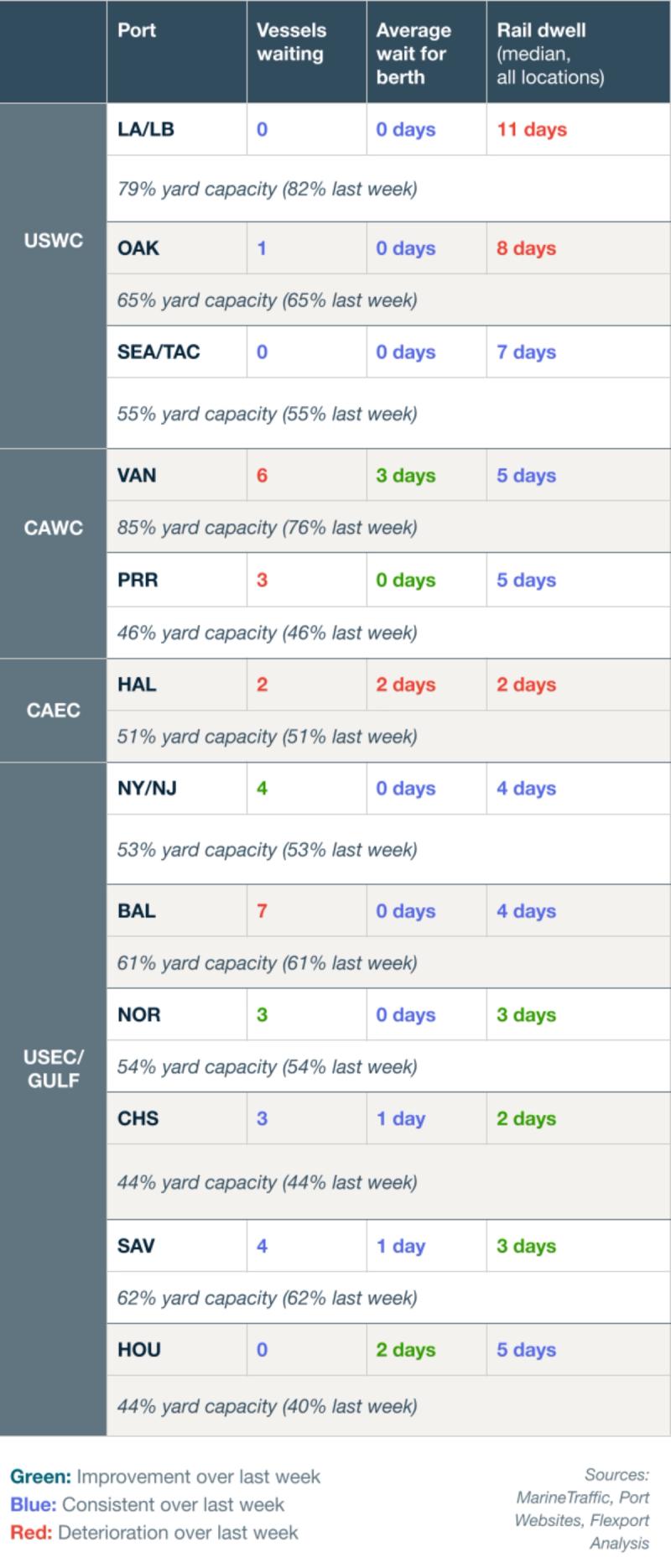
North America Vessel Dwell Times
Webinars
Tariff Trends 2026: Expert Insights on the Evolving U.S. Tariff Landscape
Wednesday, October 21 @ 9:00am PT / 12:00pm ET